Twenty birders headed out to Sand Forest Lodge near Hluhluwe for our first weekend outing of the year. Some had arrived a day earlier in pouring rain.
On Saturday we set out at 06H30 for False Bay for a 7 Km forest walk. Not all of us lasted the full 7 Km.
We heard a lot of birds but sightings were scarce as it was very dry. The trees and butterflies were amazing.
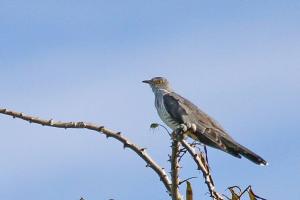
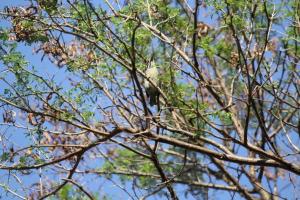
A distant Cuckoo caught our attention – either an African or Common. We managed a photo for you to judge for yourself. Our conclusion was that it was a Common Cuckoo based on the bill being predominantly black. Unfortunately we could get no views of the underside of the tail.
Common Cuckoo
Common Cuckoo
Common Cuckoo
Common Cuckoo
Further along we came across this spoor. Half the size of a ladies size six boot. Any ideas?
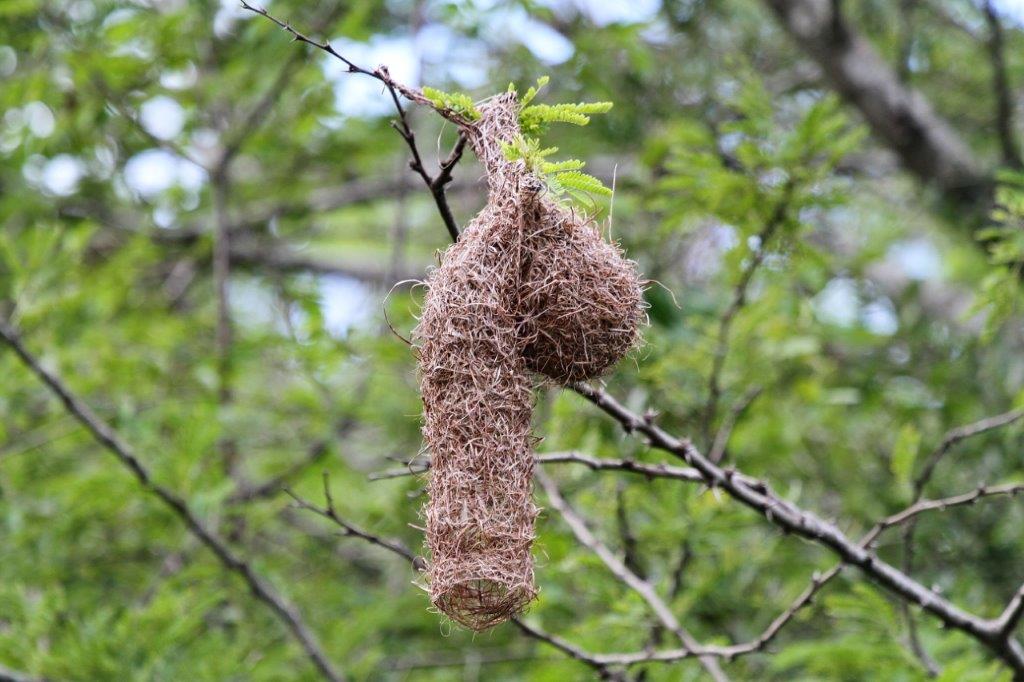
There was also a rather smart Dark-backed Weaver’s nest hanging in the woods.
Dark-backed Weaver’s nest.
After our walk we went to the picnic sight for tea. There was absolutely no water in the bay except in the far distance where we saw a group of flamingos.
Picnicking on the banks of the rather empty False Bay.False Bay looks like this.
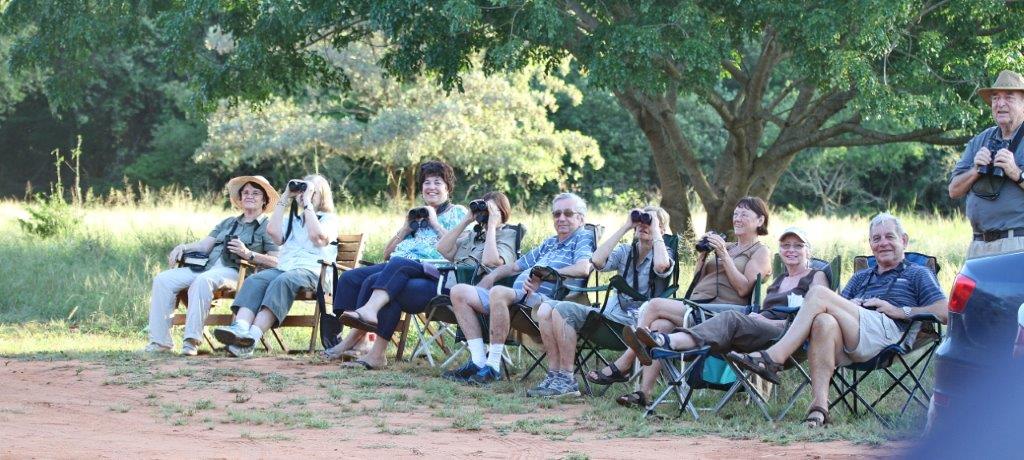
Saturday afternoon John and Paul were chatting when they saw a flock of European Bee-eaters feasting on flying ants right in the campsite. And then the show began. Everyone eventually gathered with their chairs and we were entertained for a good hour and a half with a variety of interesting birds.
Birdwatching in comfort
There were Barn and Lesser Striped Swallows, Scarlet-chested Sunbird, Collared Sunbird, Neergaard’s Sunbird, Long-tailed Paradise Whydah, White-winged Widowbird, African Yellow White-eye, Willow Warbler, Ashy Flycatcher, African Palm, Little and White-rumped Swifts, Klaas’s Cuckoo and African Paradise Flycatcher.
Klaas’s Cuckoo
Klaas’s Cuckoo
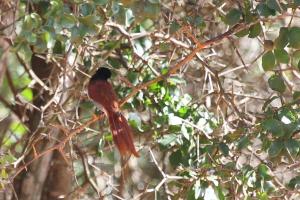
Long-tailed Paradise Whydah
White-winged Widowbird
Southern Black Tit
Ashy Flycatcher catching the sun’s reflection off the sand
Scarlet-chested Sunbird – female
Scarlet-chested Sunbird
African Paradise Flycatcher with the sand’s reflection distorting his colouring
African Paradise Flycatcher
Neergaard’s Sunbird
Also observed were the numerous butterflies and trees full of looper-type caterpillars which crawled everywhere including on you. Large hornets carrying and burying Loopers which they had stung.
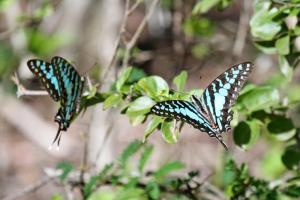
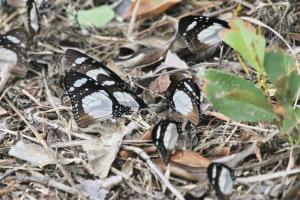
Large Striped Swordtail
Large Striped Swordtails
Wasp burying a Looper
Wasp carrying a Looper
Either a Boisduval’s or Natal Tree Nymph – probably the latter?
Either a Boisduval’s or Natal Tree Nymph – probably the latter?
Possible Boisduval’s Tree Nymph
Unidentified
A one day wonder.
A lone leaf hanging mid air in the Forest.
Sunday’s early morning walk through the sand forest and grasslands of Sand Forest Lodge brought us Woodward’s Batis, Rudd’s Apalis, African Cuckoo, Diderick’s Cuckoo, African Green Pigeon among many others. For Jane and Mike, they were attracted to the African Cuckoo by a dive-bombing Eurasian Golden Oriole. It transpired that there were two African Cuckoos in the same place – something considered unusual.
Woodward’s batis
Woodward’s Batis
Grey Sunbird
Golden-tailed Woodpecker – seen drumming like a Bearded Woodpecker
Black-backed Puffback
Juvenile African Harrier-Hawk
African Cuckoo
African Cuckoo
African Cuckoo
African Cuckoo
African Cuckoo
Diderick’s Cuckoo
UI Raptor
UI Raptor
Dark-backed Weaver
Spectacled Weaver
African Green Pigeon
What a way to end a fabulous weekend.
Click here to read the bird list of 91 species identified.
Cheryl and John Bevan
Mkuze
Paul and Sally along with Dave and Jenny Rix took a late morning trip to Mkuze on Friday before the weekend started. Nsumo pan was by no means full but the bird life was very active with all sorts of waterbirds to be seen. Mike and Jane had even seen Greater Painted Snipe there earlier in the day.
Great Egret
Openbill with lunch
Greater Flamingos
Amur Falcon
Amur Falcon
St. Lucia
Paul and Sally also spent two nights at Sugarloaf campsite on the way home. Sunday night the rains came in force. The next morning we learned that Lake St. Lucia had gained 6.1 million tons of fresh water from the Umfolozi River. A godsend as they badly need it and more.
As usual the estuary mouth was full of interesting birds. Greater Flamingo; Pink-backed Pelicans; Goliath Herons; Saddle-billed Stork; hundreds of White-faced Ducks; Avocets; Grey-headed Gulls; Swift Terns; a few Little Terns and Lesser Crested Terns; numerous Curlew Sandpipers changing into breeding plumage; White-fronted Plovers; Common Ringed Plovers; Grey Herons.
Also seen was an adult Palm-Nut Vulture flying low over the dunes and also an Osprey circling above with a large fish for dinner.
Curlew Sandpiper going into breeding plumage
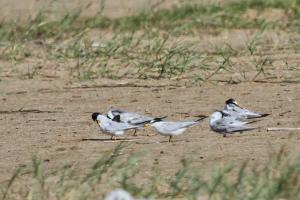
Little Terns with lovely yellow beaks.
Grey-headed Gull
Grey-headed Gull
A trip into Eastern Shores, Isimangaliso Wetland Park early morning after the rains was very quiet. Birds were trying to warm up and dry off so not much activity.
Blue-cheeked Bee-eaters
Deceptive Diadems
Deceptive Diadems
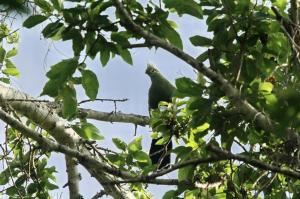
Back in camp the Livingstone’s Turacos were often calling above our campsite.
Livingstone’s Turaco
Livingstone’s Turaco
Always a special place to visit at this time of the year (and any other time of course).
Mhlopeni Nature Reserve is located between Greytown and Muden in KZN. Mhlopeni (Place of white stones) is located in a rain shadow area of the Tugela river basin. Part of the dry valley bush veld, considered to be the most degraded veld type in KZN. It is a Natural Heritage site.
Ancient and modern history provides a glimpse into archaeological sites, from early stone to iron age, findings, dating back to 250 000 years ago. Holding artifacts of these eras is a truly unique experience.
The weekend outing was organised by Cheryl and John Bevan. Five people took the cottage and six of us the campsite (an additional 2 joined the campsite group later).
Once you leave the tar road the route takes you through some challenging tracks – driving over rocky outcrops, and rough ground where high clearance is preferred. Having said that there were several regular cars which made it.
View down the valley
A Rock mushroom – part of the landscape
Intriguing rock formations
The cottage is well located overlooking bush veld to the dry river bed. It is well equipped despite the lack of electricity. It can sleep 8 though the curtained partitions may be off-putting for some. One loo and shower.
The campsite was being completed as we arrived. There is a boma and one loo with shower. Here also there is no power but there was plenty of sun to keep the solar panels busy. Although there was just enough space for all of us it meant those at the far end would have had a challenge on departure – trying to get past the other campers. Fortunately we all left together.
Tight turn down to the campsite
Campsite boma
A couple of campsites at the end
Another make-do campsite
As a Bird Sanctuary, Mhlopeni is abundant with many birds of prey, and being on the confluence of the north, south, coastal and inland species distribution limits over 230 species are recorded on their bird list.
Some of the birds photographed:
White-necked Ravens
Speckled Pigeons
Rock Martin
Cape Rock-Thrush
Cape Batis
African Paradise-Flycatcher
African Harrier-Hawk
African Harrier-Hawk at nest
White-browed Scrub-Robin
Red-fronted Tinkerbird
Red-fronted Tinkerbird
Red-fronted Tinkerbird
Lanner Falcon
Lanner Falcon
Lanner Falcon
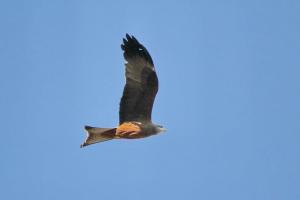
Yellow-billed Kite
Green-backed Cameroptera
Fiscal Flycatcher
Cardinal Woodpecker
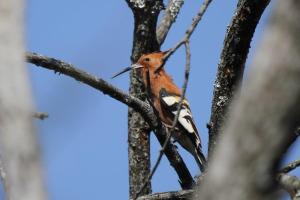
African Hoopoe
Klaas’s Cuckoo
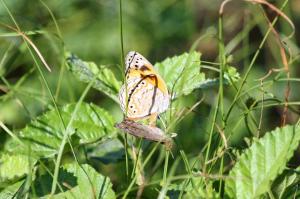
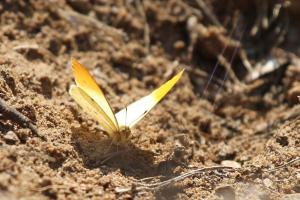
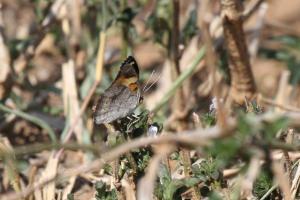
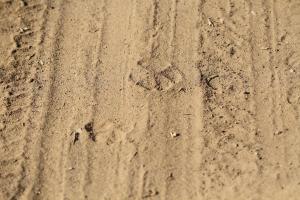
Of course other critters were seen including a gang of what I thought to be hyenas being chased by the camp dog. Butterflies need id.
Butterfly 2
Butterfly 2
Butterfly 3
Butterfly 4
Butterfly 1
Bug – Locust maybe
Suspected Hyena footprint
Rustic walking paths provided us with vistas and sounds of the diversity of healthy dry valley bush veld.
Birders on track – John and Cheryl
Birders on track – John, Jane and Mike
Birders on track – Cecil, Paul, Maureen, Jane and Mike and John
Birders on track – Cecil, Maureen, Cheryl and John. Jane and Sally behind
Birders on track – Cecil, Paul, Maureen, Jane and Mike
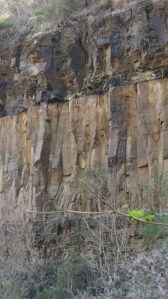
Most mornings we followed the road and paths along the dry river bed. with its intriguing geology.
Intriguing rock formations
Intriguing rock formations
River bed cliffs
Intriguing rock formations
One afternoon we visited the Mooi River which was flowing and forms part of the northern boundary of the property. This is a dead end track which several people mistakenly took on the way to the camp. It has dreadful dongas and is very narrow with steep sides to the river. Once on this track it is only possibly to turn around at the end – fortunately for those towing a trailer!
Mooi River
Mooi River
The weather was extremely hot after about 9 or 10 in the morning. By then birding was over till later in the afternoon. Most sat around a shady spot enjoying what cool breeze there was.
Much of the birding was done round the cottage and campsite. In the river bed next to the campsite there was a Schotia brachypetala in full bloom.
Schotia brachypetalaat the river bed
Schotia brachypetala
Schotia brachypetalan
Schotia brachypetala
We took chairs and sat in the shade and watched the comings and goings of a wide variety of birds – mostly Sunbirds Amethyst (male and females) Greater Double-collared (male and females) White-bellied (male and female) but there were also Olive Bushshrike, Cape White-eyes, Green Woodhoopoes, Barbets, Weavers, Woodpeckers nearby. Birds were constantly coming and going.
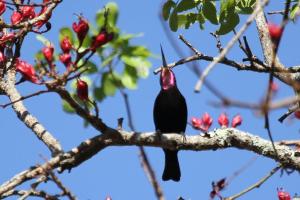
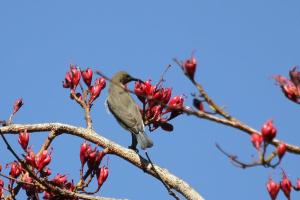
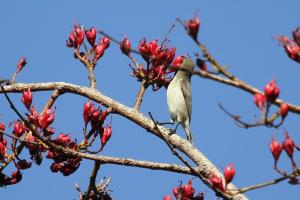
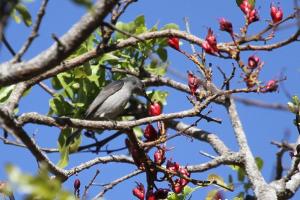
One Sunbird in particular came regularly and called every time it arrived staying at the top of the tree, taking its nectar and flying off. We guess that it was possibly feeding young. The problem with this bird – if it is what we believe – it is out of range. An out of range form with photos has been submitted following our atlas card being sent in. The call of the bird was recognised as that of a Grey Sunbird and you can make your own judgement from the photos below. This was not the only place we had seen and heard the Grey Sunbird while we were there.
Altogether we compiled a bird list of 110 different species. Click here to see our list.












































 Birds are our Story