Last year towards the end of April there was a weekend outing to Ilala Palm Park – the first time BLPN had visited the park. Everyone agreed it was not only a great venue but also a great base for good birding in the local reserves.
On the 15th May a number of us (4 couples) revisited Ilala Palm Park for 3 nights. The weather was cooler and the vegetation greener than last year. The accommodation was again excellent. We were the only visitors. Each campsite has its own ablutions with good hot water as well as a wash-up area.
Showing the size of a small campsite with its private ablutions and wash-up area.
We had 2 full days there plus the afternoon on arrival and the morning before departure. The plan – to spend the first day visiting Muzi Pan and Mkuze Game Reserve and the second day, Tembe Elephant Park. The rest of the time was spent birding in and around the campsite.
Muzi Pan – Friday:
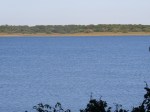
The water is in the distance
Despite this being the wrong time for waders, we enjoyed a couple of hours early morning at Muzi Pan. As you can see from the photo the water level was far away from the road. Compare that to January last year when the water was raging under the road bridges and came right up to the road.
Muzi Pan Jan 2013
During the short stay there we recorded 34 species seen from the roadside. There were over 100 Great White Pelicans masterfully fishing together on left side of the causeway as you head towards Mkuze.
Fishing together – quite a sight
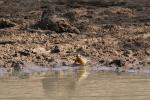
Then there was an obliging Malachite Kingfisher beside the road openly sunning on the bank. On return home later in the day he was still there.
Malachite Kingfisher – still there 6 hours later
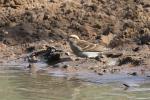
And probably the other interesting species were Wire-tailed Swallows, the Lapwings – both African Wattled and Senegal. Several Caspian Terns also made an appearance on our return home.
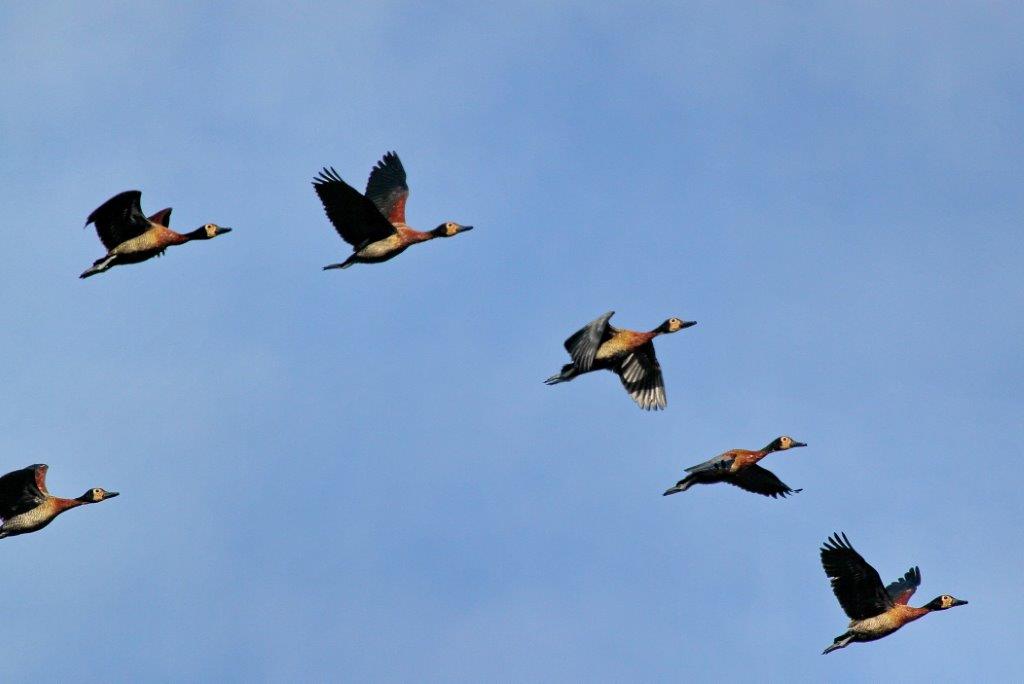
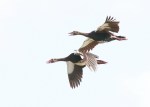
Formation FlyingSenegal Lapwing – part of a group of 6
Mkuze – Friday:
A late start in Mkuze rarely produces a large bird list and this was no exception – especially at this time of year. In total we managed 69 species in the 6 hours we were there.
We visited Nsumo Pan picnic site for tea and saw a number of Yellow-billed Storks with a few Openbills amongst them – in the trees opposite.
Nsumo Pan Picnic site
Pale Flycatcher
Yellow-billed Storks
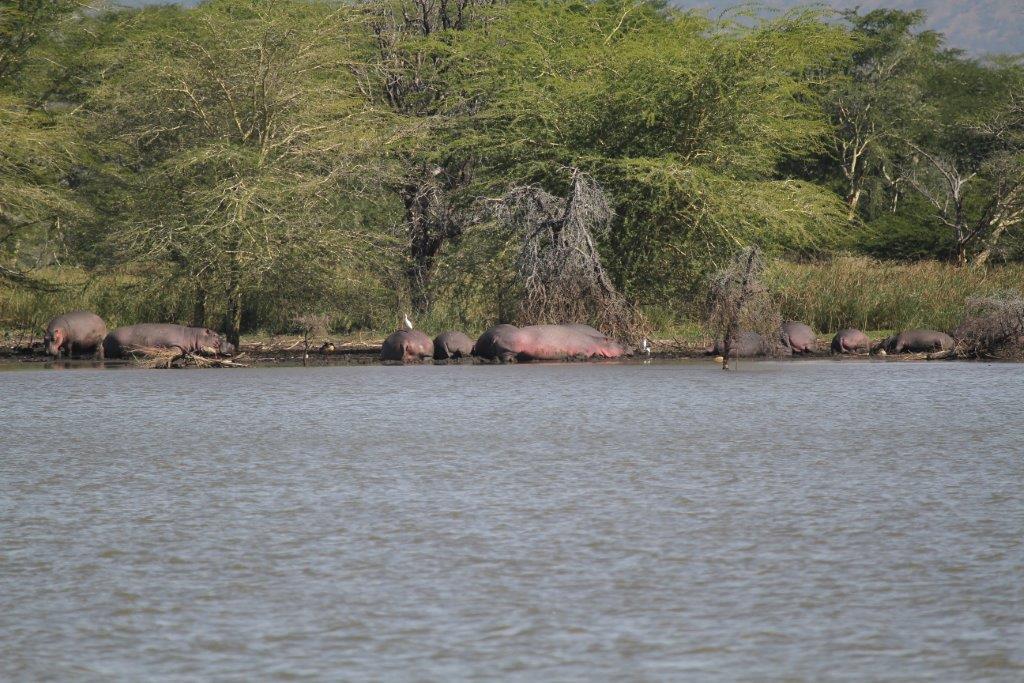
There were also a few Whiskered Terns over the water in the distance and a bank of hippos lying in the sun on the opposite shore – showing their pink bellies.
Hippo downtime
A couple of us went to the kwaMalibala Hide to be entertained by a lazy White Rhino and another missing one horn as well as Giraffe having a drink. It was here that we saw the Dark Chanting Goshawk preening in a bare tree opposite.
Legs splayed
Dehorned
Dark Chanting Goshawk
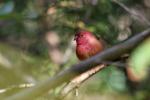
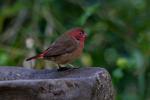
Red-billed Firefinch
Red-billed Firefinch
Red-billed Oxpecker
Lunch was at the kuMasinga Hide picnic area followed by an hour in the hide before returning to Ilala Palm Park. It is always good to sit in the hide around lunchtime when the birds come in to drink. There were very blue Blue Waxbills, Yellow-fronted Canaries, Dark-capped Bulbuls, Yellow-throated Petronias, Golden-breasted Buntings, Emerald-spotted Wood-Doves at the water’s edge nervously drinking. Numerous White-crested Helmetshrikes, Brubrus, Fork-tailed Drongos, Scimitarbills, Spectacled Weavers, Brown-hooded Kingfisher all flitting around in the trees around the hide. Overhead the odd Bateleur.
Brown-hooded Kingfisher
Emerald-spotted Wood-Dove
Scimitarbill
Dark-backed Weaver
Golden-breasted Bunting
Blue Waxbill & Yellow-fronted Canary
Blue Waxbills
Very blue Blue Waxbill
Yellow-throated Petronia
Yellow-throated Petronia
Several birds stood out as unusual – African Stonechat, Violet-backed Starling and Fiscal Flycatcher. More photos of some of the other birds seen.
African Pipit
Black-bellied Starling
Stonechat – female
White-browed Scrub-Robin
White-crested Helmetshrike
White-crested Helmetshrike
The refurbished hides are all still in good order but the wooden walkways to the hides are in a very sorry state as well as the kwaMalibala hide itself.
Tembe Elephant Park.
Saturday was dedicated to a visit to Tembe Elephant Park. We arrived at 07h30 and set off looking for the elusive Plain-backed Sunbird on the Gowaninini Loop – a wasted effort and we somehow managed to turn round on the the sandy road and return to the entrance and proceeded to the hide at the Mahlasela Pan.
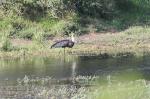
At the moment there is quite a large swamp area just beyond the Pan to its left. There were a number of species in that area – White-faced Duck and 8 ducklings, Woolly-necked Stork and little Grebe being the more interesting.
White-faced Duck and ducklings
Woolly-necked Stork
Three-banded Plover
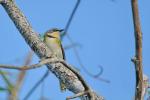
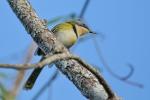
After a short uneventful stay we drove the East Swamp road to the Ponweni Hide for tea. The East Swamp road is very open and affords good views over the swamp all the way along the 10 kms. Along the way there were excellent sightings of a Little Bee-eater and Grey-rumped Swallows.
Little Bee-eater
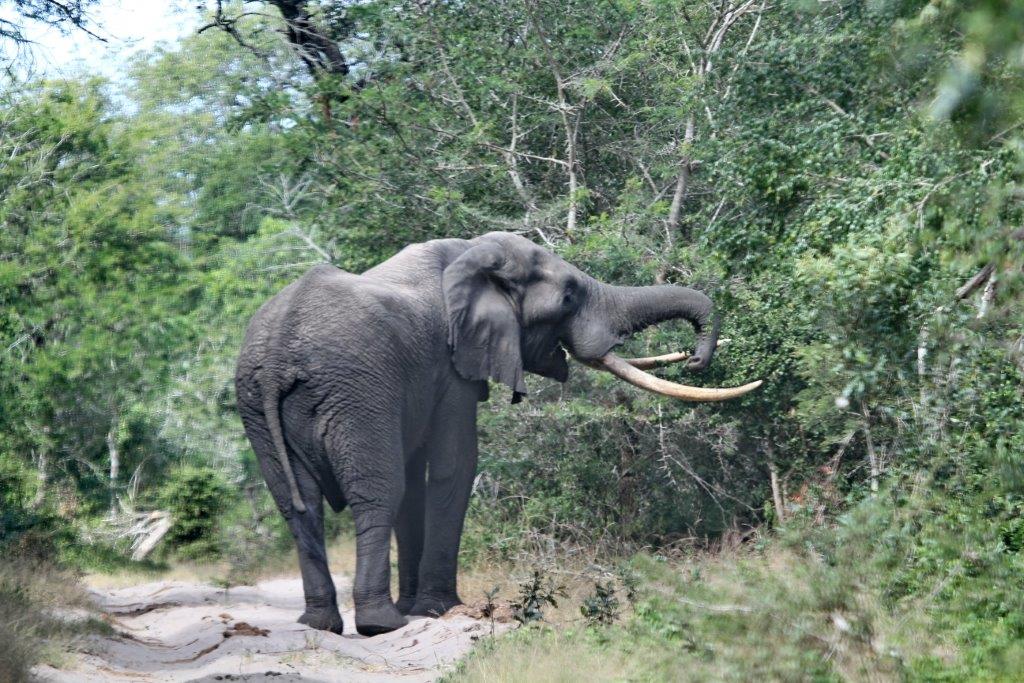
We returned to the hide at Mhlasela Pan via the West Swamp road – more wooded with few places to view the Swamp. A rather large bull elephant slowly ambled in front of us for a good 10 minutes before stepping off the road to let us past!
Large bull elephant keeping us warily at a distance
Noticeably along this stretch there were numerous sightings of White-crested Helmetshrikes.
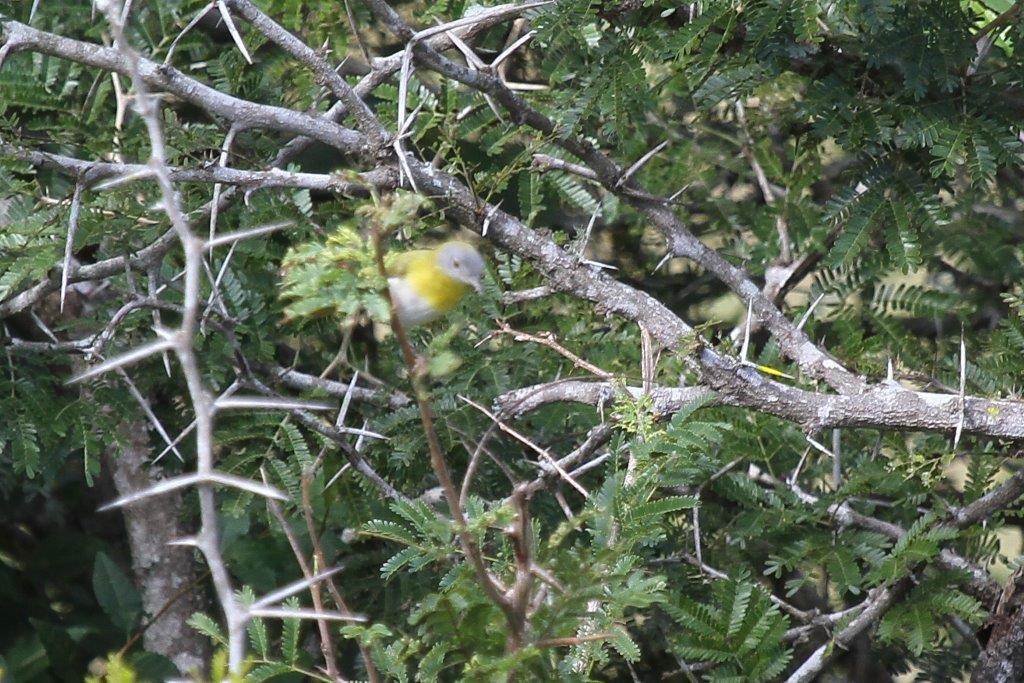
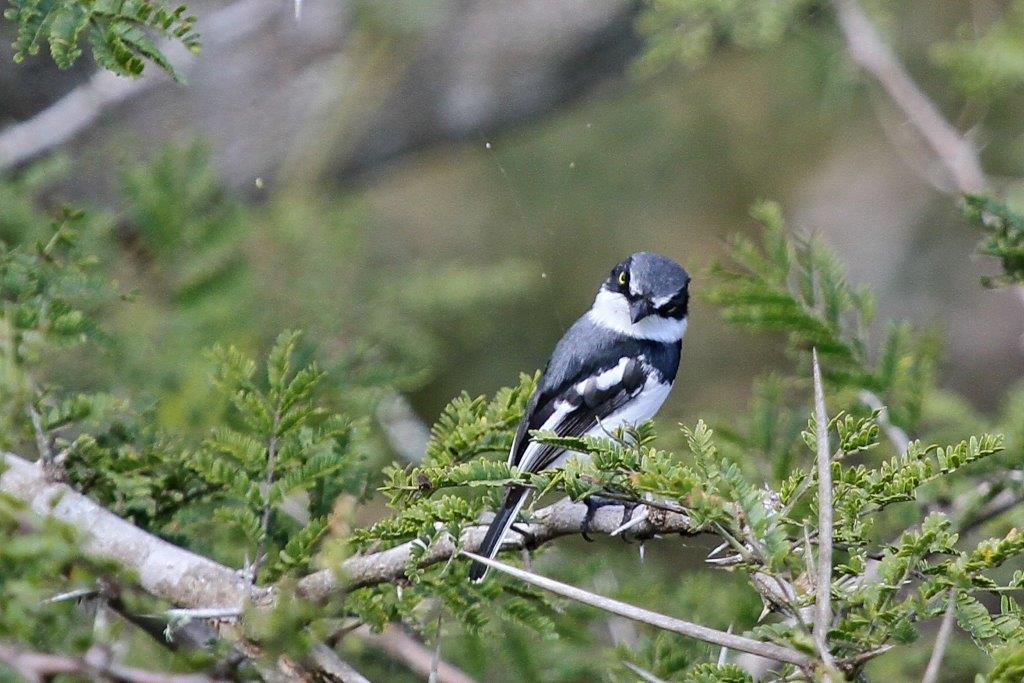
Back at the hide the nearby trees yielded close-up sightings of Chinspot Batis, Yellow-breasted Apalis and Fiscal Flycatchers.
In total we saw/heard some 53 species – with perhaps the fly past of the African Marsh Harrier being the highlight of the day as the sun caught the bird showing its colour and markings extremely well.
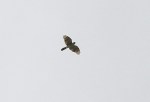
African Harrier-Hawk
Hamerkop
Lizard Buzzard seen on way to Tembe
Ilala Palm Park:
On Sunday we actively birded around the camp- taking a 2 hour walk up the road and into the bush around the camp. The rest of our records came from incidental sightings as and when we were in the camp.
The conditions were cool but sunny. A late start on Sunday – 07h00 – was decided to give the sun a chance to get some heat into and over the bush. Perhaps we should have started earlier as the birds were quite vociferous from first light. Two of us stayed on for an extra day, started earlier and noticed this the following morning.
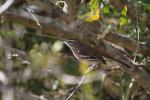
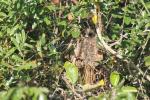
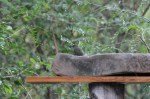
We had a hard time trying to ID a bird which only showed its back – see if you get it right first time:
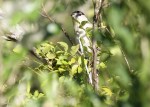
What bird is this.
Although the number of species seen this time was less than last year, the quality of the sightings was excellent. In total we recorded 52 different species including Pink-throated Twinspots (camp bird calling everywhere); African Goshawk; African Yellow-White-eye; Bearded Scrub-Robin; White-throated Robin-Chat; Rudd’s Apalis; Olive Bushshrike; Blue-mantled Crested-Flycatcher; Fiscal Flycatcher; Grey, Olive and Collared Sunbirds as well as an unusual Klaas’s Cuckoo heard calling.
Fiery-necked Nightjar and Spotted Eagle-Owl were heard calling at night. And a Woodward’s Batis was thought to be calling on arrival.
But perhaps the highlight was the sight of a Little Sparrowhawk on the waterbath at campsite number 2.
Dusky Flycatcher
Dusky Flycatcher
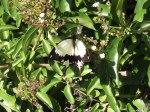
UI Butterfly
UI Butterfly with wings up
Olive Sunbird
Brimstone Canary
Spectacled Weaver
Spectacled Weaver
Neddicky
Golden-tailed Woodpecker
Southern Boubou
Speckled Mousebird- very bedraggled
Chinspot Batis – male
Black-backed Puffback
African Yellow White-eye
Yellow-rumped Tinkerbird
Yellow-rumped Tinkerbird
Yellow-rumped Tinkerbird
White-throated Robin-Chat
White-throated Robin-Chat
Sombre Greenbul
Rudd’s Apalis
Rudd’s Apalis
Red-billed Firefinch
Red-billed Firefinch
Red-billed Firefinch
Red-billed Firefinch
Olive Bushshrike
Olive Bushshrike
Emerald-spotted Wood-Dove
Emerald-spotted Wood-Dove
In all it was a great long weekend of birding and a location we think should be really productive in the summer. In my opinion 5 nights would give one the opportunity to visit many of the other interesting areas nearby – like Kosi Bay, Lake Sabaya, Babibi and possibly Ndumo (although it is almost a 2 hour drive to get there).
For those interested click on the following link for a copy of our bird list in each area we visited.
Paul & Sally Bartho; Cecil & Jenny Fenwick; Dave & Jenny Rix; Ian & Lyn Graham.
Attending: Jane Morris and Mike Roseblade,Jenny and Cecil Fenwick, Sally and Paul Bartho, Jenny and Dave Rix, Jackie and Roland Suhr, Rob Jamieson, Lynette Bingham, Sabrina Porritt, Keith Booysens and Kathy Cleggett.
Ilala Palm Park is a 35 hectare site situated about 6 kms west of Mbazwana on the road to Jozini from the centre of town. It has six campsites – each with their own ablutions and scullery with hot water and power point. The grassy campsites vary in size and most have sufficient shade. And there is a swimming pool.
Ilala Palm Park entrance
Ilala Palm campsite 2
Bird bath campsite 2 – the best bird bath just to the left of the pole next to the ablutions.
Ilala Palm campsite 3
Ilala Palm campsite 4
Ilala Palm campsite 5
Ilala Palm campsite 6
Ilala Palm swimming pool
The owners are a delight. We were welcomed with an information pack on each area we were intending to visit and a bird list, they constantly checked that all was well and that we were comfortable and provided all night security – what more could anyone want!!
The habitat consists of sand forest, Ilala Palm savannah and grassland areas.
The beauty of the Park is plentiful. The campsite alone is a birders’ paradise with bird baths dotted about which attract a huge variety of bushveld birds. Pink-throated Twinspots are regularly seen. Yellow White-eyes, Mannikins, Lesser Honeyguide, Flycatchers, Bulbuls, Greenbuls, Robin-Chats, Scrub-Robins, Starlings, Sunbirds, Doves are all seen around the bird baths. Many other special species were seen in and around the camp including Woodward’s Batis, Rudd’s and Yellow-breasted Apalis, Green Malkoha, all the Bush-Shrikes, Spotted Eagle-Owls, Fiscal and other Flycatchers, Cuckoos. The occasional raptor was seen overhead and the Fiery-necked Nightjars were heard at night along with the Owls.
Pink-throated Twinspot, Ilala Palm
Southern Boubou, Ilala Palm
Sombre Greenbul, Ilala Palm
Rudd’s Apalis, Ilala Palm
Rudd’s Apalis, Ilala Palm
Red-capped Robin-Chat, Ilala Palm
Pink-throated Twinspots, Ilala Palm
Pink-throated Twinspot, Ilala Palm
Olive Sunbird, Ilala Palm
Olive Sunbird, Ilala Palm
Olive Bush-Shrike, Ilala Palm. Look carefully – he is there. Did you find him?
Lesser Honeyguide, Ilala Palm
Grey Sunbird, Ilala Palm
Green Malkoha, Ilala Palm
Green Malkoha, Ilala Palm
Dusky Flycatcher, Ilala Palm
Brown-hooded Kingfisher, Ilala Palm
Brimstone Canary, Ilala Palm
Black-backed Puffback, Ilala Palm
African Goshawk, Ilala Palm
Yellow-bellied Greenbul, Ilala Palm
Yellow White-eye, Ilala Palm
Yellow White-eye and Grey Sunbird, Ilala Palm
Woodward’s Batis, Ilala Palm
Thick-billed Weaver – female, Ilala Palm
Stick Insect, Ilala Palm
Sometimes the pace just got too much, Ilala Palm – Jane Morris
Ilala Palm is ideally situated for access to: Muzi Pan, Mkuze, Hluhluwe, Ndumo and Tembe Game Reserves also Lake Sibaya, Nine Mile Reef & Mabibi, Sodwana and Kosi Bay to name but a few.
Summer time birding ought to be spectacular if you are based at Ilala Palm and visit the variety of habitats all within easy reach.
And to cap it all the cost to stay is better than reasonable!
The Outing.
Mike and Jane set an active program for the time there. And the 15 of us found that although parts of each day might have been spent away from the camp, there was always the camp to return to for rest and resuscitation.
The weather throughout the stay was very pleasant – sunny yet not too hot and a dribble of rain one night. There were no signs of mosquitoes perhaps because it was nippy after the sun went to rest.
Each evening Mike provided a braai around the swimming pool and many a tall tale was told.
Friday 25th:Arrival day
Two couples arrived a day early and spent Friday morning visiting Kosi Bay Camp and the mouth of Kosi Bay. Birding was slow in both areas with few water birds as you might expect at this time of the year. However there were Greater Flamingos at the mouth, an obliging Malachite Kingfisher and a Black-chested Snake-Eagle circling above.
Kosi Bay Camp Entrance
Kosi Bay Camp Entrance
Lake 3 from Kosi Bay Camp
Mangroves by Lake 3
Lake 3 from Kosi Bay Camp
Kosi Bay Estuary
Kosi Bay Estuary
Kosi Bay mouth
Kosi Bay mouth
Fish traps at Kosi Bay mouth
Malachite Kingfisher, Kosi Bay mouth
Black-chested Snake-Eagle, Kosi Bay Camp
Black Saw-wing, Kosi Bay Camp
Butterfly, Kosi Bay Camp
Butterfly, Kosi Bay Camp
Butterfly, Kosi Bay mouth
Saturday 26th: Camp Birding and Sodwana.
Saturday morning started early with a walk around the farm in the sand forest – perfect weather for birding and the highlight was to watch some Pink-throated Twinspots on the road justoutside the campsite whilst they fed in the sandy tracks. Fiscal Flycatchers were numerous and there was a constant parade of birds to see.
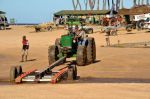
In the afternoon a group went to visit Sodwana – only 20 km down the road – to check out the beach and bird round the campsite. A Caspian Tern greeted the group at the river mouth, a group of White-fronted Plovers hid in the dune vegetation and 6 Sanderlings posed an ID challenge for us. Rob and Cecil behaved like city slickers and refusing to take off their shoes hitching a ride across a 30cm deep, 1.2 meter wide stream on a tractor, what the carbon footprint was we can only imagine!!
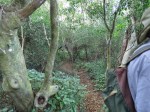
Mgobozeleni Trail
Mgobozeleni Trail pathway
Mgobozeleni Lake at end of Trail
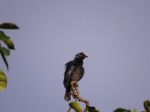
Black-bellied Starling, Sodwana
Sanderlings, Sodwana – Jane Morris
Sanderlings, Sodwana – Jane Morris
Rob and Cecil getting a lift across the river at Sodwana!! – Jane Morris
Safely on the other side – Jane Morris
Sunday 27th: Lake Sibaya and Mabibi.
Fifteen of us packed into four 4×4 vehicles set off on a clear sunny day from camp and picked up our Wakkerstroom trained birdguide, Jabulani Mbonambi, from Mbazwana petrol station – organised through Adri.
Once we had entered Sibaya we drove along a beautiful coastal forest road to the east of the Lake. It was interesting habitat yet relatively quiet – perhaps because we had few stops along the way to our breakfast area beside the Lake. However birding at the breakfast stop was interesting.
In some dead trees beside the lake about 50 White-fronted Cormorants were nesting. A Fish Eagle was roosting comfortable among them. It was interesting to see that the Cormorants took nesting material from the shore and doused it in the lake, apparently to sort out the strands of the material to facilitate nest building.
Lake Sibaya
Birding the shoreline at Lake Sibaya
Breakfast at Lake Sibaya
White-breasted cormorant roost and nest site, Lake Sibaya.
White-fronted Plover, Sibaya
Water Thick-knee, Sibaya
White-breasted Cormorants, Sibaya
Whitefronted Plover – Jane Morris
Woodward’s Batis at Lake Sibaya – Jane Morris
Paul setting off to do some birding at Sibiya – Jane Morris
Rob contemplating – Lake Sibaya- Jane Morris
Whitefronted Plover – Jane Morris
There were not a lot of birds on the lake it being too deep. However there were Three Banded Plovers, Little Egret, Egyptian Geese, one Greenshank and a Water Thick-knee. Jabulani heard the Woodward’s Batis calling in the dune forest so we went to investigate. Most of the group had lovely sightings of it. A bird wave came through among which were Forest Weavers, Yellow – breasted Apalis and Blue-mantled Flycatcher.
After tea we carried on through the forest and then through rolling grasslands to Mabibi, quite a long bumpy sandy trek. Jabulani organized a car guard for us and we proceeded down the 139 steps to the beach to do some snorkelling in the protected waters of a reef. The snorkelling was great and a good variety of fish were seen, a moray eel and some parrot fish among many others. For those not snorkelling a walk along the beach was lovely, the rock formations were interesting and White-fronted Plovers hid among them.
Mabibi
Mabibi
Moray Eel, Mabibi – Keith Booysen
Sally waiting patiently at Mabibi – Jane Morris
There was a lovely spot in the camp site for lunch and it wasn’t long before the birds began to call and there were good sightings of Kurrichane Thrush, Woodward’s Batis among others.
After a walk about the campsite we started the long trek back to camp across typical Maputaland vegetation with lots of Ilala Palms to the main road. A thoroughly enjoyable day.
Monday 28th: Muzi Pan, Ophansi Pan & Mkuze.
By 08h30, our group of 15 arrived at Muzi Pan and spread out along the causeway. The water level had receded almost to its usual position compared to a month earlier.
Muzi Pan, as usual, did not disappoint despite the windy conditions. There was abundant bird life – water birds predominantly as you might expect. Specials seen included African Pygmy Geese, Pink-backed Pelicans, African Spoonbill, Black-winged Stilts, Yellow-billed Storks also Lemon-breasted Canaries, Long-billed Crombec and Yellow-breasted Apalis. Apparently the following day Lesser Jacana, Black Coucal and Kittlitz Plover were also seen round the Pan from the Adventure Centre. In all about 40 species were seen. The following pictures show the difference in water level from one month earlier.
Muzi Pan – April 2013
Muzi Pan – March 2013
Lemon-breasted Canaries, Muzi Pan
Spur-winged Geese, Muzi Pan
African Pipit, Muzi Pan
Cattle Egret with yellow thighs! Had us confused for a while.
After an hour or so the convoy moved to another Pan, nine kilometres beyond the Ophansi Village (instead of turning left to the Mkuze entrance, travel straight on). The Pan is right beside the dirt road on the left. A number of different water birds were seen including African Purple Swamphen, Red-knobbed Coots and Whiskered Terns.
Ophansi Pan
Wattled Starling at Ophansi Pan – Jane Morris
The group then headed for Mkuze. At the gate, the vehicles separated to do their own thing. The rest of the day was spent here, lunch was attempted at Nsumo Pan but the wind was fierce making it most unpleasant. Some chose to picnic in the parking lot which was protected while others took their lunch to the picnic site at the entrance to the kuMasinga Hide.
Tea break on the causeway before entering Mkuze. Right in the heart of the fig forest..
Fig Forest under water all the way from Mkuze River bridge to Ophanse Gate into Mkuze March 2013 – one month earlier.
Mkuze River – March 2013. One month earlier
Animal viewings were few and far between – perhaps because of the time of day the Park was entered. However a White Rhino did make a lengthy appearance at the kuMasinga Hide.
In fact the hide attracted a good many different birds over the midday period. It was a good vantage point for photography. There were excellent viewings of Green-winged Pytilia, Crested Barbet, Kurrichane Thrush amongst many others.
White-eared barbet, Mkuze
Yellow-fronted Canary, Mkuze
Yellow-throated Petronia, Mkuze
Black-headed Heron – juveniles, Nsumo Pan Mkuze
Black-collared Barbet, Mkuze
Cape Glossy-Starling, Mkuze
Crested Barbet, Mkuze
Crowned Lapwing, Mkuze
Green-winged Pytilia, Mkuze
Hadeda Ibis, Mkuze
Kurrichane Thrush, Mkuze
Greater Honeyguide – juvenile, Mkuze
Red-billed Oxpecker, Mkuze – latest in head gear.
Chacma Baboon and young, kuMasinga Hide, Mkuze
Warthog, kuMasinga Hide Mkuze
Burchell’s Zebra, kuMasinga Hide Mkuze
Red-eyed Dove, Mkuze
Brown Snake-Eagle, Mkuze
Fiscal Flycatcher, Mkuze
Three-ringed Plover, Mkuze
Raptors were few – no vultures. Those that were seen included Shikra, Little Sparrowhawk and a Brown Snake-Eagle on the way out. Only about 70 species of birds were seen in Mkuze.
Tuesday 29th. Tembe.
The usual early start led to another productive birding day in Tembe Elephant Park. Only 4×4 vehicles are permitted entry and they ensured an uneventful trip along the many single sandy tracks.
The reserve is known for the potential to find the Plain-backed Sunbird. It was on everyone’s agenda. However only Cecil was able to find it – at the Mahlasela Pan Hide. The Mahlasela Pan Hide is a raised hide at canopy level overlooking the Pan. It is a well designed hide. A webcam from this hide shows activity at the Pan on the internet. Go to http://www.tembe.co.za. The Africam is on the Home page.
The reserve is also known for its large elephants which fortunately showed themselves calmly.
There is a viewing tower near the entrance and another hide at the north end of the Swamp roads – the Poweni Hide. It too is a raised hide at canopy level and it looks down at a flood plain below.
Most agreed that the swamp area, the east Swamp Road (Umjamgazi Road) in particular, offered most sightings including Grey Waxbills, Yellow Fronted Longclaws, Stonechats, Rudd’s Apalis, Southern Banded Snake-Eagle, Eastern Nicator, Lilac-breasted Roller and Pink-throated Twinspots. Raptors included Bateleur and Brown Snake-Eagle but no Vultures. The waterhole antics of small families of elephants provided treasured moments for many of the group, as did the occasional roadside encounter. In all around 60 species were seen.
Most of the group departed around midday leaving only a few lucky behind.
Birding during the day was spent around the camp and at the several bird baths. Pink-throated Twinspots made their regular appearances along with a number of other specials.
Thursday May 1st: Final departure.
Part of the morning was spent birding around the camp where several Olive Bushshrikes made appearances as well as a very obliging Green Malkoha.
Olive Bush-Shrike, Ilala Palm. Look carefully – he is there. Did you find him?
Green Malkoha, Ilala Palm
Green Malkoha, Ilala Palm
Anecdote:
One amusing incident related to a certain loo which when flushed would not respond. After several attempts to flush, the pot began to boil and the head of a snake appeared!
The next morning in another loo the occupant was chased out by a Bushbaby!
Summary:
Although only about 180 different birds were seen over the period at Illala Palm, there were many specials as you will have noted above. The number of bird species seen around the camp alone was about 88.


























































 Birds are our Story