On impulse Sally and I decided to head up to St. Lucia for 4 nights and the same at Kube Yini (between Mkuze and Phinda). Then onwards, wherever, for a further week.
As it happened we ended up staying only 3 nights at Kube Yini then coming home. Everywhere was exceptionally dry. But the deciding factor to return home was yet another side wall puncture.
At St. Lucia we camped in the Sugarloaf campsite. Water was restricted due to the drought but the campsite did not appear to be affected – other than they only opened two of their four ablution blocks.
During our time at St. Lucia we went birding in Eastern and Western Shores of Isimangaliso Wetland Park as well as around the estuary mouth and the campsite. As you can see from our bird list (click here to see it), our time in St. Lucia around the estuary and campsite was the most rewarding.
On the first morning we headed for Eastern Shores. However as we left the camp gate we checked the sand bank in front of the Boat Club and restaurant. There were quite a number of Pied Avocets among numerous waders and terns. Most striking, however, were eight Black Herons together.
Pied Avocets
Pied Avocets
Black Herons
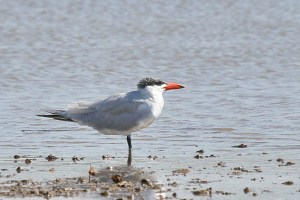
Caspian Tern feeding young
In the Eastern Shores we had two interesting experiences – firstly on three occasions we came across Southern Banded Snake-Eagles. One with a full crop after devouring a green snake.
Southern Banded Snake-Eagle
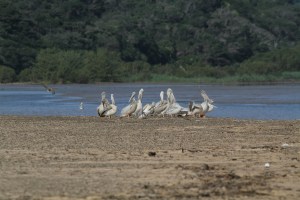
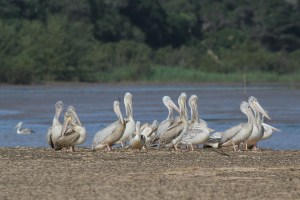
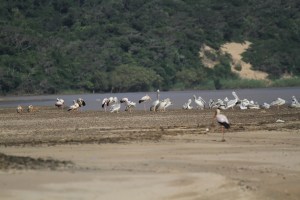
The second experience was at Lake Bengazi. (An aside – the causeway is still not passable due to the road collapse some years ago). Looking out across the Lake to the western side there were hundreds and hundreds of Pelicans on the shore line – mainly Great White but also Pink-backed.
Altogether in the 6 hours we were there we identified 72 different species.
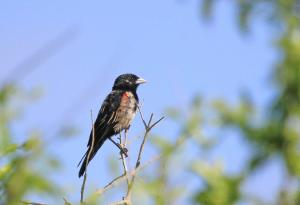
Fan-tailed Widowbird
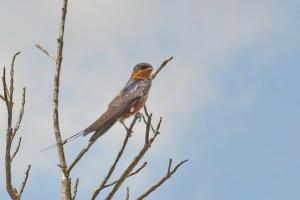
Red-breasted Swallow
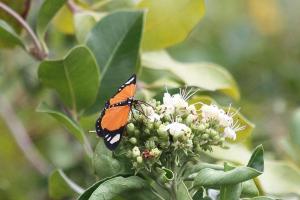
Large Striped Swordtail
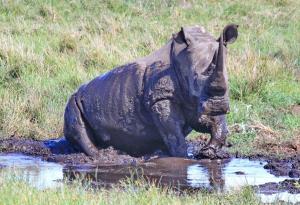
White Rhino at the Mafazana HIde.
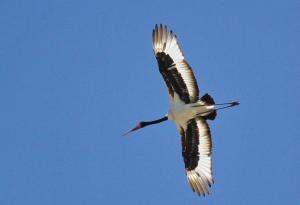
Saddle-billed Stork
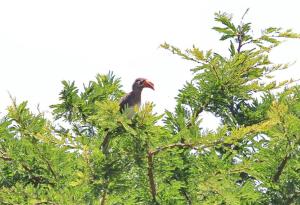
Crowned Hornbil
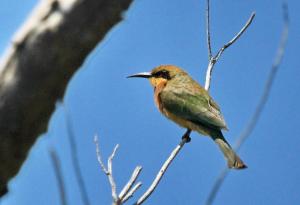
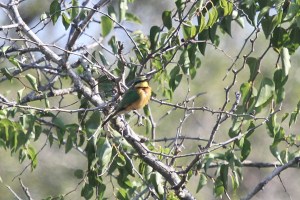
Little Bee-eater
Saddle-billed Stork
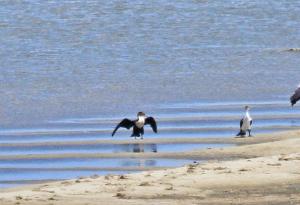
White-breasted Cormorants (note the full white underside of the young bird)
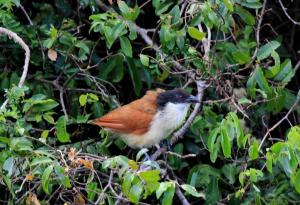
Burchell’s Coucal
The second full day at St. Lucia we headed for Western Shores – windy and overcast. Virtually all the dams were empty of water. From the boardwalk overlooking Lake St. Lucia we could see how much the drought had affected the water levels in the Lake.
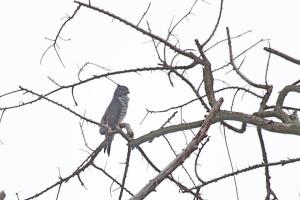
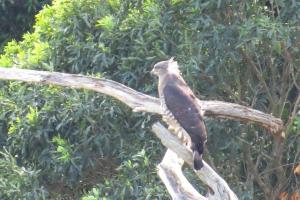
One of the highlights was stopping next to a male and female African Cuckoo-Hawk on the ground not 20 metres from us.
African Cuckoo-Hawk- female
African Cuckoo-Hawk- female
African Cuckoo-Hawk – male
African Cuckoo-Hawk- male
African Cuckoo-Hawk- male
And then at the main picnic site, we noticed a small dam with some water – probably being pumped in. At the dam there were a number of Collared Pratincoles and a Wood Sandpiper – soon to be scattered when three noisy Spur-winged Geese arrived.
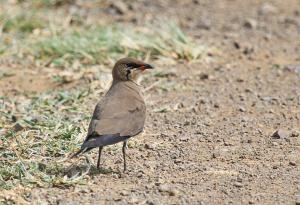
Collared Pratincole
Collared Pratincole
The picnic site is a lovely location however it could do with some tables and benches under the trees. Here we had a good sighting of a Scarlet-chested Sunbird. Altogether only 48 different species were identified in the 5 hours we were there.
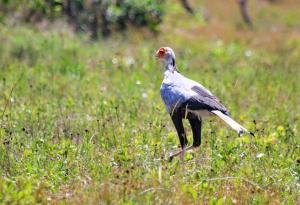
Secretarybird
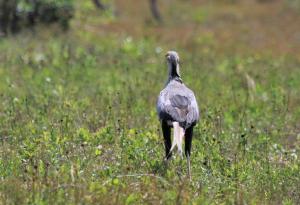
Secretarybird
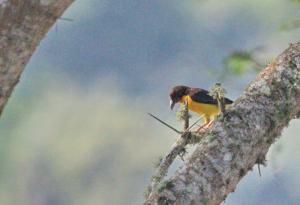
Violet-backed Starling
Dark-backed Weaver
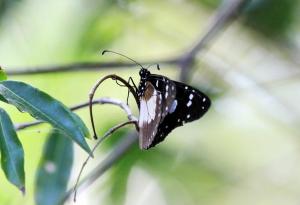
Variable Diadem
Most afternoons we spent time birding around the campsite and on the beach. Because of the wind the beach was fruitless and the banks of the estuary had few birds.
The exception to this was the sand bank in front of the boat club restaurant. Among the numerous waders and shore birds we did manage to find an unusual Plover.
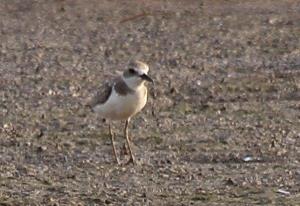
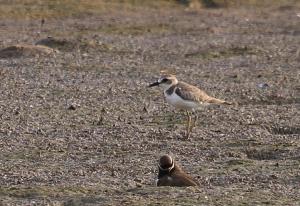
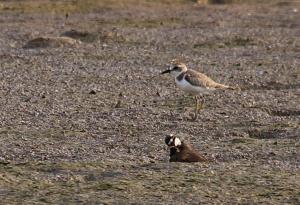
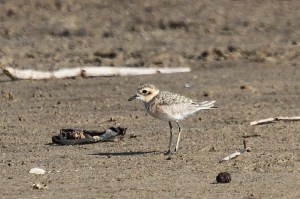
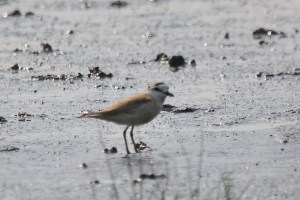
The guide with a group of American tourists said it was a Lesser Sand Plover. However as the photos below show – it was in fact a Greater Sand Plover (unless of course both were present). The greenish legs lead me to question what I photographed.
If we had read the text in the Roberts App more closely we would have known to watch its behaviour. When foraging the Lesser takes about 3 paces then pauses for about 2.5 to 3 seconds. The Greater takes about 9 to 10 paces then pauses for 5 to 8.5 seconds!
Greater Sand Plover
Greater Sand Plover
Greater Sand Plover
Greater Sand Plover
Greater Sand Plover
Greater Sand Plover
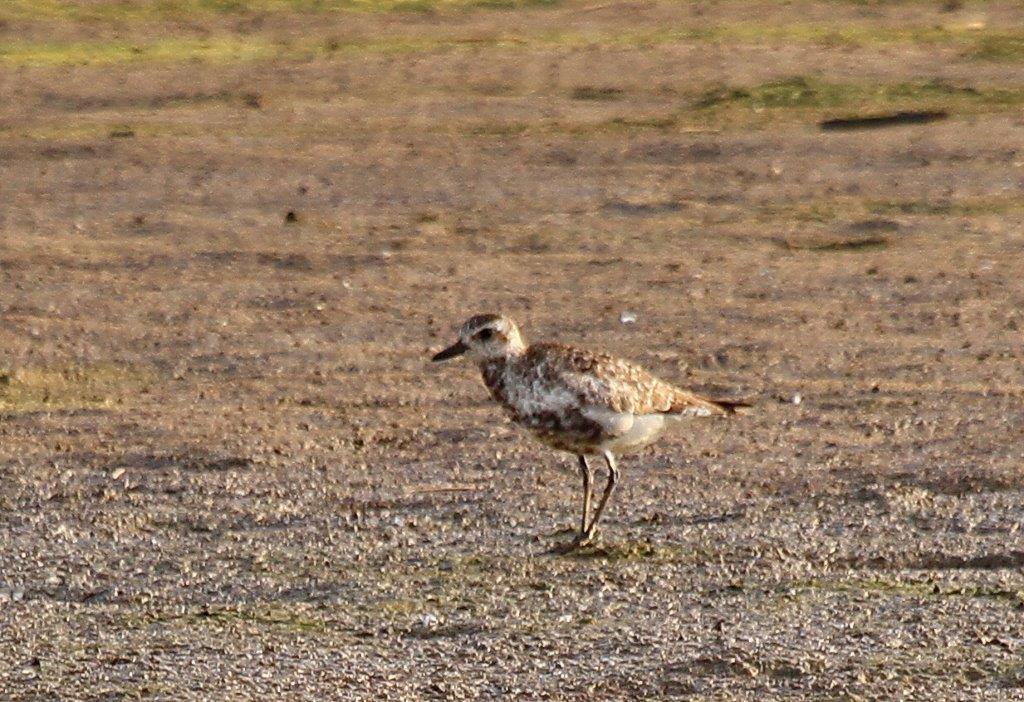
Also present on the sand bank was a Grey Plover in semi-breeding plumage.
The campsite itself as usual had an abundance of different birds – some of the more notable for us were the Livingston’s Turacos, Purple-banded Sunbirds and an obliging Bearded Scrub-Robin.
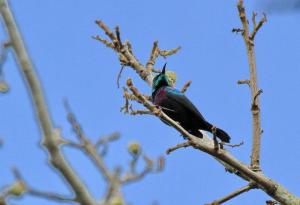
Purple-banded Sunbird
Purple-banded Sunbird
White-eared barbet
Brown Scrub-Robin
Yellow Weaver
Yellow Weaver – male and female
Livingston’s Turaco
Southern Boubou
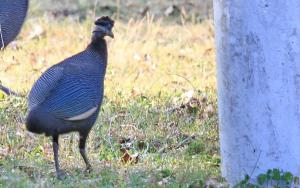
Crested Guineafowl
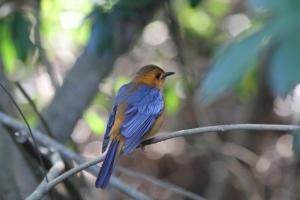
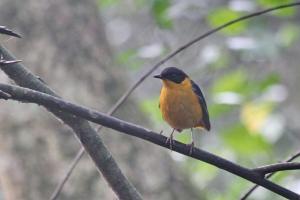
Red-capped Robin-Chat
Orange Cat
But perhaps the most unexpected appearance was that of an African Wood-Owl. We were having dinner when it flew to our table knocking over a handbag on the ground beside the table. It then sat in a nearby tree and kept foraging at the base of a tree not three metres away from us.
Altogether in the camp and nearby estuary a count of 94 different species – not too shabby.
And then it was time to move on to Kube Yini where we stayed in a rather large cottage belonging to a friend of ours. The cottages are all on the top of a number of steep hills. Everywhere was very dry and waterholes empty – except for the two where water was pumped in – both rather small.
It was a decided challenge to back the camper into the driveway!
Here we settled in to the luxury of large space. Checking the map of the area we thought that we should head for the river in the canyon below. So the first afternoon after settling in we headed down to do a short loop. In parts it was steep any very rocky – progress was slow and the birds likewise.
The next day we headed for a longer drive alongside the river. Again steep and rocky everywhere so the drive lasted probably 2 hours longer than we thought. Birds there were, close to the river but nothing that stood out.
Our best birding was around the cottage – Burnt-necked Eremomela, Bearded Scrub-Robin and African Yellow White-eye. In the evening the call of the Fiery-necked Nightjar. And on the plains below next to the clubhouse a Flappet Lark called for our attention. 61 different bird species were identified while we were there.
Bearded Scrub-Robin
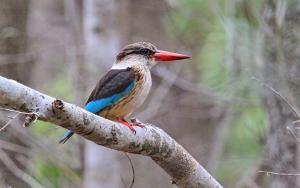
Brown-hooded Kingfisher
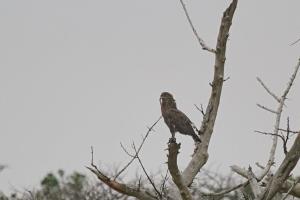
Steppe Buzzard
Steppe Buzzard
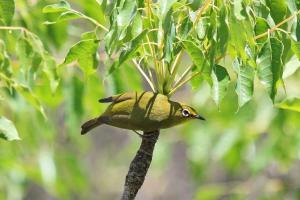
Yellow White-eye
That evening we went to the clubhouse to watch the RSA semi-final along a number of other residents. In one conversation we mentioned that the roads are very rocky especially on the way up and down to the river. They were aghast and surprised that we had ventured there as none of them did.
After the rugby on the way back to the cottage we heard the very unpleasant sound of a tyre giving off puffs of air on each revolution and the piping alarm of the tyre pressure monitor sounding. Somehow we managed to get back to the cottage before it went completely flat.
The tyre took ages to change simply because we have a Fortuner and they have this ridiculous system to lower the tyre beneath the car. The problem being to insert a long bar unsighted into a slot designed for perfect alignment. Much cursing and swearing until by chance it unexpectedly went in.
The next day we only ventured to the clubhouse to watch the final on our own. The next day – home.
Enough adventure for this trip. But altogether 152 different birds identified.
Sugarloaf campsite in St Lucia was not too busy. School holidays had ended. There was water rationing in St Lucia which meant that one day we had no tapped water but the rest all day. Water bottles were laid out at each of the ablutions blocks. Power cuts were from 5 to 6 pm several nights – yes only one hour.
We spent a morning in each of the two parts of the Isimangaliso Wetland Park – Eastern and Western Shores. And one morning in the Gwalagwala trail. Time was spent on the beach too, though the gulls and terns were mostly down the coast chasing the sardines. No Franklin’s Gull!
The weather was mostly kind to us and we did have rain on several nights which helped to bring out the birds the following mornings.
In all we identified 63 birds in Eastern Shores, 64 birds in Western Shores and 82 birds in and around the campsite, Gwalagwala trail and on the beach. In total 125 different bird species were identified. Click here to see the lists.
Here are some photos of the birds seen.
Blue-mantled Crested-Flycatcher
Black-winged Lapwing
Senegal Lapwing
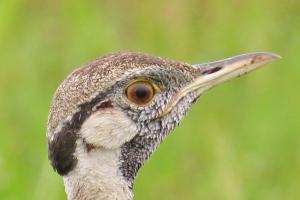
Black-bellied Bustard
Ashy Flycatcher
African Fish-Eagle
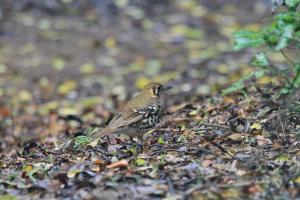
Spotted Ground-Thrush
Spotted Ground-Thrush
Spotted Ground-Thrush
Terrestial Brownbul
Trumpeter Hornbill
African Cuckoo Hawk
Southern Boubou
Red-capped Robin-Chat
Olive Bushshrike
Common and Swift Terns
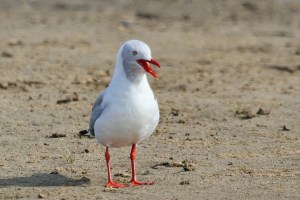
One footed Grey-headed Gull
Whiskered Tern
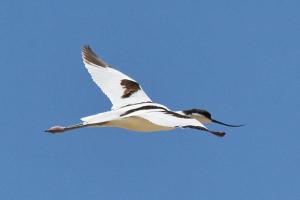
Pied Avocets
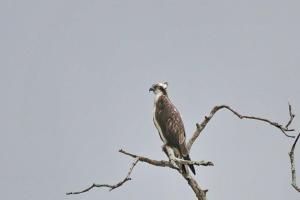
Osprey
Osprey
Saddle-billed Stork
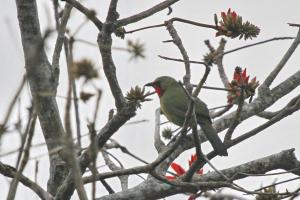
Gorgeous Bushshrike
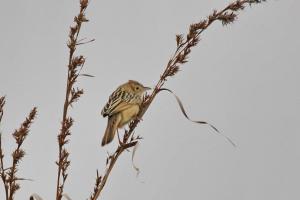
Croaking Cisticola
Collared Pratincole
Collared Pratincole
Brown Snake-Eagle swallowing breakfast whole.
Brown Snake-Eagle swallowing breakfast whole.
Chorister Robin-Chat
Chorister Robin-Chat
And a few butterflies and mystery Cisticolas for ID.
Having been closeted away in Hillcrest for four months it was time to get away – St. Lucia and Mkhuze were the destinations – for four or five nights in each.
Sugarloaf campsite in St. Lucia is ideally located. It is close to the beach and the mouth of the St. Lucia estuary as well as to access to Eastern and Western Shores of Isimangaliso Wetland Park. Furthermore it is only an hours drive to Umfolozi.
The Franklin’s Gull had been seen in the St. Lucia estuary the week before we arrived so it was a target bird for me. Unfortunately I was not to be lucky. It was still around apparently. We met Themba of Themba’s Birding & Eco Tours on the beach and he said he had seen it while we were there. We were in one of the Parks at the time.
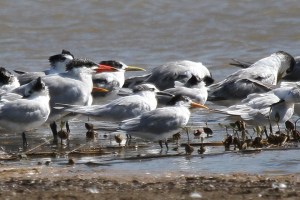
However we did see a number of different Terns among the Grey-headed Gulls. These included Swift, Sandwich, Caspian, Lesser Crested and Common Terns.
Grey-headed Gull
Grey-headed Gull
Grey-headed Gull
Caspian Tern
Caspian, Swift, Sandwich and Lesser Crested Terns
Caspian, Swift, Sandwich and Lesser Crested Terns
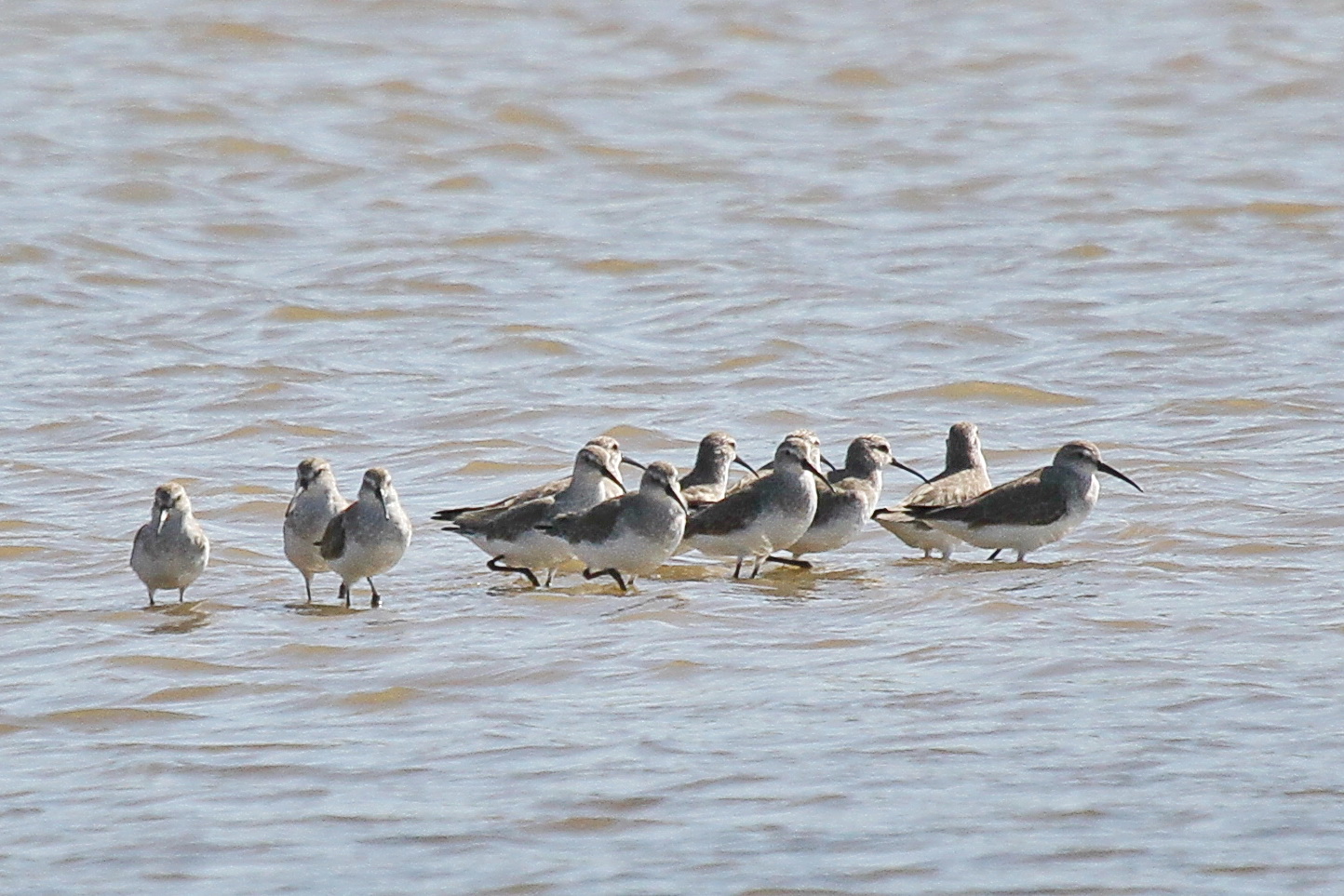
Unexpectedly among the Terns were a dozen Curlew Sandpipers closely knit.
And then we spotted a lone Lesser Sand Plover running among the many Three-banded and White-fronted Plovers and the odd Kittlitz’s Plover.
Lesser Sand Plover
Lesser Sand Plover
Lesser Sand Plover
Lesser Sand Plover
Some other birds seen at the beach:
African Crowned Eagle
African Fish-Eagle – juvenile
African Fish-Eagle – juvenile
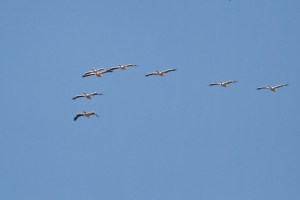
Pink-backed Pelicans in formation
White-fronted Plover
White-fronted Plover
Pink-backed Pelicans
Pink-backed Pelicans
Beach Birds
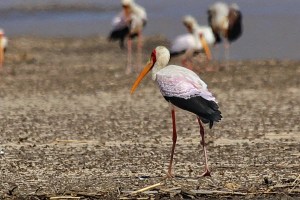
Yellow-billed Stork
Sacred Ibis and Yellow-billed Ducks
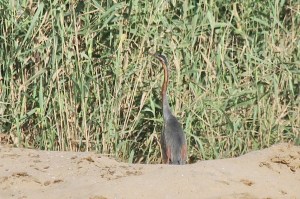
Purple Heron
African Pipit
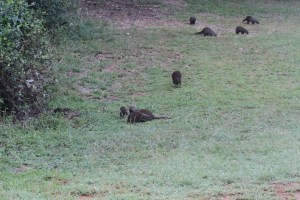
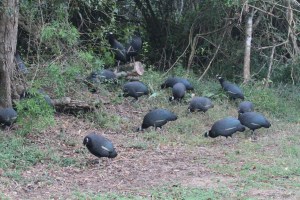
Sugarloaf campsite proved almost as good a birding spot as any of the Parks we visited. There were Woodward’s Batises, Green Twinspots, Black-throated Wattle-eyes (five or six chasing each other), African Goshawks, Livingstone’s Turacos, Rudd’s Apalis, Brown Scrub-Robins, Green Malkoha, Wood Owls to name a few of the specials. Campsite regulars included Grey Duiker, Bushbuck (playing with the monkeys), Banded Mongooses and Crested Guineafowl.
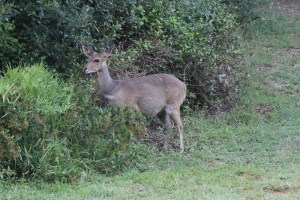
Bushbuck
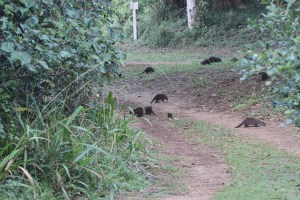
Banded Mongooses
Banded Mongooses
Crested Guineafowl
Yellow Weaver
Little Bee-eater
Square-tailed Drongo
Black-throated Wattle-eye – female
Black-throated Wattle-eye – female
African Goshawk
African Goshawk
African Goshawk
Look at the photos of the African Goshawk above. The first impression was the two spots on the tail and we called it “Little Sparrowhawk”. Sally’s second opinion was that it was much larger than a Dove and questioned our first impression. So we checked the books and they told us to check the cere – what colour – yellow or grey. If yellow then Little Sparrowhawk, if grey then African Goshawk. Looking more closely at the spots on the tail you can see that they are in fact bands which are brightest in the middle fading towards the sides. Don’t always go with first impressions – too easy to make a mistake!
Eastern and Western Shores in Isimangaliso Wetland Park – see Part Two of Four.
St. Lucia as well as Eastern and Western Shores of Isimangaliso Wetland Park – 23 to 27 November 2014
Paul and Sally Bartho
After a short drive from Ndumo we reached St. Lucia and chose to stay in the large Sugarloaf campsite which was relatively empty. Eden Park is very nice and well treed but Sugarloaf is situated right next to the boardwalk which follows the estuary to the beach. Peak season and the campsites are full to bursting – not pleasant. We tend to avoid weekends at Sugarloaf due to boisterous fishermen. Eden Park – if it is open – is quieter at those times.
Sugarloaf campsite
Sugarloaf
During our time here we visited both Eastern and Western Shores of the Isimangaliso Wetland Park as well as spending time around the estuary and on the beach. The campsite too is usually full of interesting birds – Green Twinspots, Woodward’s Batis, African Goshawk, Livingstone’s Turacos amongst many more common bush birds.
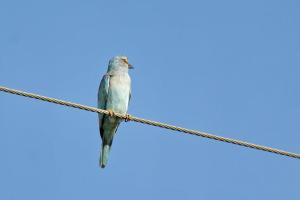
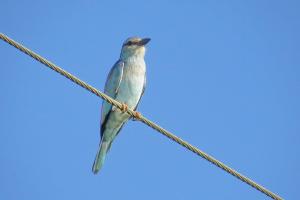
Eastern Shores was the first place we visited. We went in early and spent till midday there. On entry we had our first and only trip sighting of an European Roller.
European Roller
European Roller
We took the Pan Loop to visit Amazibu Pan – it was quiet. However there were several Collared Pratincole on the opposite bank. One obligingly appear on our side for a photo.
Collared Pratincole
Then we took the Vlei Loop around a large wetland area. Also very quiet but we did manage to see a southern-banded Snake-Eagle in the distance. Apologies for the quality of the photos.
Southern Banded Snake-Eagle
Southern Banded Snake-Eagle
Southern Banded Snake-Eagle
Just after the Mission Rocks turn-off there is a road to the left taking you to the relatively new Mafazana Bird Hide. Again all was quiet here too. It is a 200 metre walk through the forest to the hide. The hide is massive with 3 viewing levels. Be alert to potential predators. Once, on arrival, I exited the car only to be shouted at by Sally to get back in. There was a large male leopard not 30 metres away.
View along the walkway to the hide.
View from Mafazana Hide
View from Mafazana Hide
Splat was sat in the driver’s seat to look after our vehicle.
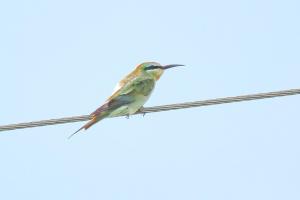
On the way back we had our first sighting of Blue-cheeked Bee-eaters and a lone Crowned Hornbill.
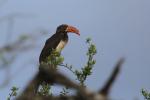
Crowned Hornbill
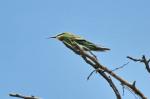
Blue-cheeked Bee-eater
Blue-cheeked Bee-eater
Blue-cheeked Bee-eater
In total we only identified 56 different bird species during the few hours we were in Eastern Shores.
Western Shores was a lot more productive and yielded 108 different bird species. We were there for a few hours longer.
It is very different from Eastern Shores – large expanses of open grassland, wetland areas, several open ponds, intermittent patches of forest, a very clean and open picnic site, a boardwalk up through the forest to a tree top platform overlooking Lake St. Lucia below as well as a bird hide at the northern end of the Park where the elephant prefer to hang out.
Picnic Site
Large open pond right by the road
Barn Swallows a plenty and showing the open nature of the grasslands
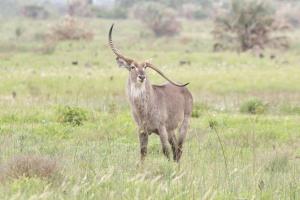
Waterbuck with crooked horn – rather suave and foppish
During the drive on the one way loop we came across a number of interesting species – Long-crested eagle, a juvenile fish-Eagle, numerous Black-bellied Bustards, Red-breasted Swallows, Yellow-throated Longclaws and Petronias to name a few. However the highlight for me was the Lemon-breasted Canaries. We had great views of 2 or 3 right in front of us beside the road.
Some photos of birds on this loop:
Red-breasted Swallow
Burchell’s Coucal
Black-bellied Bustard
Black-bellied Bustard
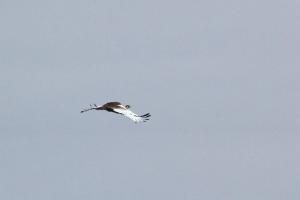
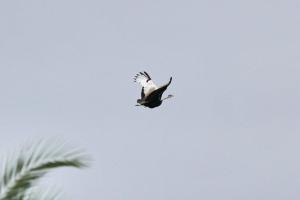
Black-bellied Bustard in flight
Black-bellied Bustard in flight
Black-bellied Bustard in flight
Black-bellied Bustard in flight
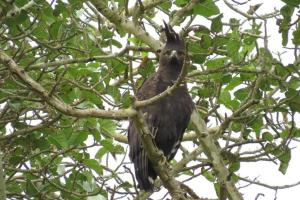
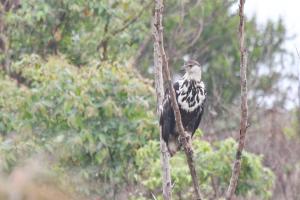
Long-crested Eagle
Long-crested Eagle
Long-crested Eagle
African Fish-Eagle – juvenile
Black-chested Snake-Eagle
Black-headed Heron
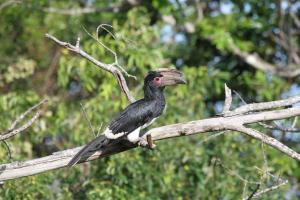
Trumpeter Hornbill
Yellow Weaver
Yellow-billed Egret
Yellow-throated Petronia
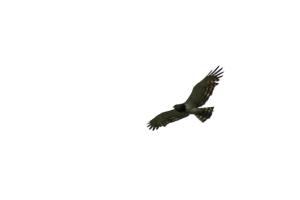
We came across what we believe to be a Booted Eagle going from one grassy area to another.
Booted Eagle
Booted Eagle
Booted Eagle
Booted Eagle
And a mystery Cisticola – possibly a Black-backed?
Mystery Cisticola
At the hide there was little or no water unfortunately but we did see this juvenile African Cuckoo-Hawk on the branch of a distant tree.
African Cuckoo Hawk – juvenile
When we visit St. Lucia, Western Shores is a must visit for us.
Back at the campsite we spent some time listening to the birds and walking around the 100 campsites. The Woodward’s Batis serenaded us each morning as well as the Livingstone’s Turacos, Red-capped Robin-Chats (Natal Robin) or RCRC birds, Greenbuls; Eastern Nicator and others.
If it was not windy we went to the estuary and the beach – looking for the Sooty Tern which seems to have habituated the estuary for a number of years now as well as for the Bar-tailed Godwit which we had heard about on Trevor Hardaker’s Rare Birds Report.
Looking towards the boardwalk with the sea to the right.
Beach Flora
Beach Flora
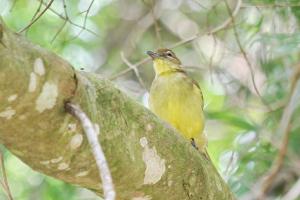
Yellow-bellied Greenbul in the campsite.
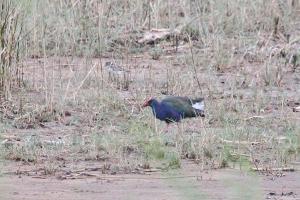
Purple Swamphen on the way to the beach
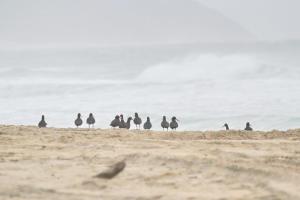
On the beach we were fortunate to find a flock of 13 African Black Oystercatchers:
African Black Oystercatchers
African Black Oystercatchers
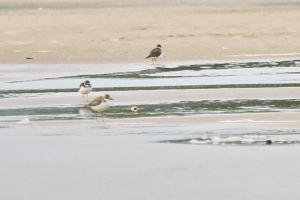
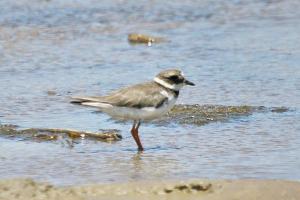
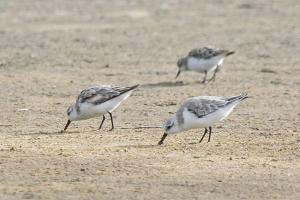
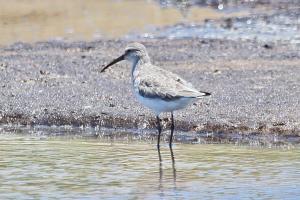
And further down the beach towards the river mouth we spotted numerous terns – mainly Swift Terns but also Little and Common – all distantly on the opposite bank on the river mouth. Amongst them were many waders including Sanderlings; Little Stints; Common Ringed, White-fronted and Three-banded Plovers; Curlew and Common Sandpipers; Common Whimbrel. However the birds that stood out most were the Terek Sandpiper and the Lesser Sand Plover.
Lesser Sand Plover
Lesser Sand Plover
Lesser Sand Plover
Common Ringed Plover
White-fronted Plover
Sanderlings
Sanderlings
Curlew Sandpiper
We walked the mudflats at the mouth of the estuary – watching out for both Hippos and Crocs when we remembered and weren’t too carried away by the birds. On the way to one area we came across a feeding area full of common Waxbills. They were there on previous occasions when we had visited.
Common Waxbill
Common Waxbill
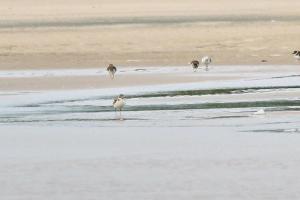
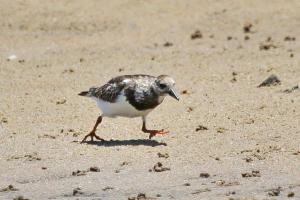
Many small waders were present; Sanderlings; Little Stints; Common Ringed, White-fronted and Three-banded Plovers; Curlew and Common Sandpipers. But there were a number of specials too: Pink-backed Pelican, Grey Plover, Pied Avocet, Ruddy Turnstone:
Pied Avocet
Pied Avocet
Pied Avocet
Ruddy Turnstone
Grey Plover
Grey Plover in flight
Pink-backed Pelican
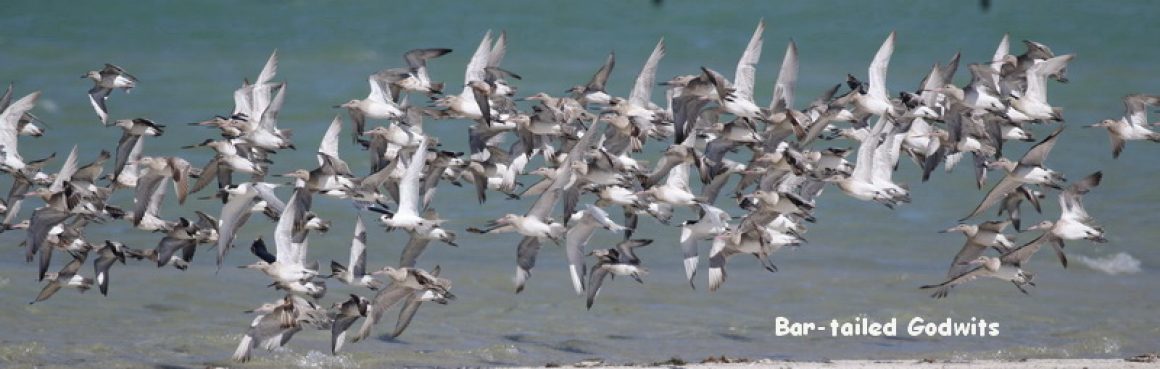
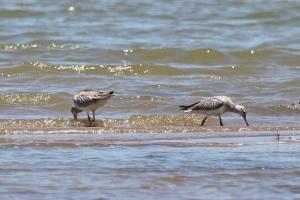
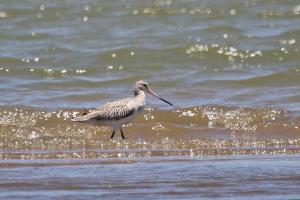
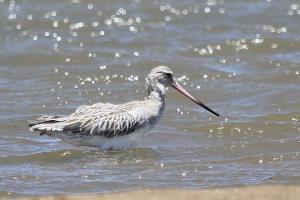
And then to cap it off we found a pair of Bar-tailed Godwits.
Bar-tailed Godwits – a pair
Bar-tailed Godwits – a pair
Bar-tailed Godwit
Bar-tailed Godwit
Bar-tailed Godwit
Bar-tailed Godwit
The campsite, the beach and the estuary gave us 71 different bird species.
In total we had observed 142 different bird species whilst in St. Lucia.
And then it was time to go home after 7 weeks away.
Look out for a summary follow up including:
a bird list of what we saw where, highlighting what we thought were specials
our worst sighting
pictures of birds for ID
photos of some of our specials
Hope you have enjoyed the series. It has brought back fond memories for us and the desire to venture anew.
Sally and I decided to spend the New Year camping away from home. Northern Zululand was our destination. Our program:
3 nights in Bonamanzi
4 nights in Mkuze
4 nights in Ndumo
3 nights in St. Lucia
Bonamanzi.
At Bonamanzi we stayed in Campsite 5 and joined friends who were already there. Campsite 5 is huge and can accommodate 4 camp groups easily – however there is only one toilet/shower and one wash-up area. As pensioners it cost us R90 pppn.
In Bonamanzi as you may know you are able to walk anywhere on the property except in their Game viewing area. This is great for birding. However elephants do use the area as well. One morning when driving to the office we found a huge branch across the road and elephant tracks confirming who was the culprit for this roadblock. Beware.
The first night we had a lot of rain. So the next morning we (our friends and ourselves) decided to visit Hluhluwe rather than bird in the rain around the campsite. It continued raining.
Taking the shortcut to the freeway we went through numerous muddy pools past the Hakuna Mutata accommodation until we got to the bridge. The approach to the bridge was up a short steep bank which looked muddy and badly cambered – so down I went into Low range 4×4 and up we went – well actually did not make it. About a third of the way up the Fortuner slowly drifted off the road onto the trees on the left. Fortunately I was able to reverse out of trouble without damaging the car. Now the long way round to Hluhluwe.
The rain persisted. However we decided to look for the Finfoots (Finfeet?) which our friends had seen the previous day. Taking the immediate right turn as you enter the park we drove round to where they had seen them basking next to the river crossing – no luck! About the only excitement we had were 7 White Rhino crossing the road in front of us. They were the first aminals we saw since entering! Aminals were scarce and the birding was not much better. Eventually we decided to return to Bonamanzi for lunch. Altogether we had seen 35 species of birds in the 3 hours we were in Hluhluwe.
Croaking Cisticola
European Bee-eater
Dusky Indigobird
Fan-tailed Widowbird
Red-backed Shrike
The following day we walked around the camp area and went on a drive to explore other parts of Bonamanzi. In one section we had heard an African Broadbill on a couple of occasions (Pathway E to F). Later we went back with our friends and another couple who had arrived to see if we would have any better luck.
Sally mentioned to Irene that you needed to look on cross branches about head height in the bush. We had not gone more than 20 metres when Irene spotted a Broadbill – unbelievable. I managed to get a few poor shots which you can see in the gallery below. On the way back I popped into the bush to see if I could get a few better shots – no luck finding the Broadbill but I did surprise a Narina Trogon – see pics in Gallery.
After that we visited the office area and drove back in the dark spotting a Shikra on the road munching on its prey – unconcerned with the car’s headlights on him. Poor pictures in the gallery.
Painted Reed Frog, Bonamanzi (Tree Frog)
Emperor Moth, Bonamanzi – lovely leaf feelers
Luna Moth, Bonamanzi (Not an Emperor Moth)
UI Buzzard
Same UI Buzzard
Twisted Grey Heron
Spear fishing – great catch
Almost got it all in!
Pied Kingfisher waiting patiently
Pied Kingfisher about to go for it.
One exponent in the Nyala dance.
What a mouthful for a Malachite Kingfisher
Little Egret and Common Greenshank
White-faced Ducks
Water Thick-knee
Water Thick-knee in ambush
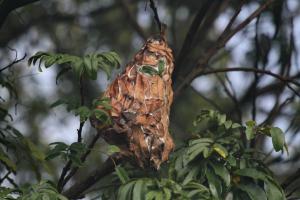
Sunbird Nest – but which one – reach for your books
Thick-billed Weaver. All pics of weavers in same pond.
Lesser Masked Weaver
Village Weavers
Yellow Weaver
Yellow Weaver- I need food! Now!
African Jacana
African Pied Wagtail
Common Scimitarbill
Diedrick’s Cuckoo
Black-bellied Starling
White-browed Scrub-Robin
White-browed Scrub-Robin
Black Cuckooshrike showing all his colours, Bonamanzi (Not a Cuckoo!!)
Shikra
Shikra
Shikra
Narina Trogon
Red-fronted Tinkerbird – peek-a-boo
Red-fronted Tinkerbird
African Broadbill
Bonamanzi yielded 89 species plus one UI (Unidentified) Raptor – have a go there is a pic in the gallery. Most of the Cuckoos were heard as well as the Green Malkoa. A Black Cuckooshrike in magnificent breeding plumage gave a great display round the campsite – yellow gape and epaulets very strident. A Red-fronted Tinkerbird and a Bearded Scrub-Robin also gave us great displays in the campsite.
Mkuze.
Surprisingly the tent was dry as we packed to leave Bonamanzi. We headed for the new gate to enter Mkuze. On the way we passed Muzi Pan. The water level was so high that it was a raging torrent beneath both bridges along the Muzi Pan dam wall. Not surprisingly there were few bird species about – we saw only 9 in the 10 minutes we stopped there. The Knob-billed Duck being the most interesting.
Mkuze Campsite. Still has water problems – the boreholes run dry regularly and the water is unfiltered so not only is it inadvisable to drink but the silt that comes with it is damaging all their taps – water leaks all the time.
Trying to book a campsite at Mkuze is often difficult because of this. Also they try to restrict the number of bookings to 10 campsites as that is all their one staff member can handle. They have over 30 potential sites. When we arrived on 31st December one man was still trying to cut the knee high grass in 50% of the sites!
On top of this the Ezemvelo Parks Board have fixed the campsite rate at R230 for 3 people – an increase from R180 last year (almost 30%) with no improvement in facilities and no way to get a rate for 2 people. Like Sodwana who charge for 4 people irrespectively, this is a total rip off.
During the 3 full days in Mkuze we never managed to find the newly released Lions perhaps because they are still happy to return to their boma where they were kept originally and also because all the rain the grass was high everywhere.
Some of our more interesting bird sightings include:
Black bellied Bustard
Lemon-breasted Canaries
Cuckoos vociferously calling – Black, African Emerald, Diedrik’s, Klass’s, Jacobin, Levaillant’s and Red-chested. A pair of the latter chasing each other round the main office.
Namaqua Doves
Lesser Spotted Eagle.
Burn-necked Eremomelas
Grey Go-away-bird
a juvenile Greater Honeyguide around our camp being fed by Black-bellied Starlings.
Woodland Kingfishers
Common Quail obligingly walking ahead of us on the road to KwaMalibali Hide
Red-backed Shrikes – everywhere
Neergaard’s Sunbird – always a pleasure
Grey Penduline-Tits in the trees above our campsite
Red-throated Wrynecks
European Bee-eater
European Roller
Grey Go-away-bird
Golden-breasted Bunting
Greater Honeyguide – immature
Greater Honeyguide – immature
Green-winged Pytilia
Green-winged Pytilia
Grey Penduline-Tit
Grey Penduline-Tit
Helmeted Guineafowl
Klaas’s Cuckoo – female, Mkuze (Not a Klass’s!!)
Klaas’s Cuckoo, Mkuze (Not a Klass’s!!)
Klaas’s Cuckoo, Mkuze (Not a Klass’s!!)
Klaas’s Cuckoo, Mkuze (Not a Klass’s!!)
Lappet-faced Vulture,
Lesser Striped Swallow,
Lesser Striped Swallow,
Lesser Striped Swallow,
Lizard Buzzard
Lizard Buzzard
Lizard Buzzard
Long-tailed Widowbird
Long-tailed Widowbird
Mkuze campsite
Namaqua Dove
Nsumo Picnic site – beware Lions!
Pale Flycatcher,
Pied Kingfishers,
Marico Sunbird, Mkuze (Not a Purple-banded)
Purple-crested Turaco,
Rattling Cisticola
Red-backed Shrike – female,
Red-backed Shrike – female,
Yellow-billed Hornbill,Mkuze (NOT a Red-billed!!!)
Red-billed Oxpecker
Red-billed Queleas
Red-chested Cuckoo
Red-chested Cuckoo
Red-chested Cuckoo
Red-throated Wryneck
Red-throated Wryneck
Red-throated Wryneck
White Rhino minus one horn
Rufous-naped Lark
Sabota Lark
Sabota Lark
Spotted Flycatcher,
Striped Kingfisher
Three-banded Plover
Common Fiscal – juvenile, Mkuze (UI Bird)
Long-tailed Paradise-Whydah, Mkuze in transitional plumage (UI Bird)
Long-tailed Paradise-Whydah, Mkuze in transitional plumage (UI Bird)
Dusky Indigobird
Violet-Backed Starling – female
Violet-Backed Starling – male
Wahlberg’s Eagle infant on nest
Wahlberg’s Eagle
Water Thick-knee
Western Osprey,
White-browed Scrub-Robin
White-faced Duck
Willow Warbler
Yellow-fronted Canary
Yellow-throated Longclaw
African Firefinch
African Hoopoe
African Pied Wagtail
Barn Swallow,
Black-bellied Bustard
Black-bellied Bustard with ticks!
Black-shouldered Kite,
Blue-cheeked Bee-eater
Broad-billed Roller
Cardinal Woodpecker
Common Quail
Common Quail
Common Quail
Common Quail
At the end of our visit we had identified 140 bird species – the pans were very full discouraging many water birds otherwise we would have expected many more.
Ndumo.
Ndumo is always a special place to visit and the local guides have a reputation of excellence. It is always a pleasure to take advantage of the early morning walks which at R110 pp is really good value.
Again we had 3 full days in the Reserve. On one of these days we spent the morning in Tembe Elephant Park.
Tembe was full of elephants – fortunately in the open swamp area so we could easily see them and not be chased by them as happened twice the last time we visited.
Although it felt like birding was quiet, we managed to identify 66 species in the 4 hours we were there. We were rewarded with sightings of an African Cuckoo-Hawk juvenile and an African Harrier-Hawk – the only place where we saw each of them. The other special sighting was of a pair of Woodward’s Batis. No Plain-backed Sunbird.
African Cuckoo-Hawk – immature
African Cuckoo-Hawk – immature
Upside Down or downside up.
African Cuckoo-Hawk – immature
African Cuckoo-Hawk – immature
Croaking Cisticola
European Bee-eater
Big Boy
We like the sign
Swamp elephants
Little Bee-eater
Rufous-naped Lark,
Serendipidy
Steppe Buzzard
UI Warbler – what am I?
Woolly-necked Storks
Yellow-throated Longclaw
The rest of our time spent in Ndumo. We went on a morning drive and 2 early morning walks and of course explored the Reserve on our own. In all we identified 142 species including an Eurasian Hobby.
On the last morning I went on the Southern Pongola walk. There were 3 of us and our guide, Sontu. His skills are superb. On the walk we heard the Narina Trogon and an African Golden Oriole – however the highlight was spotting a Black Coucal in the wetland area.
Trumpeter Hornbill,
White-eared Barbet
White-winged Widowbird
Wildebeest – juvenile,
Woodland Kingfisher
Woodland Kingfisher
Yellow Weaver being given a hand
Yellow Weaver building his nest
African Fish-Eagle
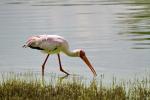
Yellow-billed Stork (not a Spoonbill – quite doff!)
Sugarloaf Campsite in St Lucia was our base for 3 nights. It is a huge camp with 100 sites ideally located right by the sea. It was only about 20% full and the fishermen were well behaved. Watch it on weekends as they can be quite raucous. The three nights was R432 for both of us – very reasonable.
We birded in 3 areas: Eastern and Western Shores and around the campsite.
Western Shores is the newly opened area of the iSimangaliso WetlandPark. It has been very well developed. The habitat is predominantly flat open grassland with outcrops of woodland and forest. There is currently a lot of freestanding water with many wetland areas. There is one hide and a boardwalk to a lookout point overlooking LakeSt Lucia. The picnic site is large, shady and well situated. We spent almost 6 hours there covering the whole road network.
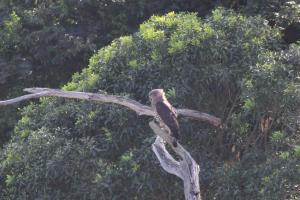
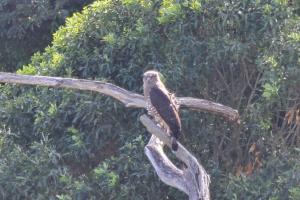
As we approached the hide a herd of elephants – about 15 – saw us and calmly walked away allowing us access. Then at the hide, just as we were about to leave, Sally saw a raptor flying over the pan in front of the hide. Small head and quite barred underside. We got excited. Sally immediately pronounced what she thought it was. The bird then landed in one of the large broad-leafed trees opposite us about 100 metres away. Out came the scope and luckily the bird was not secretly hidden within. On further inspection we had a clear sighting of its head and tail and it was clear that Sally was correct. A lifer for me – a European Honey-Buzzard.
I include some pictures of the habitat and a few of the birds we were lucky enough to photograph. In all we saw 72 species in the 5.5 hours we were there.
Steppe Buzzard
Crested Guineafowl
Crested Guineafowl
European Honey-Buzzard
European Roller
Hamerkops
Hamerkops
Malachite Kingfisher
Red Bishop
Purple-banded Sunbird
Boardwalk
View from the boardwalk deck
View from the boardwalk deck
Western Shores Habitat
Western Shores Habitat – early morning, eerie light
Western Shores Habitat
Western Shores Habitat
Western Shores Habitat
White-backed Ducks
White-eared Barbet
Ashy Flycatcher and young
Black-breasted Snake-Eagle
Black-headed Heron,
Blue-cheeked Bee-eater
Blue-cheeked Bee-eater
Burchell’s Coucal – juvenile begging
Burchell’s Coucal – juvenile
Burchell’s Coucal
Burchell’s Coucal
Eastern Shores. Similar in habitat to the WesternShores but more hilly with coastal forest and the sea and shore. There are 2 bird hides and several lookout points and picnic sites as well as a number of side loops off the main road to CapeVidal. In the past we have seen both White and Black Rhino and Leopards (one right next to the car park for the large new Mafazana hide).
On the Vlei Loop we saw our first raptor – a Southern-banded Snake-Eagle. It was sitting prominently in a bare tree with the sun directly behind it. We had to work hard to get the right angle to see it clearly enough to identify it.
At the Mafazana hide Sally spotted 2 Saddle-billed Storks on top of a distant tree. We wondered if they were starting to breed early!
The other sighting worth mentioning was surprisingly that of a Lilac-breasted Roller. It was the first and only sighting of one on our whole 2 week trip – most unusual.
In all we identified 73 species in the 6 hours we were there.
Southern Banded Snake-Eagle
UI Raptor – have a go at its ID
View from Mafazana Hide
Cape Wagtail
Lilac-breasted Roller
Saddle-billed Storks – could they be nesting so early?
St. Lucia, Sugarloaf Camp and the immediate shore.
On setting up camp the monkeys arrived. There were also a couple of Grey Duiker close by. It was hilarious to watch them interact. One approached the other and the next minute they were all chasing each other around the site. Other aminals seen in the camp included Bushbuck, Red Duiker and interestingly Reedbuck – often paying little attention to us Humans.
Right next to the camp is the boardwalk to the sea and the mouth of LakeSt Lucia. Hippos and Crocs were very evident – just waiting for one of the fishermen to get too close.
On the first afternoon after setting up our camp we headed for a walk on the beach. We were surprised by a Palmnut Vulture which flew over our heads and landed on the inland side of the beach at the mouth of LakeSt. Lucia. We approached slowly watching it nibbling on the base of some of the spindly grass protruding from the muddy edges of the lake – managing to get with 15 metres of it. An unexpected waterbird!
Campsite birding was very good. One R-C R-C (Natal Robin or as Sally says Cossypha Natalensis) joined us for a sundowner doing good imitations of an African Emerald Cuckoo. An African Goshawk landed in the tall pine trees above us to sing his good-bye as we prepared to leave. But probably the highlight was a wonderful view of a male Green Twinspot in vivid plumage.
In all we recorded 57 species in and around the campsite including the walk along the waterfront.
Palmnut Vulture
Palmnut Vulture
Palmnut Vulture
Palmnut Vulture
Palmnut Vulture
Palmnut Vulture
African Goshawk
Common Ringed Plover
Livingston’s Turaco
Livingston’s Turaco
Sadly we returned home to a chilly welcome in a not so sunny Hillcrest.
In total we identified 235 species on our two week odyssey.
If anyone would like a copy of our excel spreadsheet showing which birds we identified in each of the 9 different reserves we visited, then click here to contact me.
Cape Vidal and St. Lucia. 25th to 30th August 2013.
Sally and I went to Cape Vidal campsite for 2 nights followed by 3 at Sugarloaf campsite in St. Lucia. We endured strong wind for all 5 days. Our tent extension was defrocked one night in Cape Vidal and on the last day when we were in Umfolozi.
Despite the wind the weather was pleasantly sunny and not too hot.
The campsite in Cape Vidal was infested with Vervet and Samango monkeys. Turn your back on them at your peril as they will take any food within your arm’s reach if you are not looking – and sometimes even when you are! It is well shaded and mostly flat and sandy. Beware – it is expensive as they charge for 4 people even if there are only 2 of you. It cost the 2 of us R252 a night and that was with a 40% discount! Sugarloaf cost us R324 for the 2 of us for 3 nights (also with a 40% discount).
The Loop road past Lake Bengazi is closed as part of the road has been washed away – apparently sometime ago and there is no sign that it is being repaired.
Sugarloaf Campsite in St. Lucia is located right at the end of the road to the boardwalk beside the estuary leading to the beach. Unfortunately it is a preferred fisherman’s campsite and so to be avoided at the weekends despite it having 100 campsites.
iSimangaliso Wetland Park (Eastern Shores) is one of our preferred parks close to Durban. It has a good variety of game and is known for its leopard sightings. We go for the birds and we were not disappointed this time with excellent sightings of Southern-banded, Black-chested and Brown Snake-Eagles; adult and juvenile Cuckoo Hawks; Collared Pratincoles; etc…
(If you click on an image it will enlarge and you will be able to scroll through the rest of the pictures in that gallery. To return to the text move the mouse cursor to the top left of the screen and click on the “X” when it appears).
Southern-banded Snake-Eagle
Southern-banded Snake-Eagle
Southern-banded Snake-Eagle
African Cuckoo Hawk
African Cuckoo Hawk
African Cuckoo Hawk
Black-chested Snake-Eagle
Juvenile African Cuckoo Hawk
Juvenile African Cuckoo Hawk
Juvenile African Cuckoo Hawk
Juvenile African Cuckoo Hawk
Juvenile African Cuckoo Hawk
Juvenile African Cuckoo Hawk
Collared Pratincole
Collared Pratincole
Collared Pratincole
Collared Pratincole
Collared Pratincole
Female Thick-billed Weaver
Crested Guineafowl
Home Sweet Home
And this is….
African Jacana straight out of the egg!
Saddle-billed Stork
Red-capped Robin-Chat a.k.a. the RC RC bird
Speckled Mousebird
Speckled Mousebird
Sanderling
Sanderlings
Grey-headed Gull
Grey-headed Gull
Samango Monkey – a little off-colour.
Banded Mongooses
Wood Sandpiper
Banded Mongoose inspecting us.
Fiscal Flycatcher
St. Lucia also did not disappoint with a good variety of waterbirds including African Black Oystercatcher, a sea paddling Pied Avocet, Kittlitz’s, White-fronted, Three-banded and Curlew (in partial breeding plumage) Sandpipers, Ruff, Wood and Marsh Sandpipers, Caspian and Swift Terns, Grey-headed Gulls.
African Black Oystercatcher
African Black Oystercatchers
African Black Oystercatchers
African Black Oystercatchers
African Black Oystercatchers
Pied Avocet and Marsh Sandpiper
Caspian Terns
African Stonechat
Ruff
Sea paddling Pied Avocet
A very dishevelled wind-blown Goliath Heron.
Ruff
Three-banded Plover
Kittlitz’s Plover
Kittlitz’s Plover
White-fronted Plover
Curlew Sandpiper in partial breeding plumage
Curlew Sandpiper in partial breeding plumage
Curlew Sandpiper in partial breeding plumage
And this is….
However “la piece de la resistance” was a Sooty Tern amongst a group of other Terns, Gulls and Avocets. It was sheltering on the leeward side of the wind in the estuary.
Sooty Tern among Swift Terns
Sooty Tern
Sooty Tern
Sooty Tern and Swift Tern
If you visit St. Lucia do take a walk along the Gwalagwala Trail early morning. Park in the Office car park. Listen for Woodward’s Batis and Green Malkoha.
The campsite too has a good variety of birds.
Yellow Weaver
Red-capped Robin-Chat
African Stonechat
We spent one day in Umfolozi and were not disappointed despite the extensive burnt areas in the park.
The Bhejane Hide is still under construction so our only alternative was the Mfafa Hide. Recently it has been the source of a number of leopard and lion sightings – however for us it was a number of interesting small birds and a rather large Rock Monitor.
Rock Monitor
Rock Monitor
Some photos taken around the Park:
Yellow-throated Petronia
Tawny-flanked Prinia
Yellow-throated Petronia
Kurrichane Thrush
Spectacled Weaver
Southern Boubou
Brown Snake-Eagle
Brown Snake-Eagle
Red-billed Oxpeckers
Red-billed Oxpeckers
Red-billed Oxpeckers atop an obliging Impala
Red-throated Wryneck
Probably our best viewing area was at the bend of the Umfolozi river at the end past the Cengeni Gate. Here we saw quite a number of raptors: a Lanner Falcon on the river bed, a couple of Lanner Falcons dive bombing a Tawny Eagle with a little help from a pair of African Harrier Hawks and a Yellow-billed Kite not to be left out of the action, Bateleur, Brown Snake-Eagle. There was also a good view of a Southern Ground-Hornbill across the river.
Yellow-billed Kite
Tawny Eagle
Lanner Falcon
Lanner Falcon
Brown Snake-Eagle
Bateleur
Southern Ground-Hornbill
Finally to cap the day we had the following sighting on the way back past the Cengeni Gate. It was no more than 20 metres from us but totally camouflaged. Look at the photos first without enlarging and you will see how easy it is to be missed.
Stunning & Lucky
Stunning & Lucky
Now click on the images and enjoy what we were able to see with the help of our binoculars.
Altogether we saw 88 Species in iSimangalizo (Eastern Shores); 71 species in and around the campsite in St Lucia and 61 species in Umfolozi.







































































































































































 Birds are our Story