Ten birders attended the outing. This bushveld reserve is very dry at the moment, which is to be expected at this time of the year, and it was rather cold to begin with.
Mention must be made of 10-year old Decklan, our “chief” photographer, who handled the camera with a very large lens like a pro and his birding skills weren’t bad either! Well done Decklan. We need youngsters like you in the Bird Club!
The birds were slow to show themselves at first but as we got close to the bottom dam, we had good views of Golden-breasted Bunting, Blue and Common Waxbills, African Firefinch, Common Scimitarbill and Black-crowned Tchagra as well as 2 “teenage” Red-knbobbed Coots with their parents.
Little Grebe – Paul Bartho
Red-knobbed Coot – Paul Bartho
Red-knobbed Coot juvenile – on Golden Pond – Paul Bartho
Then we had a real slog up to the top bird hide. We were anticipating some good birding over the vlei from the hide, but unfortunately the entrance to the hide was overgrown so we decided to go and have our coffee and picnic back at the cars.
The bird count was 55. We need to go back to Bisley in summer to experience the excellent bushveld birding that it is known for!
Paul suggested that we move on to Darvill Sewerage Works and this proved to be a very good decision although it was very, very windy.
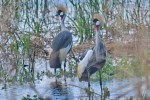
We were treated to two dancing Grey-crowned Cranes! Of special interest was a group of Ruff, one of which still had a partial ruff which none of us had ever seen before! We also had lovely views of an African Marsh-Harrier quartering over the reeds.All three species of teal were present (Cape, Red-billed and Hottentot). The bird count was about 37.
Mid-day today Sally and I went to Cumberland NR to see if we could find the Allen’s Gallinules which Norman Freeman had reported seeing yesterday.
On the water we saw Egyptian Geese, two pairs of Little Grebes and a juvenile, several pairs of Red-knobbed Coots, a number of Common Moorhens and a pair of Purple Swamphens but unfortunately no Allen’s Gallinules – nor were we lucky enough to even hear them.
Purple Swamphens, Common Moorhen and Little Grebe
There were 13 Bald Ibis resting on the roof of the “hide” (more a launching jetty for canoes). Norman also reported seeing them there yesterday.
Bald Ibis
Bald Ibis
Bald Ibis
Bald Ibis
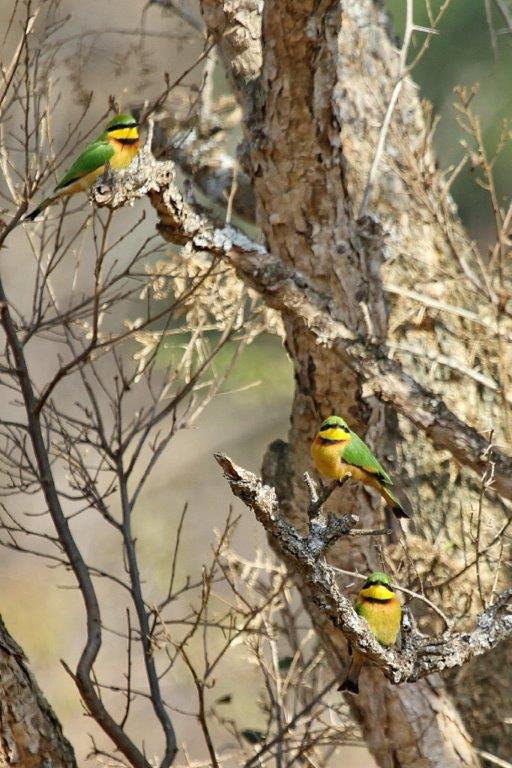
A couple of African Fish-Eagles flew overhead at one point along with another raptor which might have been a Black Sparrowhawk. A lovely group of 3 Little Bee-eaters were in the trees nearby along with a number of other species.
Little Bee-eaters
Sadly, we found a Red-chested Flufftail right beside the start of the jetty – floating in the water. We have brought it home to give to David Allen for the Durban Natural Science Museum.
Two degrees Centigrade at 07h00 at the Hilton College gate did not augur well for a good day’s birding. However the sky was clear and the sun would come out. At the end, the birding was much better than expected.
Four of us descended to the river in one vehicle – Penny de Vries, Cheryl King, Sally and Paul Bartho. Heater full on but with windows open. The four kilometre descent was taken slowly – birding all the way.
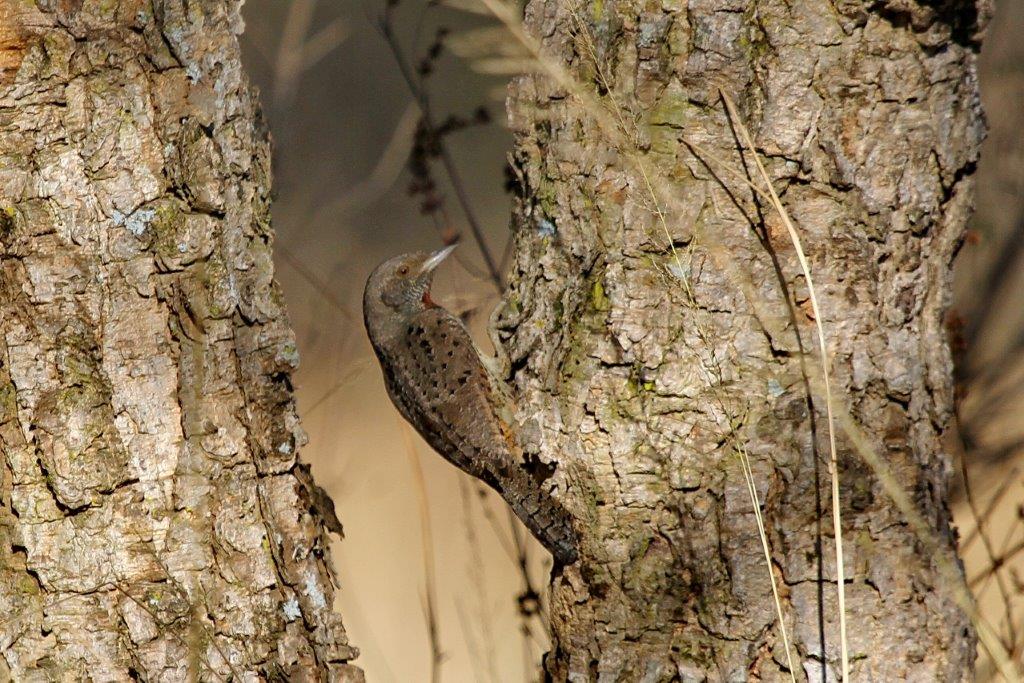
Probably one of the better sightings all day was the Red-throated Wryneck at the entrance to the picnic area where numerous birds held our attention before we eventually arrived there.
Red-throated Wryneck
At the picnic site a cup of tea/coffee was in order. By this time the sun was warming us up and Sri Lanka were 130 something for 5. The picnic site is right by the river with a number of different species flying up and down as we supped our hot beverages.
The following photos give you an idea of the scenery, the river trail, Finfoot Hide and the picnic site:
View up river with the Umgeni Valley NR as background.
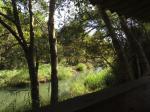
River view from the trail.
Geni’s Junction at the end of the river trail going up river.
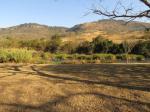
View through the grassland to the escarpment.
Euphorbia in bloom
Interesting trees.
Trail along the river
View from the picnic site across the river to Umgeni Valley NR.
Picnic Site.
View of the river from the Finfoot Hide.
Then we set off following the river upstream along a well-maintained trail. African Firefinch were heard then seen followed by Common Waxbills, Golden-breasted Bunting with Trumpeter Hornbills flying overhead. Of course we kept an eye on the river in hope of seeing an African Finfoot and/or African Black Duck.
Trumpeter Hornbill
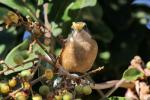
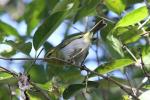
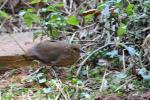
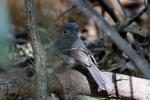
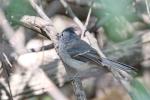
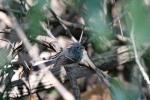
Just before we reached the Finfoot Hide we were held up for about half an hour by a bird party consisting of Yellow-throated Woodland-Warblers, Bar-throated Apalis, Cape Batis and this unidentified species which eluded all our attempts to get a great sighting. Full grey head to just below the eye, white throat, greeny-yellow stomach and green back. Anyone got any ideas? If so please let us know. The closest we came to identifying the bird was that it could be a Bar-throated Apalis without the bar or an Eremomela way out of range.
Unknown Species. The beak points down just to the left of the green leaf. It’s eye can be seen just behind the twig running across its face.
Yellow-throated Woodland-Warbler
Tawny-flanked Prinia
Cardinal Woodpecker
The Finfoot hide overlooks a small patch of the river but nothing special was observed there at that time.
On we clambered along the path by the river keeping our eyes out for a Bushveld Pipit which had been seen previously – no luck. More African Firefinches were seen and Lazy Cisticola heard and seen. Then we came across a pair of Swee Waxbills which, caught in the sunshine, radiantly showed off their colours.
Eventually we came to the end of the trail at Geni’s Junction – another large open area well treed. Here a number of Robins got our attention but only the Cossypha natalensis was positively identified.
The return journey was made in quick time – it was late in the morning and there was not much to grab our attention.
We made a quick detour to visit to the hide as we passed – very fortunate timing as there were two African Black Ducks swiftly swimming up-river. And further along another three were seen flying down-river.
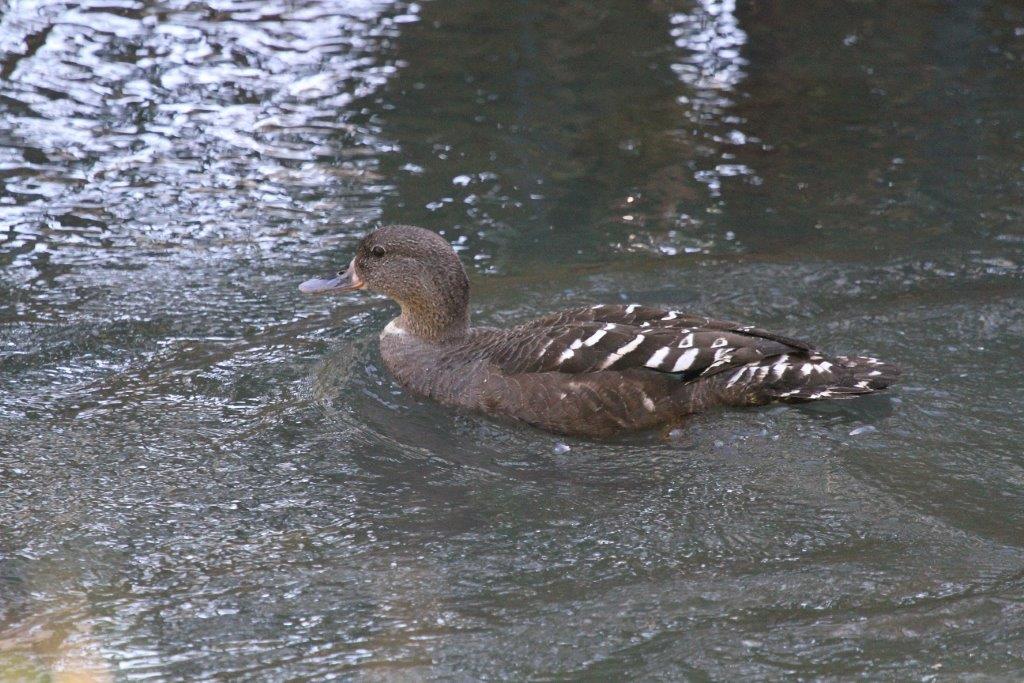
African Black Duck
While having a bite to eat by the river at the picnic site a Burchell’s Coucal made a brief appearance.
Then on the drive back up the hill a Black-crowned Tchagra sat quietly in a tree close-by giving us excellent views. And an African Fish-Eagle gave us an overpass as we reached the top – the only raptor we had seen all morning.
By the time we reached the top we had a bird list of 60 seen and/or heard. Click here to see the bird list.
This is a great venue and worth visiting in the summer when the migrants return.
We are sparkling here currently in Pigeon Valley NR. People are coming to see the Buff-spotted Flufftails, which are very obliging while conditions are so dry. While at the spot most likely to see them, I have also had great views of a confiding Narina Trogon, persistent attention from the Blue-mantled Crested-Flycatcher female, African Firefinches, very friendly Yellow-rumped Tinkerbirds, and a bird yesterday that I and another watcher did not see well enough to be sure – she think it could be a Greater Honeyguide juvenile.
Buff-spotted Flufftail
Buff-spotted Flufftail
Buff-spotted Flufftail
Buff-spotted Flufftail
Buff-spotted Flufftail
Buff-spotted Flufftail – female
Bar-throated Apalis
Collared Sunbird
Southern Boubou
Southern Boubou
Spotted Ground-Thrush
Spotted Ground-Thrush
Blue-mantled Crested-Flycatcher
Blue-mantled Crested-Flycatcher
Blue-mantled Crested-Flycatcher
We have also had a rare visit from a Grey-headed Bush-Shrike.
But perhaps the most spectacular was when 25 of us on the BirdLife Port Natal outing to Pigeon Valley started the walk and then watched as a Scaly-throated Honeyguide tried to take over a Cardinal Woodpecker nesting hole in a branch over the main path just after the map. It was unflustered by the onlookers, as it tried persistently, at one point locking bills with the female Cardinal Woodpecker in the nest.
Scaly-throated Honeyguide
Scaly-throated Honeyguide
Cardinal Woodpecker
Later in the morning, most of the BirdLife members stood and watched the male and female Buff-spotted, as a way of ending the morning.
One of the Red Duikers has died; I had a look at the body this morning; it is a bit decayed, but potentially it was taken by a Crowned Eagle; maybe I will be able to see the right eye socket a bit later to see if there are the marks of a talon.
I am getting emails that I am often not good at responding to, asking for co-ordinates of Pigeon Valley, and whether it is safe. There are no guarantees of course, but I am not aware of any recent problem incidents, at all.
Co-ordinates are 29° 51′ 52″ S, 30° 59′ 19″ E
Despite the new hide being burnt down earlier this month, this venue is still probably one of the best viewing sites to see Cape Vultures.
The new hide is already being rebuilt through the generosity of a local builder and when complete will be about 40 metres from the restaurant with excellent viewing over level ground.
Not only will it be possible to watch the vultures carnivoring the carcasses from the hide but it is also possible to walk to the edge of the cliff and see the nesting sites below and watching the vultures catch the thermals and gliding past within metres.
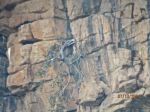
Vulture nesting sites
View from the top of the cliff face
View from the top of the cliff face
View from the top of the cliff face
Open ground to walk across to the cliff face with the vulture restaurant on the left.
Currently there are over 30 nesting sites and in total more than 120 Cape Vultures have been counted at this site – including many juveniles thought to have come from elsewhere.
If you visit please look out for shoulder tags on the birds and report these sightings to your guide.
The site is located on the private property of a local farmer and can only be visited by booking through BirdLife Trogons – www.vulturehide.blogspot.com.
Sunrise reflection on the water at the river mouth.
On Sunday 13th July 06h45, twenty-one intrepid birders gathered together by the Umgeni River mouth at the Green Hub – the centre of the Durban Green Corridor initiative.
The Green Corridor initiative has created a guided tour for birders to explore the Umgeni River venturing into areas many people would be hesitant to visit on their own.
This tour is known as the Finfoot Loop – why? Because the African Finfoot is regularly seen – right here in the eThekwini municipality.
The first part of the morning was spent birding the river mouth whilst we waited for our guide.
Birding the river mouth pre-dawn
Numerous birds were seen including Cape Cormorants, Pink-backed Pelicans, Kittlitz’s and White-fronted Plovers, Grey-headed Gulls and Swift Terns as well as many other waterbirds. Even a Black Sparrowhawk sat patiently in one of the palm trees while photos were taken.
Cape Cormorant
Cape Cormorant
Caspian Tern
Kittlitz’s Plover
Pink-backed Pelican
Pink-backed Pelicans
African Pied Wagtail
Black Sparrowhawk
Black Sparrowhawk
Eventually, with all of us loaded into 8 vehicles, we set off. Joe – our guide – was in the lead car.
Joe took us away from the metropolitan area into the Umgeni Valley following the river towards the Inanda Dam. Every so often we stopped at appropriate places to bird.
Our first stop was at the large new Kwadebeka bridge over the river on the M25.
Kwadebeka Bridge over the Umgeni River
Kwadebeka Bridge over the Umgeni River
View from the Kwadebeka Bridge over the Umgeni River
We had views up and down river from up on high; after which we drove down to a place below the bridge and spent some time birding up close to the river. Here we saw a female Klaas’s Cuckoo, a lifer for some, and both Mountain and Pied Wagtails hopping amongst the rocks. Mocking Cliff-chats abounded in this particular spot as two Giant Kingfishers flew up and down the river. As we were leaving, we saw a Purple-banded Sunbird.
Below Kwadebeka Bridge
Below Kwadebeka Bridge
Below Kwadebeka Bridge
Below Kwadebeka Bridge
Below Kwadebeka Bridge
Below Kwadebeka Bridge
Below Kwadebeka Bridge
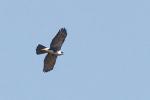
Jackal Buzzard
Lanner Falcon
He wasn’t visiting was he?
Some of the bridges gave us good opportunities to make sure we knew the difference between Rock Martins and Brown-throated Martins. We were a little surprised to see African Palm Swift too, in the absence of any palm trees.
Goliath Heron
Goliath Heron in flight
Purple Heron
Cape Rock-Thrush
Cape Rock-Thrush
Village Weavers
Cape Rock-Thrush
Black Sparrowhawk in flight
African Fish-Eagle
African Black Duck
Southern Black Flycatchers
Rock Dassie
Mountain Wagtail
Mountain Wagtail
Martial-Eagle_Lanner-Falcon_8589_s
Little Grebes
Little Bee-eater
Hamerkop
In all we stopped at 7 different locations along the river to bird; sometimes parking on the road by the river and at other times driving off the road a short distance. The local people we met were all very friendly.
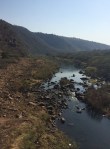
The scenery is also stunning with the river running through gorges, lovely rolling hills, sheer cliffs and many indigenous trees. Of course, it was very dry being winter. Litter was bad in some areas but as we progressed further inland, it became less obvious.
birding in action
birding in action
birding in action
Scenery
Scenery
Scenery
Scenery
Scenery
birding in action
birding in action
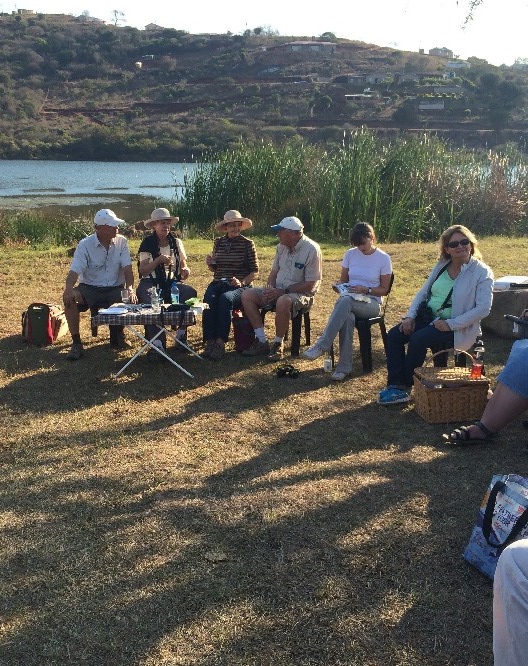
Tea Break
Tea Break
Tea Break
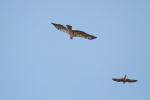
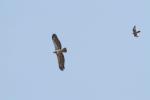
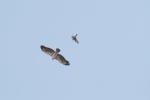
Crossing over a mountainous area from one stopping point to another we were treated to an aerial display of a juvenile Martial Eagle being bombed by a Lanner Falcon.
Martial Eagle being attacked by Lanner Falcon 1
Martial Eagle being attacked by Lanner Falcon 2
Martial Eagle being attacked by Lanner Falcon 3
Martial Eagle being attacked by Lanner Falcon 4
Martial Eagle being attacked by Lanner Falcon 5
Martial Eagle being attacked by Lanner Falcon 6
Martial Eagle being attacked by Lanner Falcon 7
Martial Eagle being attacked by Lanner Falcon 8
Martial Eagle being attacked by Lanner Falcon 9
Martial Eagle being attacked by Lanner Falcon 10
Martial Eagle -second attack 1
Martial Eagle -second attack 2
Martial Eagle -second attack 3
Martial Eagle -second attack 4
Martial Eagle -second attack 5
Martial Eagle -second attack 6
Martial Eagle -second attack 7
Martial Eagle -second attack 8
It was at the last bridge crossing below the Inanda Dam wall that the African Finfoot was eventually spotted by a small number of the group. Unfortunately it was some distance away and moving upstream quite quickly and out of sight. Despite many of us going to the area where it was seen, none of the rest of us spotted it.
Inanda Dam
Inanda Dam
View down river
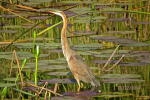
Purple Heron
Where is the African Finfoot?
The final venue was the picnic site at eNanda Adventures on the Inanda Dam – about 4 km NE from the dam wall. We arrived about 14h00 for our picnic and braai. Tables and chairs were quickly brought out for us as well as a couple of braais.
Braai time at eNanda Adventures Picnic ground
After the braai the remaining group of five vehicles crossed the same bridge where the African Finfoot was spotted earlier. As they crossed, one of the group – Geoff- spotted the Finfoot. Mad panic ensued with all the vehicles stopping on the bridge, doors being flung open, bodies tumbling out and there in all its splendour the African Finfoot calmly swam up to and onto a close-by rock for all to view.
Madness erupts as the African Finfoot is spotted.
The day was well organised and well guided. The birding was excellent for the time of year and over 90 different species were seen.
Full Moon ending a perfect day
Photographs submitted by: Crystelle Wilson, Penny de Vries; Rex Aspeling; Paul Bartho
We met @ 07h00 at the Simbithi main gate and, then drove to the Heron Centre to park. The two Simbithi residents then guided us on a trail which passed along a well covered section of riverine bush, through some open grassland to a valley with two dams on a perennial seep. The top dam had a Fulvous Duck swimming on it and the lower one had been the favourite haunt of a White-backed Duck the previous week, but which was not evident when we were there.
After the walk of about 3km, we arrived back at the Heron Centre to have a very comfortable breakfast on the veranda of the centre overlooking a large dam.
Mike White
Photos of some of the birds seen, courtesy of Rex Aspeling:
Simbithi Estate
Simbithi Gathering
Wire-tailed Swallow
Perplexies
Purple Heron
Simbithi Bush birders
Fulvous Duck
Fulvous Duck
Fulvous Duck
Fulvous Duck showing back of head.
In total we saw about 70 different birds of the estate which lists nearly 200 species.
































































 Birds are our Story