Despite the new hide being burnt down earlier this month, this venue is still probably one of the best viewing sites to see Cape Vultures.
The new hide is already being rebuilt through the generosity of a local builder and when complete will be about 40 metres from the restaurant with excellent viewing over level ground.
Not only will it be possible to watch the vultures carnivoring the carcasses from the hide but it is also possible to walk to the edge of the cliff and see the nesting sites below and watching the vultures catch the thermals and gliding past within metres.
Vulture nesting sites
View from the top of the cliff face
View from the top of the cliff face
View from the top of the cliff face
Open ground to walk across to the cliff face with the vulture restaurant on the left.
Currently there are over 30 nesting sites and in total more than 120 Cape Vultures have been counted at this site – including many juveniles thought to have come from elsewhere.
If you visit please look out for shoulder tags on the birds and report these sightings to your guide.
The site is located on the private property of a local farmer and can only be visited by booking through BirdLife Trogons – www.vulturehide.blogspot.com.
Sunrise reflection on the water at the river mouth.
On Sunday 13th July 06h45, twenty-one intrepid birders gathered together by the Umgeni River mouth at the Green Hub – the centre of the Durban Green Corridor initiative.
The Green Corridor initiative has created a guided tour for birders to explore the Umgeni River venturing into areas many people would be hesitant to visit on their own.
This tour is known as the Finfoot Loop – why? Because the African Finfoot is regularly seen – right here in the eThekwini municipality.
The first part of the morning was spent birding the river mouth whilst we waited for our guide.
Birding the river mouth pre-dawn
Numerous birds were seen including Cape Cormorants, Pink-backed Pelicans, Kittlitz’s and White-fronted Plovers, Grey-headed Gulls and Swift Terns as well as many other waterbirds. Even a Black Sparrowhawk sat patiently in one of the palm trees while photos were taken.
Cape Cormorant
Cape Cormorant
Caspian Tern
Kittlitz’s Plover
Pink-backed Pelican
Pink-backed Pelicans
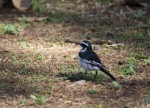
African Pied Wagtail
Black Sparrowhawk
Black Sparrowhawk
Eventually, with all of us loaded into 8 vehicles, we set off. Joe – our guide – was in the lead car.
Joe took us away from the metropolitan area into the Umgeni Valley following the river towards the Inanda Dam. Every so often we stopped at appropriate places to bird.
Our first stop was at the large new Kwadebeka bridge over the river on the M25.
Kwadebeka Bridge over the Umgeni River
Kwadebeka Bridge over the Umgeni River
View from the Kwadebeka Bridge over the Umgeni River
We had views up and down river from up on high; after which we drove down to a place below the bridge and spent some time birding up close to the river. Here we saw a female Klaas’s Cuckoo, a lifer for some, and both Mountain and Pied Wagtails hopping amongst the rocks. Mocking Cliff-chats abounded in this particular spot as two Giant Kingfishers flew up and down the river. As we were leaving, we saw a Purple-banded Sunbird.
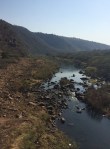
Below Kwadebeka Bridge
Below Kwadebeka Bridge
Below Kwadebeka Bridge
Below Kwadebeka Bridge
Below Kwadebeka Bridge
Below Kwadebeka Bridge
Below Kwadebeka Bridge
Jackal Buzzard
Lanner Falcon
He wasn’t visiting was he?
Some of the bridges gave us good opportunities to make sure we knew the difference between Rock Martins and Brown-throated Martins. We were a little surprised to see African Palm Swift too, in the absence of any palm trees.
Goliath Heron
Goliath Heron in flight
Purple Heron
Cape Rock-Thrush
Cape Rock-Thrush
Village Weavers
Cape Rock-Thrush
Black Sparrowhawk in flight
African Fish-Eagle
African Black Duck
Southern Black Flycatchers
Rock Dassie
Mountain Wagtail
Mountain Wagtail
Martial-Eagle_Lanner-Falcon_8589_s
Little Grebes
Little Bee-eater
Hamerkop
In all we stopped at 7 different locations along the river to bird; sometimes parking on the road by the river and at other times driving off the road a short distance. The local people we met were all very friendly.
The scenery is also stunning with the river running through gorges, lovely rolling hills, sheer cliffs and many indigenous trees. Of course, it was very dry being winter. Litter was bad in some areas but as we progressed further inland, it became less obvious.
birding in action
birding in action
birding in action
Scenery
Scenery
Scenery
Scenery
Scenery
birding in action
birding in action
Tea Break
Tea Break
Tea Break
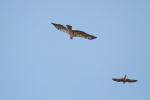
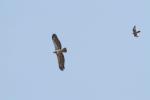
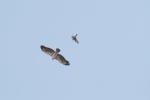
Crossing over a mountainous area from one stopping point to another we were treated to an aerial display of a juvenile Martial Eagle being bombed by a Lanner Falcon.
Martial Eagle being attacked by Lanner Falcon 1
Martial Eagle being attacked by Lanner Falcon 2
Martial Eagle being attacked by Lanner Falcon 3
Martial Eagle being attacked by Lanner Falcon 4
Martial Eagle being attacked by Lanner Falcon 5
Martial Eagle being attacked by Lanner Falcon 6
Martial Eagle being attacked by Lanner Falcon 7
Martial Eagle being attacked by Lanner Falcon 8
Martial Eagle being attacked by Lanner Falcon 9
Martial Eagle being attacked by Lanner Falcon 10
Martial Eagle -second attack 1
Martial Eagle -second attack 2
Martial Eagle -second attack 3
Martial Eagle -second attack 4
Martial Eagle -second attack 5
Martial Eagle -second attack 6
Martial Eagle -second attack 7
Martial Eagle -second attack 8
It was at the last bridge crossing below the Inanda Dam wall that the African Finfoot was eventually spotted by a small number of the group. Unfortunately it was some distance away and moving upstream quite quickly and out of sight. Despite many of us going to the area where it was seen, none of the rest of us spotted it.
Inanda Dam
Inanda Dam
View down river
Purple Heron
Where is the African Finfoot?
The final venue was the picnic site at eNanda Adventures on the Inanda Dam – about 4 km NE from the dam wall. We arrived about 14h00 for our picnic and braai. Tables and chairs were quickly brought out for us as well as a couple of braais.
Braai time at eNanda Adventures Picnic ground
After the braai the remaining group of five vehicles crossed the same bridge where the African Finfoot was spotted earlier. As they crossed, one of the group – Geoff- spotted the Finfoot. Mad panic ensued with all the vehicles stopping on the bridge, doors being flung open, bodies tumbling out and there in all its splendour the African Finfoot calmly swam up to and onto a close-by rock for all to view.
Madness erupts as the African Finfoot is spotted.
The day was well organised and well guided. The birding was excellent for the time of year and over 90 different species were seen.
Full Moon ending a perfect day
Photographs submitted by: Crystelle Wilson, Penny de Vries; Rex Aspeling; Paul Bartho
We met @ 07h00 at the Simbithi main gate and, then drove to the Heron Centre to park. The two Simbithi residents then guided us on a trail which passed along a well covered section of riverine bush, through some open grassland to a valley with two dams on a perennial seep. The top dam had a Fulvous Duck swimming on it and the lower one had been the favourite haunt of a White-backed Duck the previous week, but which was not evident when we were there.
After the walk of about 3km, we arrived back at the Heron Centre to have a very comfortable breakfast on the veranda of the centre overlooking a large dam.
Mike White
Photos of some of the birds seen, courtesy of Rex Aspeling:
Simbithi Estate
Simbithi Gathering
Wire-tailed Swallow
Perplexies
Purple Heron
Simbithi Bush birders
Fulvous Duck
Fulvous Duck
Fulvous Duck
Fulvous Duck showing back of head.
In total we saw about 70 different birds of the estate which lists nearly 200 species.
Note that you can double click on the photos to enlarge them.
If you would like me to send you a copy of our bird list – what Sally and I saw and where then click here to email me.
Sally and I recently returned from a nine day trip into Southern Mozambique. We went with Grahame Snow (our guide) of Reach Africa and three others – Pat Nurse, Joan Saggers and Andre Pienaar.
The purpose of the trip was to explore the Limpopo Floodplains; Panda forest and nearby floodplains; and the Bobiane-Unguana thickets. Our goal: to find the specials in each area as well as those birds which we do not see regularly back home. The two main specials included the Olive-headed Weaver and the Eastern Green Tinkerbird. Because of the time of year we also had our eyes out the Mascerene Martin and Malagasy Pond-Heron. The Eurasian Bittern was another hopeful in the numerous floodplains.
The day before we departed we drove to Johannesburg and stayed overnight in a B&B (My Home in Joburg) close to Grahame’s home. Arriving early we were able to spend a couple of hours in Walter Sisulu Botanic Gardens.
Bokmakerie
Bokmakerie
Cape Robin-Chat
Cape Sparrow
Cape Weaver
Cape White-eye
Cape White-eye
Helmeted Guineafowl
Karoo Thrush
Karoo Thrush
Karoo Thrush
Spectacled Mousebird
Streaky-headed Seedeater
Streaky-headed Seedeater
Verreaux’s Eagle on nest
Walter Sisulu Waterfall
Wattled Lapwing
Wattled Lapwing
The early start from Johannesburg got us away before rush hour. We reached Komatiport just after midday and got through the border quite quickly – perhaps because it was mid week and out of school holidays.
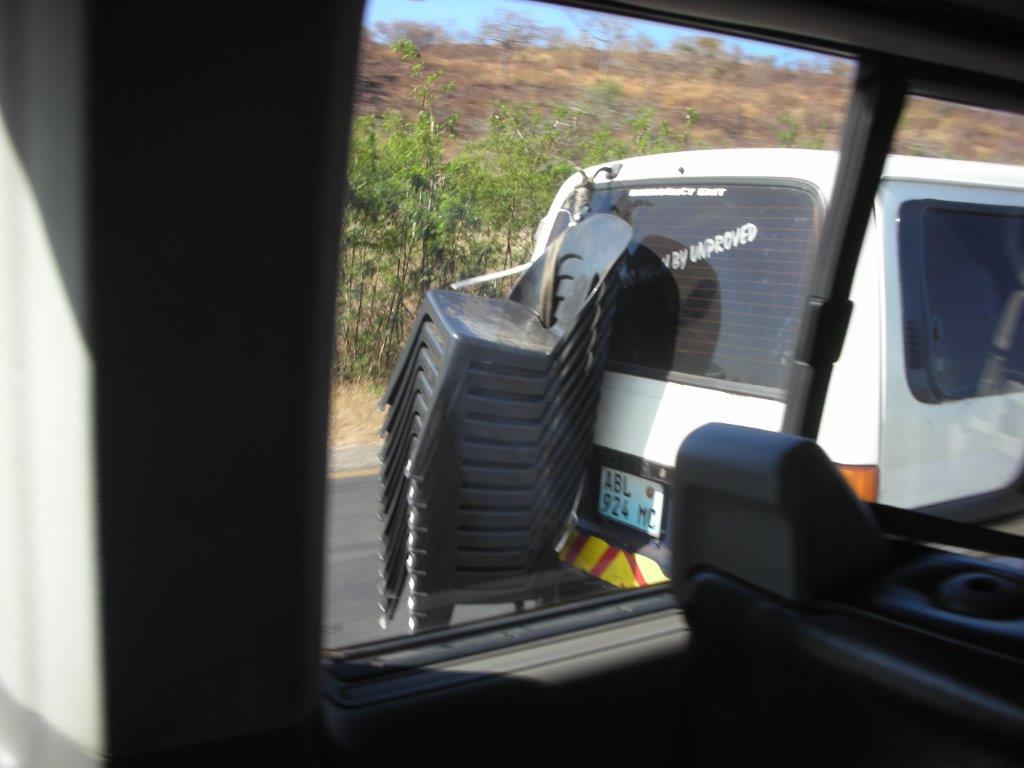
All taxis were similarly loaded as we entered Mozambique.
Instead of travelling via Maputo to our first stopover just north of Xai Xai, Grahame took us north from Moamba towards the small village of Sabie then NE to Magude and then east to join the EN1 and on to Xai Xai. This route is rough in places and mostly gravel all the way. The route is quiet and we were able to bird as we travelled.
The railway bridge shared by vehicles travelling in either direction!
Zona Braza 10 kms off the main road 30 kms north of Xai Xai was our overnight stop. We arrived quite late. The accommodation was very pleasant and the food at the restaurant very tasty.
The next morning we were up for an early morning walk around the camp and down to a rather large water-lily covered pan. There were numerous water birds including many African Pygmy-Geese and Southern Pochard. Black-throated Wattle-eye and Brown Scrub-Robin also entertained us.
Greater Crested Grebe – seen en route before Komatiport.
The Long Chinese-made EN1.
Entrance to Zona Braza
The vehicle in front of our chalets
View from one of the Chalets
View from one of the Chalets
Small Lake at Zona Braza- covered in Waterlilies
African Pygmy Geese
African Pygmy Geese
African Pygmy Goose
Southern Pochard
Brown Scrub-Robin
Interesting Caterpillar
After breakfast we headed to Morrungulo Bay – our luxury lodge for the next three nights – north of Inhambane close to Massinga.
The sandy road to Morrungulo Bay Lodge
Morrungulo Bay Lodge
Morrungulo Bay Lodge
The lodge we stayed at
View from the Deck
Steps down to the beach
Prior to arriving at the lodge we went looking for the Spinetails some 50 kms north of our turnoff for the lodge – near a village called Nhanchengue. Both the Mottled and Bohm’s Spinetails were seen circling the many large baobabs.
Mottled Spinetail
Bohm’s Spinetail
Bohm’s Spinetail
Bohm’s Spinetail
Bohm’s Spinetail
Mosque Swallows also seen in the Boababs
This detour was made to secure the first 2 specials of the trip.
The next three mornings the wake-up call was well before the sparrows so that we could arrive at the Bobiane-Unguana thickets by 06h30 – an hour’s drive away.
Some pictures of the habitat in the area:
The Eastern Green Tinkerbird our main goal. We searched 3 or 4 different locations where it had been seen before but had no luck in finding the bird – although we did hear the call once.
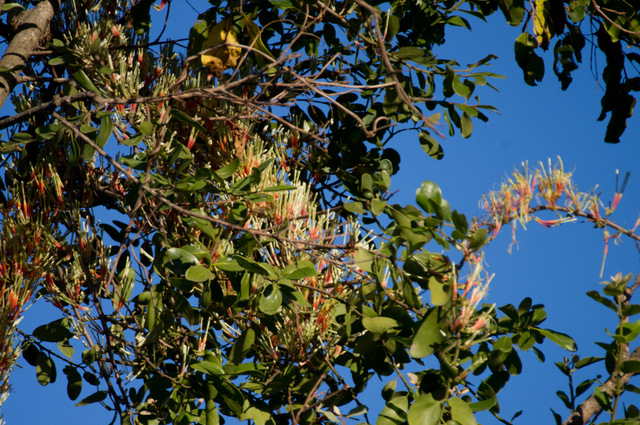
Grahame showed us the Eastern Green Tinkerbird’s nest recently found – see pictures. It was the unusual red seeds sticking to the bark which attracted attention to finding the nest. (Read all about this nest in the latest edition of Africa Birds and Birding.)
Eastern Green Tinkerbird’s Nest
Eastern Green Tinkerbird’s Nest
Eastern Green Tinkerbird’s Nest
One morning we were greeted by the call of the East Coast Akalat. We searched in vain and despite it being very close we were unable to spot it. Grahame had heard it in the area on a number of occasions but had never seen it. The following day we tried again and eventually Sally saw it on a low branch in the thickets and I managed to see it as it flew away. None of the others were so lucky unfortunately – a lifer for both Sally and me. Everyone else except Joan had seen it elsewhere.
Several butterflies were seen (and identified by amateurs) including the following:
Gold-banded Forester
Twin Dotted Border
Great Emperor
Great Emperor
Guineafowl
Guineafowl
Cambridge Vagrant
Common Joker
The habitat destruction here and in Panda Forest has been the subject of an earlier posting – “The Sadness of Mozambique’s Forests” so I will not repeat myself in this report.
Other birds photographed in the area include:
Crowned Hornbill
Magpie Mannikin
Red-backed Mannikin
Black Saw-wings.
Brown-headed Parrot
Red-throated Twinspot – male
Red-throated Twinspot – female
Cuckoo Hawk
Klaas’s Cuckoo
Klaas’s Cuckoo
Lizard Buzzard
Lizard Buzzard
Neergaard’s Sunbird
Neergaard’s Sunbird
Neergaard’s Sunbird
Purple-banded Sunbird – juv male with eyebrow
Purple-banded Sunbird – juv male with eyebrow
Purple-banded Sunbird
Purple-banded Sunbird
Amethyst Sunbirds
Yellow-breasted Apalis
Pale Flycatcher
Magpie Mannikin
Yellow-rumped Tinkerbird
Yellow-rumped Tinkerbird
There was one other beautiful bird which a number of us had as a lifer- the Livingstone’s Flycatcher. It was incessantly on the move making it very hard to get a decent photograph.
Livingstone’s Flycatcher
Livingstone’s Flycatcher
Eventually it was time to move on. Back south to Caju Afrique “close” to Panda for our next three nights. Caju Afrique -where we stayed – is inland from Inharrime off the road to Panda. There are a number of lodges and a couple of full facility campsites – all overlooking the Inharrime River which was very broad at this point and looked like a lake, complete with small dhows and rowing boats
Caju Afrique
The lodge
View from the deck
View from the deck.
Habitat around the lodge
Local Habitat
On route from Morrungulu we stopped at Chucuque near the ferry across to Inhambane where we were treated to the sight of a flock of Greater Flamingos in the foreground of a passing Dhow with Inhambane as the background. A couple of Pied crows in display and a lovely Scarlet-chested Sunbird entertained us.
Dhow and Flamingos – opp Inhambane
Pied Crows on heat
Scarlet-chested Sunbird
Wetland area on exit to EN1 from Morungulu accommodation
Overload! A common sight with as many as 30 people!
Palm tree highways.
The road to the lodge is very colourful – check these photos:
Sand track to Caju
Treacherous middelmannetjie on way to Caju
Speaks for itself – scene on a passing wall.
Speaks for itself – scene on a passing wall.
Speaks for itself – scene on a passing wall.
Although the lodge is basic it does have hot water, power when we want it and friendly staff. In fact everyone we met was exceptionally friendly and helpful.
Again each morning it was up early – even earlier on the first day as Panda is almost two hours driving away and we wanted to be there at first light.
We set off into the “forest” and listen out for bird parties. Very soon we hear our first and see White-breasted Cuckooshrikes, White-crested Helmetshrikes, Southern Black Tits all moving fast from one tree to the next. We try to keep up and catch glimpses of the birds as they move through the trees – but no Olive-headed Weaver.
We get sightings of a number of interesting species – Pale Batis, Southern Hyliota, Black Cuckooshrikes, Retz’s Helmetshrikes, Shikra, Striped Kingfisher, Purple-banded and Scarlet-chested Sunbirds, Yellow-fronted Tinkerbirds, Red-headed Weavers and Bearded Woodpeckers. As well as witnessing two male Cardinal Woodpeckers vying for position over a female.
Bearded Woodpecker
Black-crowned Tchagra
Black-headed Oriole
Brown-headed Parrot
Striped Kingfisher
Striped Kingfisher
White-breasted Cuckooshrike
White-breasted Cuckooshrike
Yellow-rumped Tinkerbird
Retz’s Helmetshrikes
Common Scimitarbill
Retz’s Helmetshrikes
Southern Hyliota
Pale Batis – male
Pale Batis – female
Further into the forest we come across many large open clearings where the trees have been logged out. And, it was on the edge of one such clearing that we find our first pair of Olive-headed Weavers – a male and female.
Olive-headed Weaver
Olive-headed Weaver
Olive-headed Weaver
Olive-headed Weaver
Olive-headed Weaver
Olive-headed Weaver
Olive-headed Weaver – female
We look out for Chestnut-fronted Helmetshrikes without success but do eventually find a flock of five or six Racket-tailed Rollers.
Racket-tailed Roller
Racket-tailed Rollers
Racket-tailed Rollers
One the way back we notice all the wetland areas we passed by in the early morning and we check out several to return to. Grahame goes waist deep in one place and flushes out Lesser Jacana.
Exploring the wetlands
Exploring the wetlands
The next morning we head for the most promising wetland area with a view to seeing an Eurasian Bittern. Wet grass and wet feet as we trample through the wetland – Grahame knee high in the water and Andre with the other end of the rope hoping to raise an Eurasian Bittern.
African Snipes everywhere, Lesser Jacana make appearances, Rosy-throated Longclaws give us aerial displays, Shelley’s Francolins call vociferously “Drink your beer, Drink your beer”. Rufous-bellied Herons appear and fly overhead – but no Bittern.
Rosy-throated Longclaw
Rosy-throated Longclaw
Rosy-throated Longclaw
Rosy-throated Longclaw
Rosy-throated Longclaw
Rufous-bellied Heron
Rufous-bellied Heron
Rufous-bellied Heron
Rufous-bellied Heron
Rufous-bellied Heron
Rufous-bellied Heron
Rufous-bellied Heron
Rufous-winged Cisticola
Squacco Heron – fooling us into a hopeful Malagasy Pond Heron
Squacco Heron – fooling us into a hopeful Malagasy Pond Heron
Squacco Heron – fooling us into a hopeful Malagasy Pond Heron
Squacco Heron – fooling us into a hopeful Malagasy Pond Heron
Squacco Heron – fooling us into a hopeful Malagasy Pond Heron
Squacco Heron – fooling us into a hopeful Malagasy Pond Heron
Little Bee-eater
Lesser Jacana
Lesser Jacana
Lesser Jacana
Great Egret
Blacksmith Lapwing – bombing us
Little Rush-Warbler
Grahame and Andre wander ever deeper into the wetland and eventually after several hours turn round and head back still dragging the rope between them. We get to the shorter grass plodding back through the wet when suddenly we hear this huge roar as Grahame yells at the top of his voice “Bittern”. Immediate unbelievable response from all of us – we watch this huge bird not more than 50 metres away and flying away from us. We watch as the bird languidly flaps into the middle of the wetland. Another lifer for all of us.
Eurasian Bittern – photographed just before it went down.
During the course of the day we lunched beside the road next to a clump of woodland – which was teeming with birds.
Purple-banded Sunbird
Purple-banded Sunbird
Purple-banded Sunbird
Pale Flycatcher
Lilac-breasted Roller
Collared Palm-Thrush
Scarlet-chested Sunbird
Scarlet-chested Sunbird
Scarlet-chested Sunbird
Purple-crested Turaco
Purple-crested Turaco
Purple-crested Turaco
Birds photographed as we travelled in this area:
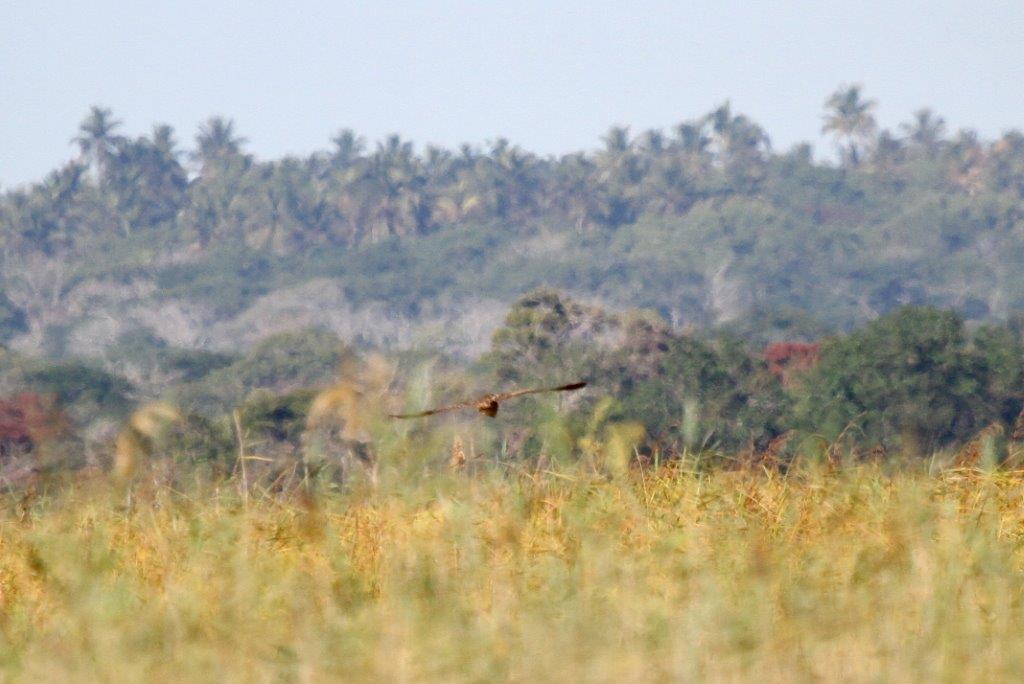
African Marsh Harrier
African Pipit trying to fool us into thinking it may be a Tree Pipit!
Black-bellied Bustard
Dickinson’s Kestrel – seen next to the road on the way south.
Dickinson’s Kestrel – seen next to the road on the way south.
Dickinson’s Kestrel – seen next to the road on the way south.
Lizard Buzzard
Then we headed south once again, through the exceptionally crowded town of Xai Xai to the Honey Pot, our overnight accommodation. We took the opportunity to visit the Limpopo floodplain after dropping off the trailer and before checking in as it was getting late. We returned there early in the morning before departing to Johannesburg.
Limpopo Floodplain
Limpopo Floodplain
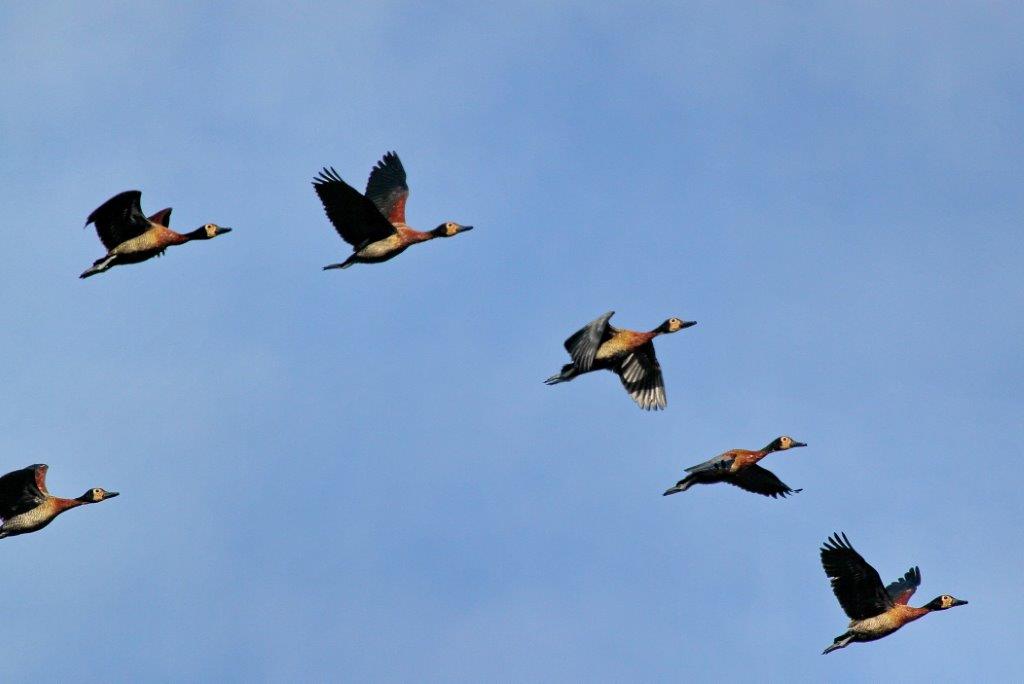
We were treated to a number of birds we had not seen on the trip including Collared Pratincole, Allen’s Gallinule (lifer for Joan), Fulvous Duck, Goliath Heron, African Sacred and Glossy Ibis, Brown-throated Martin (we tried our best to convert some into Mascerene), Black-crowned night-Heron, Three-banded and Kittlitz’s Plovers, African Spoonbill, Wattled Starlings, Grey-rumped Swallows and Hottentot Teal.
After sunset we had an appearance of many Nightjars which we believe to have been both Square-tailed and Swamp Nightjars.
Common Waxbill
Common Waxbill
Common Waxbill
Rufous-winged Cisticola
Squacco Heron
African Spoonbill
Allen’s Gallinule
Black-crowned Night-Heron
Fan-tailed Widowbirds – male and female
Hottentot Teals
Kittlitz’s Plover
Collared Pratincole
Collared Pratincole
Purple Swamphen
Purple Swamphen
Purple Swamphen
Finally it was time to head home. So after a quick squizz at the floodplain and a bit of breakfast off we set following our tracks back to Johannesburg.
Seen along the way;
Brimstone Canary
Senegal Lapwing
Senegal Lapwing
Red-faced Cisticola
Red-faced Cisticola
TFP or Cisticola
Eventually we arrived well after dark.
It was a fantastic trip with good company and an excellent Guide. Hectic at times but that is birding. Would love to return to find all those specials we dipped on.
Mozambique’s forests are rapidly disappearing. This does not augur well for the indigenous birds which depend on these forests – the Green Tinkerbird (Unguana), the Olive-headed Weaver (Panda), the Green-headed Oriole (Mount Gorongoza).
Sally and I have just returned from a trip into Mozambique and saw the ongoing destruction of the Panda forest and the forests at Unguana – near Massinga.
In the Unguana forest:
Looks like a series of poles to hold a net
Looks like a series of poles to hold a net. There were a series of these pathways (at least 8) along one section of road
All that remains of the trees directly behind the 3 bags of charcoal. These pits are seen everywhere in the forest.
Logging – presumably as fire wood.
And now Panda:
Panda forest – tree barking – seen wherever we walked.
Panda Forest!
Panda Forest! – Looking in the other direction
As it should be – perhaps a little more wooded
Urgent action needs to be taken if we are not to lose these forests. The relevant land custodians need to be convinced that it is in their interests to maintain the forests.
A system needs to be thought out whereby the resident population benefit by maintaining what is left of the forests. One suggestion is a community charge for anyone visiting the forests.
However that alone will not stop further deforestation. Too many people live in and around the forests and depend on it for their livelihood – wood for fires; wood for making charcoal to earn money; creatures as a food source.
Urgent action at the political level has to be found. NGOs sought and funds raised. Martin Taylor – BirdLife South Africa- is assisting with the development of AACEM, a bird orientated conservation organisation in Mozambique. Let us hope that this initiative is taken seriously by the Mozambique government and action is swiftly forthcoming. Otherwise Mozambique’s Green Tinkerbird, the Olive-headed Weaver and the Green-headed Oriole will follow the fate of the Dodo.
The Birdclub’s outing to Oribi Gorge had 10 members attending. A few having some ‘target’ birds for the day.
Rock pool
We started off by birding in a different area from normal, but as it was along the road the latecomers were able to catch up before we’d gone very far. It seemed very quiet for Oribi and not much was seen early on, but this picked up after a while and we got great views of many Knysna Turacos and a couple of people got lifers with Mountain Wagtail.
Knysna Turaco
Blue-mantled Flycatchers showed themselves a few times but many birds where hiding in the green foliage. Apalis’s (two species), White-eyes and Sunbirds were all around and the normally shy Southern Boubou came out of hiding along with Sombre Greenbuls. We then moved onto the farmlands just above the Gorge and had both species of Longclaw along with African Pipits and a pair of Rock Kestrel’s.
Rock Kestrel
We then went down to the main picnic area for a well-deserved tea break before going along the Hoopoe Falls trail. While some where still drinking their coffee Dave Rimmer located a juvenile White-starred Robin which didn’t hang around for the others but compensation came in the form of a pair of Cape Batis.
While along the trail an adult Robin was spotted and seen by most (and a lifer for some). There were quite a few butterflies around including the unusual Dusky-veined Acraea.
Dusky-veined Acraea
Most people had lunch at the picnic spot before departing when the wind picked up.
Kite Spider
Sadly although a few were heard calling and one tapped close to the road, the Knysna Woodpecker didn’t show itself on the day – leaving something to go back for.
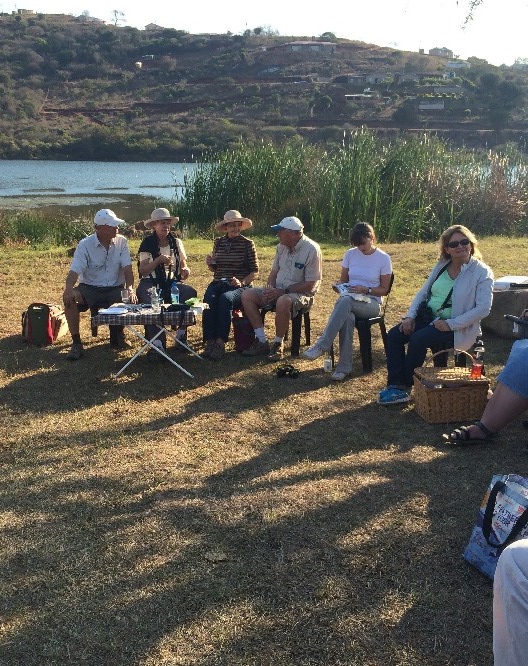
Four of us stayed for the weekend in the reserve huts and had booked to go to the vulture breeding site on the Monday. What a treat to have the Cape Vultures flying so close above our heads and to see them on the cliffs. A Black Stork also joined them for a flyby.
Photos curtesy of Declan Jordan, Rex Aspeling, John Bremner and Dave Rimmer.
Umbogavango in Winter came up trumps – it was a beautiful day and the birding was great as can be seen from the superb pics. There were 19 members & 1 visitor and we broke up into 2 groups – thanks to Ismail for leading the 2nd group.
White-eared Barbets in abundance;
White-eared BarbetWhite-eared Barbets
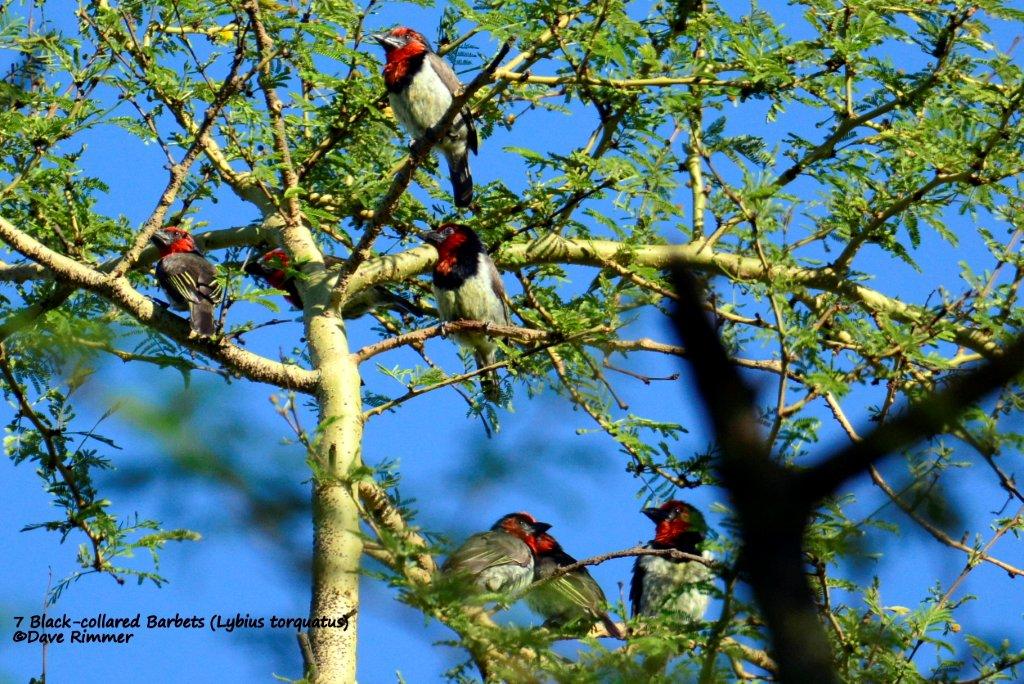
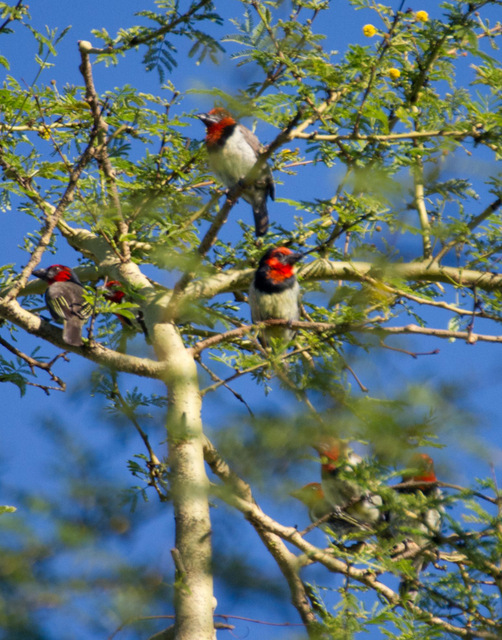
then we had the most lovely views of 6/7 Black Collared Barbets sitting in the top of a fever tree catching the sun (what a great pic!!).
Black-collared Barbets
Maybe not so many water birds as in Summer but Black Crake were seen a number of times as well as a very strange hybrid goose hanging out with a pair of Egyptian Geese and their chicks (any ideas on the lineage?).
Hybrid
Hybrid
Hybrid
Raptors: Black Sparrowhawk, Lanner Falcon, African Fish Eagle and then the piece de resistance a Palm-nut Vulture circling overhead and giving us the most fabulous display – I think we then decided it was a glorious day.
Possible Lanner Falcon
Palmnut Vulture
Palmnut Vulture
We had a brief glimpse of a Natal Spurfowl; Giant, Malachite & Brown-hooded Kingfishers, Cape, Pied & Mountain Wagtails, plenty of flycatchers and sunbirds and lots, lots more – our count was 74 but a few of us stayed on for another short walk and we had large flocks of Red-back Mannikins and a sole Blacksmith Lapwing flew into sight just as we were leaving making a total count of 76 – not too shabby for a Winter’s morning birding.
Here is a short report on Empisini – courtesy of Elena Russell.
There were 13 of us and the morning started off a little chilly and cloudy and although there was lots of bird song not much to see – a Lemon Dove gave its soft hoo from the forest’s ferny floor, maybe one or two of us caught a brief glimpse as it took off.
The Scaly-throated Honeyguide called incessantly as well as the Lesser Honeyguide, Natal Robins flitted across our path as well as Tambourine Doves. We had a couple of good bird parties – lots of Grey Cuckooshrikes & Black Cuckooshrikes – the one male had the most beautiful yellow epaulettes.
When we returned for tea the birding had not been the greatest and for Empisini we all agreed was rather disappointing.
After tea we took another walk on a different path and the birding really took off – Narina Trogon, Green Malkoha, Blue-mantled Crested Flycatchers and eventually we saw the Honeyguides including the Greater Honeyguide plus lots, lots more!! It was then decided this was one of the best outings!! – the bird count was 54.
Pics are courtesy of Dave Rimmer, Penny de Vries and Paul Bartho– does anybody know if it is a spider’s nest and which one and if not what is it? Also the ID of the Giant Woodlander Kingfisher is very suspect! As always!
Birders in the forest canopy.
Aloes in full bloom
Aloes in full bloom
Giant Woodlander Kingfisher
Sally – Empisini
Knysna Turaco
Knysna Turaco
Knysna Turaco
Kite Spider
Spider nest
Lucky Ladybug
Narina Trogon – female. Terrible photo. Submitted to convince you we actually saw one.
Last year towards the end of April there was a weekend outing to Ilala Palm Park – the first time BLPN had visited the park. Everyone agreed it was not only a great venue but also a great base for good birding in the local reserves.
On the 15th May a number of us (4 couples) revisited Ilala Palm Park for 3 nights. The weather was cooler and the vegetation greener than last year. The accommodation was again excellent. We were the only visitors. Each campsite has its own ablutions with good hot water as well as a wash-up area.
Showing the size of a small campsite with its private ablutions and wash-up area.
We had 2 full days there plus the afternoon on arrival and the morning before departure. The plan – to spend the first day visiting Muzi Pan and Mkuze Game Reserve and the second day, Tembe Elephant Park. The rest of the time was spent birding in and around the campsite.
Muzi Pan – Friday:
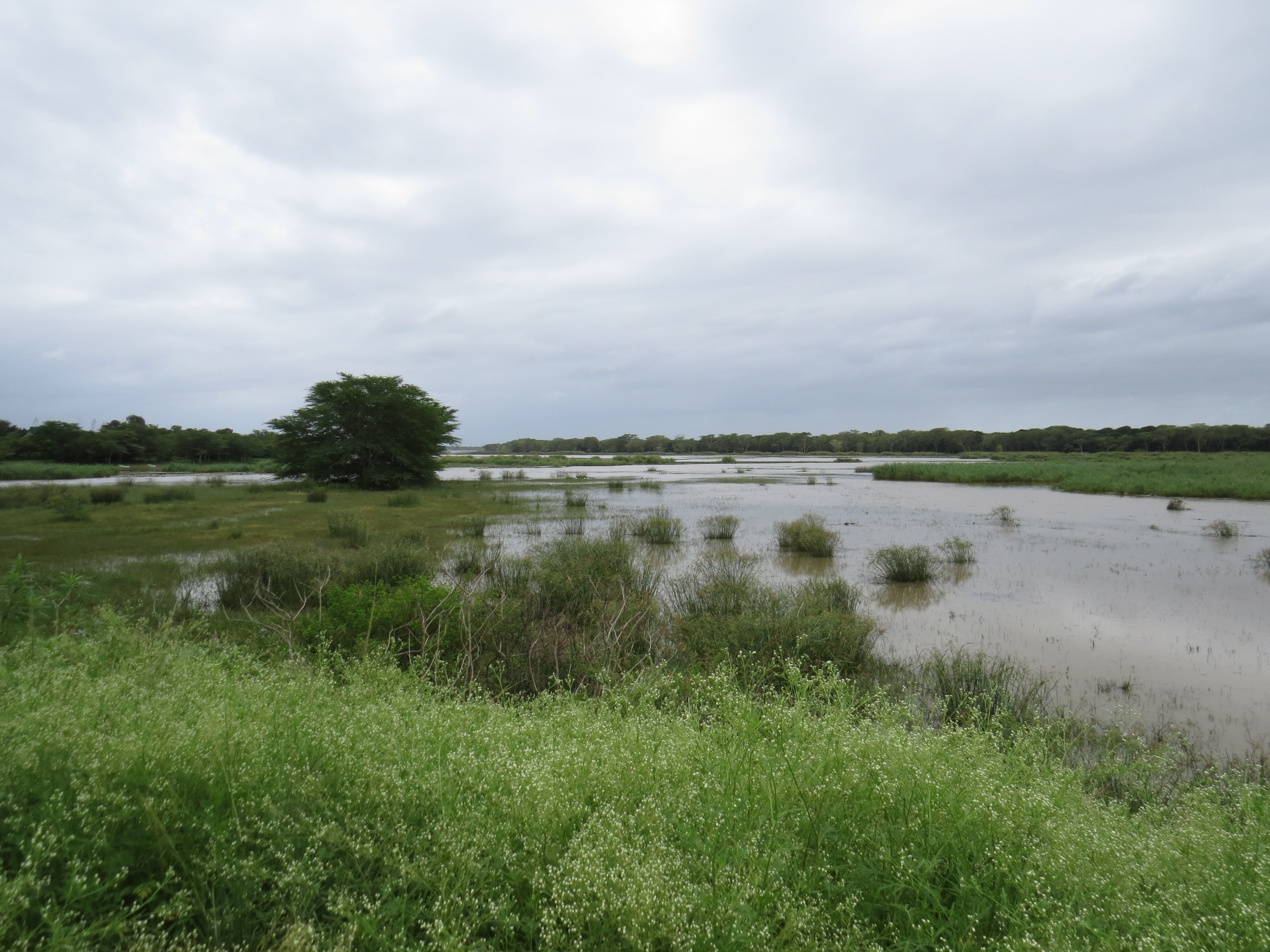
The water is in the distance
Despite this being the wrong time for waders, we enjoyed a couple of hours early morning at Muzi Pan. As you can see from the photo the water level was far away from the road. Compare that to January last year when the water was raging under the road bridges and came right up to the road.
Muzi Pan Jan 2013
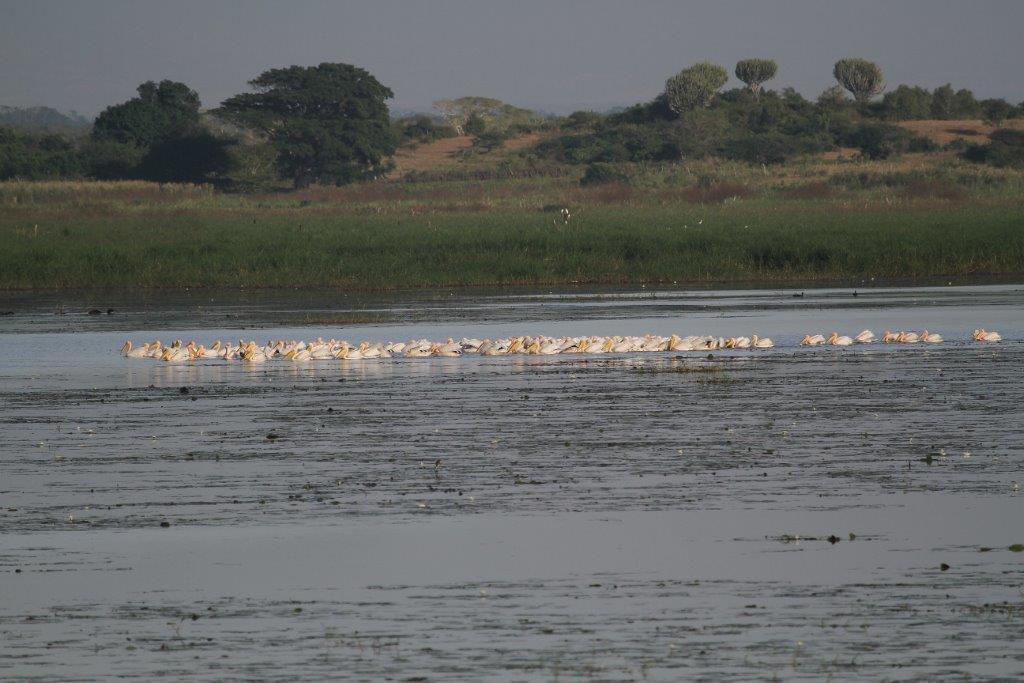
During the short stay there we recorded 34 species seen from the roadside. There were over 100 Great White Pelicans masterfully fishing together on left side of the causeway as you head towards Mkuze.
Fishing together – quite a sight
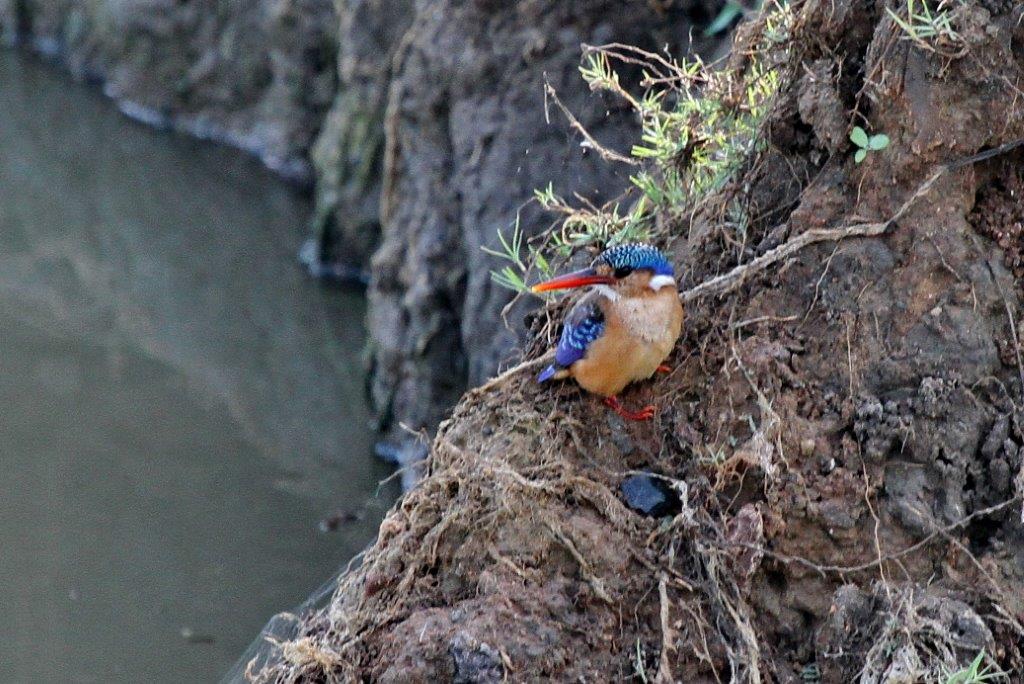
Then there was an obliging Malachite Kingfisher beside the road openly sunning on the bank. On return home later in the day he was still there.
Malachite Kingfisher – still there 6 hours later
And probably the other interesting species were Wire-tailed Swallows, the Lapwings – both African Wattled and Senegal. Several Caspian Terns also made an appearance on our return home.
Formation FlyingSenegal Lapwing – part of a group of 6
Mkuze – Friday:
A late start in Mkuze rarely produces a large bird list and this was no exception – especially at this time of year. In total we managed 69 species in the 6 hours we were there.
We visited Nsumo Pan picnic site for tea and saw a number of Yellow-billed Storks with a few Openbills amongst them – in the trees opposite.
Nsumo Pan Picnic site
Pale Flycatcher
Yellow-billed Storks
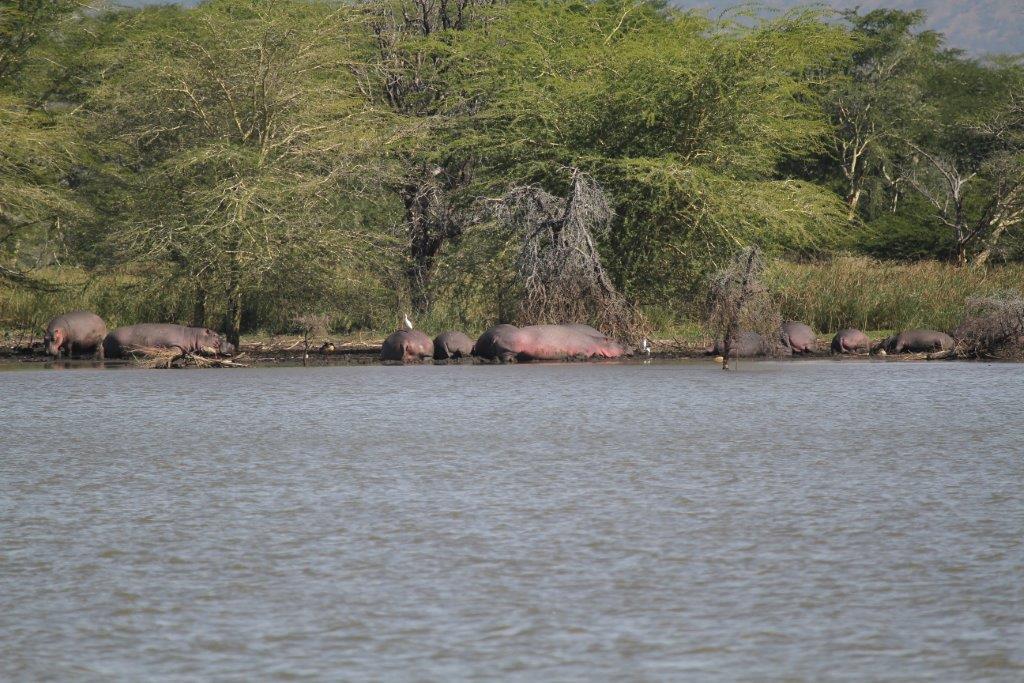
There were also a few Whiskered Terns over the water in the distance and a bank of hippos lying in the sun on the opposite shore – showing their pink bellies.
Hippo downtime
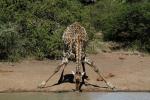
A couple of us went to the kwaMalibala Hide to be entertained by a lazy White Rhino and another missing one horn as well as Giraffe having a drink. It was here that we saw the Dark Chanting Goshawk preening in a bare tree opposite.
Legs splayed
Dehorned
Dark Chanting Goshawk
Red-billed Firefinch
Red-billed Firefinch
Red-billed Oxpecker
Lunch was at the kuMasinga Hide picnic area followed by an hour in the hide before returning to Ilala Palm Park. It is always good to sit in the hide around lunchtime when the birds come in to drink. There were very blue Blue Waxbills, Yellow-fronted Canaries, Dark-capped Bulbuls, Yellow-throated Petronias, Golden-breasted Buntings, Emerald-spotted Wood-Doves at the water’s edge nervously drinking. Numerous White-crested Helmetshrikes, Brubrus, Fork-tailed Drongos, Scimitarbills, Spectacled Weavers, Brown-hooded Kingfisher all flitting around in the trees around the hide. Overhead the odd Bateleur.
Brown-hooded Kingfisher
Emerald-spotted Wood-Dove
Scimitarbill
Dark-backed Weaver
Golden-breasted Bunting
Blue Waxbill & Yellow-fronted Canary
Blue Waxbills
Very blue Blue Waxbill
Yellow-throated Petronia
Yellow-throated Petronia
Several birds stood out as unusual – African Stonechat, Violet-backed Starling and Fiscal Flycatcher. More photos of some of the other birds seen.
African Pipit
Black-bellied Starling
Stonechat – female
White-browed Scrub-Robin
White-crested Helmetshrike
White-crested Helmetshrike
The refurbished hides are all still in good order but the wooden walkways to the hides are in a very sorry state as well as the kwaMalibala hide itself.
Tembe Elephant Park.
Saturday was dedicated to a visit to Tembe Elephant Park. We arrived at 07h30 and set off looking for the elusive Plain-backed Sunbird on the Gowaninini Loop – a wasted effort and we somehow managed to turn round on the the sandy road and return to the entrance and proceeded to the hide at the Mahlasela Pan.
At the moment there is quite a large swamp area just beyond the Pan to its left. There were a number of species in that area – White-faced Duck and 8 ducklings, Woolly-necked Stork and little Grebe being the more interesting.
White-faced Duck and ducklings
Woolly-necked Stork
Three-banded Plover
After a short uneventful stay we drove the East Swamp road to the Ponweni Hide for tea. The East Swamp road is very open and affords good views over the swamp all the way along the 10 kms. Along the way there were excellent sightings of a Little Bee-eater and Grey-rumped Swallows.
Little Bee-eater
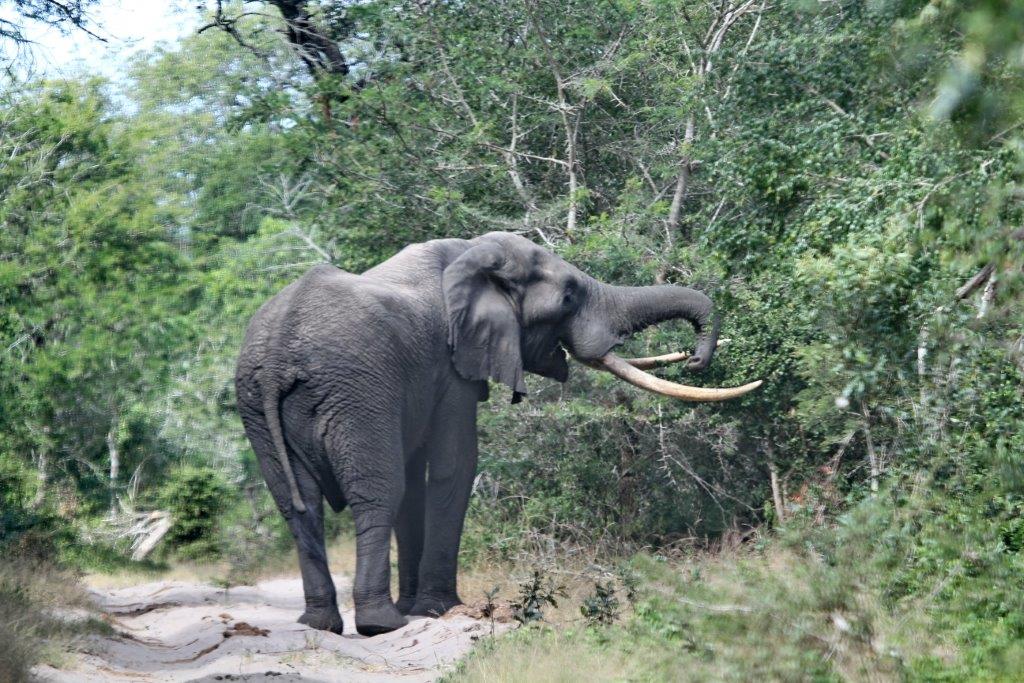
We returned to the hide at Mhlasela Pan via the West Swamp road – more wooded with few places to view the Swamp. A rather large bull elephant slowly ambled in front of us for a good 10 minutes before stepping off the road to let us past!
Large bull elephant keeping us warily at a distance
Noticeably along this stretch there were numerous sightings of White-crested Helmetshrikes.
Back at the hide the nearby trees yielded close-up sightings of Chinspot Batis, Yellow-breasted Apalis and Fiscal Flycatchers.
In total we saw/heard some 53 species – with perhaps the fly past of the African Marsh Harrier being the highlight of the day as the sun caught the bird showing its colour and markings extremely well.
African Harrier-Hawk
Hamerkop
Lizard Buzzard seen on way to Tembe
Ilala Palm Park:
On Sunday we actively birded around the camp- taking a 2 hour walk up the road and into the bush around the camp. The rest of our records came from incidental sightings as and when we were in the camp.
The conditions were cool but sunny. A late start on Sunday – 07h00 – was decided to give the sun a chance to get some heat into and over the bush. Perhaps we should have started earlier as the birds were quite vociferous from first light. Two of us stayed on for an extra day, started earlier and noticed this the following morning.
We had a hard time trying to ID a bird which only showed its back – see if you get it right first time:
What bird is this.
Although the number of species seen this time was less than last year, the quality of the sightings was excellent. In total we recorded 52 different species including Pink-throated Twinspots (camp bird calling everywhere); African Goshawk; African Yellow-White-eye; Bearded Scrub-Robin; White-throated Robin-Chat; Rudd’s Apalis; Olive Bushshrike; Blue-mantled Crested-Flycatcher; Fiscal Flycatcher; Grey, Olive and Collared Sunbirds as well as an unusual Klaas’s Cuckoo heard calling.
Fiery-necked Nightjar and Spotted Eagle-Owl were heard calling at night. And a Woodward’s Batis was thought to be calling on arrival.
But perhaps the highlight was the sight of a Little Sparrowhawk on the waterbath at campsite number 2.
Dusky Flycatcher
Dusky Flycatcher
UI Butterfly
UI Butterfly with wings up
Olive Sunbird
Brimstone Canary
Spectacled Weaver
Spectacled Weaver
Neddicky
Golden-tailed Woodpecker
Southern Boubou
Speckled Mousebird- very bedraggled
Chinspot Batis – male
Black-backed Puffback
African Yellow White-eye
Yellow-rumped Tinkerbird
Yellow-rumped Tinkerbird
Yellow-rumped Tinkerbird
White-throated Robin-Chat
White-throated Robin-Chat
Sombre Greenbul
Rudd’s Apalis
Rudd’s Apalis
Red-billed Firefinch
Red-billed Firefinch
Red-billed Firefinch
Red-billed Firefinch
Olive Bushshrike
Olive Bushshrike
Emerald-spotted Wood-Dove
Emerald-spotted Wood-Dove
In all it was a great long weekend of birding and a location we think should be really productive in the summer. In my opinion 5 nights would give one the opportunity to visit many of the other interesting areas nearby – like Kosi Bay, Lake Sabaya, Babibi and possibly Ndumo (although it is almost a 2 hour drive to get there).
For those interested click on the following link for a copy of our bird list in each area we visited.
Paul & Sally Bartho; Cecil & Jenny Fenwick; Dave & Jenny Rix; Ian & Lyn Graham.















































































































 Birds are our Story