Botswana and Namibia – Part 1

Sally and I decided to visit the Caprivi (Zambezi) region of Namibia again. We hoped to find some of the region’s special birds that we had missed on previous trips, as well as reminding ourselves of the specials we had seen before.

We were planning on going in January but for various medical reasons that was not possible. Mid March became the earliest we could get away and we needed to get away.

After much planning we decided on the following trip:

Zaagkuilsdrift

March 17th to 19th 2026

Zaagkuilsdrift Bird Sanctuary has probably one of the best reputations in South Africa for seeing Warblers in particular. It is also a good half-way point to the border with Botswana at Martin’s Drift. Zaagkuilsdrift is a place we had not visited before. The plan was to spend 2 nights there both on the way as well as on the way back.

Our journey started nice and sunny from Howick. However, as we rounded Gauteng on the M1, the heavens opened and I mean torrential rain, thunder and lightning and a bit of hail. No fun with all the traffic and us towing our Afrispoor Wildcat as well. From that point on we had rain and overcast weather all the way to Kasane (northeast Botswana).

The last 20 kms to the camp was on gravel. It took us one and a half hours.

To start with the road was relatively dry but very corrugated. Then we came to the final few kilometres. At first, looking up the straight section of road, we could see quite a number of troughs of water that we had to navigate – about 15 or so. They appeared to get smaller towards the end of that section. However, it was the opposite. The further we ventured so they got longer and deeper. There was no option to drive to the side. The sensible thing was to drive through the middle of each.

Once through all the water, the final 2 kilometres was very muddy and had to be driven very carefully to avoid sliding off the road. Eventually we made it.

Entrance to Zaagkuilsdrift

Our campsite was under a shade cloth and we shared the ablutions with another empty site. We had electricity and water.

We dined at the restaurant both nights . Set menu but not the finest of meals.

Remember that this is a Sanctuary, so not all the species we saw there were truly wild – like the Blue Cranes for example. They do have a number of good birding spots and one hide which we found really impressive – Sanctuary Hide.

– and from which we saw the majority of the birds we recorded.

In total we recorded 64 different species.

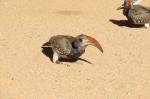
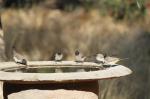
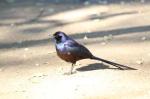
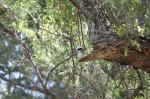
Next is a gallery of birds we were able to photograph in and around Zaagkuilsdrift. Not that we travelled very far from the camp.

The night before we left it rains all night. The muddy section as we left the gate was baie slippery. Even in low range 4×4 we got stuck twice. Both times I luckily managed to maneuver our way out. Then came the troughs. They were even more unpleasant – they seemed fuller and longer.

On one occasion we hit a severe drop which our poor Wildcat was not expecting. It was not till 100 kilometres later that we realised we had a problem with the Wildcat. We had stopped at a robot in Modimolle waiting for the green light. Then we noticed a bakkie drive onto the pedestrian pavement alongside us. The driver pointed to the Wildcat indicating that it had a problem. One of the suspension arms had disconnected and had been dragging along the road behind us since we left Zaagkuilsdrift. We had heard nothing, suspected nothing as the Wildcat had towed effortlessly behind us.

Worn away Suspension rod

More than 2 hours was spent at Supa Quick in Modimolle as they found two new matching suspension arms to replace those on the Wildcat. Nearly R3000 later we were on our way. Fortunately, we had planned to camp at Kwa Nokeng just the other side of the border in Botswana and we did not have a huge distance to travel.

Would we go back to Zaagkuilsdrift? Yes, but only in the dry season – early summer late spring. We were planning to go back at the end of our trip but decided against it because we did not want to face that gravel road in.

Kwa Nokeng, Botswana

March 19th 2026

The border crossing at Martin’s Drift was a breeze. I say that as it did not appear so as we approached the gate. We were met by a huge queue of trucks, but someone told us to move ahead to the front – in the oncoming lane. We did and crossed the entrance after just waiting for 2 trucks. On exiting the South African side we gave away all the items of food that we had heard would be confiscated on entry to Botswana. So, our fridge and freezer were virtually empty.

Going through immigration and customs on the Botswana was quick as there were so few of us in the queue.

In the past, Sally would have made quite a number of pre-cooked meals and we would have the vegetables all in the fridge – not allowed we were informed by all the official authorities. As it was nobody wanted to check anything. Maybe it was the time of day.

The campsite was a large area of just thick grass and nobody else there. Because of all the rain the grass was wet underfoot but not soakingly so. We had power and water. There were loos right beside us and a shared shower block about 100 metres away.

We had a pleasant meal at their restaurant which has a lovely setting with the river in the background.

Nata, Botswana

March 20th to 22nd

The road from Martin’s Drift to Palapye was reasonable and quick going.

In Palapye we stocked up with food as our fridge and larder were empty.

Then road conditions started to deteriorate, especially after Francistown to Nata. A new highway is being created both sides of the current A1 all the way to Kasane. Potholes are manholes. Both sides of the road are badly crumbling away. The road is just wide enough for two trucks to pass – usually at speed. And, we South Africans think our N3 is truck laden. In Botswana, on their A1, truck traffic from the north is horrendous. We averaged 70 kilometres per hour at best for the whole journey.

Our plan was to spend two nights at Nata with the intention to visit the Nata Bird Sanctuary. This did not happen despite a last minute booking to go on an afternoon drive to the sanctuary. We got no further than about 100 metres from Nata gate when the rain came. Instead, we birded around the camp the next day.

Our campsite:

Our first lifer came unexpectedly.

Sally

There was a bird party close to the lodge. We watched the activity in the drizzle, then Sally saw an unusual looking bird. Nothing like anything else we could identify easily. The key feature was a black crown down to its eyes and a grey bill – a Eurasian Blackcap we concluded. The memory remains but we were unable to get a photo.

Because of the adverse weather conditions, we were only able to use our cell phones for photos. Here are a few.

In total we did record 25 different bird species.

Senyati, near Kasane, Botswana

March 22nd to 25th 2026

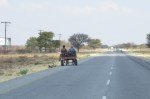
The 303 kilometres from Nata to Senyati took us 6 hours. One section of road was off-road mud for 20 kilometres. Trucks doing at best 20 kph in front of us.

As we approach Senyati Camp – 15 kms short of Kasane – we were advised by management not to drive the short 2 Km 4×4 route to Senyati camp since we were towing.

We should have ignored this. We followed the advice and took the detour – about 10 km of rough road. Our brains were addled and we should have taken the direct route – 2 kms. Although it is thick sand, we stupidly did not consider the rain effect and how compact it had become.

The entrance gate:

Our well-treed campsite and own ablution:

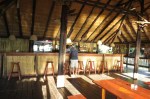
Reception, Bar, Restaurant and viewing decks overlooking the pan and hide.

View from the upper deck:

Note no fencing. Elephants do walk through the camp as I found out late one afternoon went I went underground to the hide.

The first afternoon we went into Kasane to Chobe Safari Lodge to wander around their waterfront from the hotel to the campsite. The rain that we had every day dissipated.

Generally speaking the birding was quiet – until we reached the bridge into the campsite area. More secluded and treed over. White-browed Robin-Chats (juveniles and adults) seemed to be everywhere – calling and dancing about. The juveniles had us confused for a while with their mottled appearance and almost lack of a white eyebrow. A Common Sandpiper appeared at the water’s edge under the overhanging vegetation. Parts of the walkway path were closed off as the water levels were very high. Arrow-marked Babblers and Hartlaub’s Babblers seemed to be competing for territory. We eventually had sightings of a juvenile Black Coucal which we had heard calling. Even a Swamp Boubou and a Brown Firefinch made an appearance.

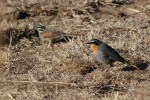
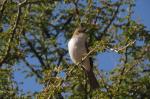
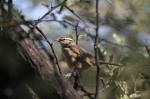
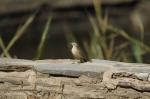
It was on the way back that we had a fabulous sighting of another lifer a Thrush Nightingale. It was not interested in us – some 5 or 6 metres away. It was on the move in an overhanging tangle next to the water’s edge. We watched for a long time.

Both the picture above and below are slideshows. Click the arrows, left and right, to see the next photo.

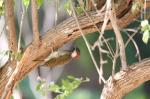
Then I moved around to see if I could get a decent photo – thwarted by it being constantly on the move and with a spindly tree half-way between us. Suddenly this bird appeared in the spindly tree – so close I needed to back off to get a photo. It stayed there preening for us for at least 10 minutes. A Schalow’s Turaco. we must have spent at least 15 minutes there watching both birds.

We recorded 19 different bird species in the short time that we were there.

The next day we went to Chobe National Park. We took the shortcut from the Senyati 4×4 road directly across the main road. The road goes directly to the Chobe NP via a route around the airport. Beats going around Kasane along the main road. Truck traffic can be horrendous as you approach Kasane.

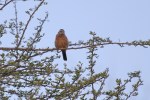
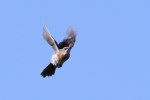
On the airport boundary fence we had a great viewing of a Lanner Falcon posing.

Chobe NP was a big disappointment as far as animals were concerned. I think we counted seeing only 8 or 9 different species and none in large or even medium sized groups. The species we did see did not include any of the “Big 5”.

The low road, as expected, was flooded although we were able to drive down to the water’s edge then back up again to the middle road.

We did record 30 different bird species in the Park. Here are a few photos we took.

The birding in Senyati camp was excellent. In and around the campsite we had unexpected sightings of Collared Palm-Thrushes as well as Bradfield’s Hornbills. Levaillant’s Cuckoos flew into the tree tops above us, Swamp Boubou and Tropical Boubou visited and called, Greater Blue-eared and Long-tailed Starlings made appearances and Swallow-tailed Bee-eaters were to be seen.

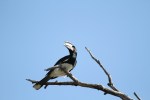
Bradfield’s Hornbill

Then there were the Collared Palm-Thrushes:

Then there were the sightings from the viewing deck overlooking the wetland pond. Most were bird sightings but a few animals also visited. A gang of Banded Mongooses appeared below our view point and a stubby-horned Impala with it’s comical look.

We recorded 43 different bird species in the Senyati Camp.

And that concludes the first leg of our trip through Botswana on our way to the Zambezi (Caprivi) region of Namibia.

Paul Bartho and Sally King.

Sunset at Senyati

Larking About in Namibia. Part 8

Part 8. Larking Around Namibia. Chobe, Woodlands and Marakele.

We left Namibia sadly and on arrival in Botswana drove through the Chobe NP on the way to Kasane.

Main road passing through Chobe NP.

Having not booked to stay anywhere when we arrived in Kasane, we headed for Senyati – a campsite recommended. It is about 6 kms from the Kazangula intersection with the Kasane/Francistown road about 10 kms south of Kasane. The drive to the camp from the main road was atrocious – deep soft sand requiring low range especially as we were towing. The receptionist was very off-hand and we did not like his attitude, the campsites were not level and the surrounding area very open and dry. So we headed back to Chobe Safari Lodge to see if we could camp there.

We managed to get a campsite in a tight space which required much manoeuvring of the trailer to get it in. We were given other choices but they were far worse. The nice campsites with space and close to the water were all reserved for Overlanders and big groups – they remained empty for the 2 nights we spent there.

A number of friendly birds welcomed us to our campsite – both in song and sight. The most exciting of these a Collared Palm-Thrush who appeared throughout each day that we were there.

The campsite deck not only overlooks a large corner of the river but has excellent views over the Chobe National Park plains and wetland area. Hundreds of Buffalo and Elephants were visible with numerous species of birds intermingling among them. Skimmers and Collared Pratincoles were clearly visible. We took the scope to enjoy the sight and had sundowners there both days.

Having decided to go into Chobe NP on our own we obtained our permit the afternoon before. When we arrived at the gate at 6 am we drove straight in – in fact we simply drove past all the game drive vehicles and in without anyone checking our permit.

The main road through the Park is horrendous and 4×4 low range was essential for long stretches.

As soon as we could we got onto the minor roads which were much more manageable. They took us down to the flood plain.

Many interesting birds were seen there – probably the highlights being a Rosy-throated Longclaw and a Slaty Egret. We did not see a wide variety of game in the Park.

After the morning tea break we had had enough and headed back to enjoy the campsite deck and to prepare for the next leg home.

We thought to stay at Elephant Sands which we had heard much about but never visited – failing that then Nata or possibly Francistown if we made good headway.

The road has been recently renewed and widened – except for a 30kms stretch which they are currently working on. Gone are the potholes of yesteryear.

Elephant Sands – one km off the main road. So we turn in and round the first corner – thick sand so into low range – much needed. Anyone driving an ordinary vehicle better watch out! We arrive after 2 kms at a small waterhole with chalets dotted about, no sign of a campsite and 30 elephants at the waterhole. We did not even bother to stop but did a U-turn and scarpered – not because of the presence of the elephants but because of the smell of the elephants – it was overpowering. And as fearfully anticipated we come across a huge bull elephant crossing slowly in front of us. Fortunately he was only interested in the water and although he gave us an unhappy stare he moved on.

We had made good time so continued on to Francistown arriving early afternoon. Unfortunately the only place we knew was Woodlands Stop Over. I had forgotten I had vowed never to return. And I soon found out why when they quoted us for the night. 95 pula each then another 30 for power (20 last year .. how much next year?) then another 20 for the trailer although we did not intend using it, then another amount as a community charge. Apart from Namutomi this was the most expensive campsite. An utter rip-off. I asked to speak to the owner twice to no avail. I doubt the receptionist even bothered to call him. It is either that or he was too scared to face my criticism. I will be sending him a link to this report and I will put the info out on all the birdnets and the 4×4 forum. Sally was tired, we were unsure of the other place we had seen in the camp book for Botswana so we paid. Never again especially as the campsites were literally on top of one another.

The next morning we were up early and on our way quite quickly as we had used our Malamoo 3 second tent. The Stockport border gate was our goal – avoids the delays at Martin’s Drift. What a breeze – through both sides in less than 15 minutes.

The journey home was broken in Marakele NP. We decided to stay 2 nights so we could enjoy the park and recuperate from the long drive from Francistown. Up went the roof-top trailer tent and out we went for a drive.

The next day we rose early and went through the tunnel and up the mountain to the Marakele Bergfontein Tower – over 2000 metres up.

It is quite a challenging drive up and definitely not for the faint-hearted especially on the way down. The road has been cut into the cliff face and long stretches are wide enough only for one vehicle with no railings on the cliff edge side. You do not want to meet a car coming in the opposite direction. One of you has to reverse and pull over in the precarious passing zones.

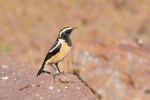
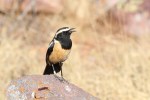
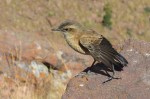
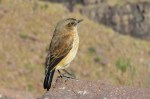
At the top we were not disappointed and saw numerous Cape Vultures soaring close by. We also had a picnic with an extremely friendly Buff-streaked Chat. Other birds seen included Gurney’s Sugarbird and Cape Rock-Thrush.

We had clear views down the valley and could see the road below. Keeping an eye out we observed 4 cars coming up so we abided our time before heading down. Luckily our timing was right and we got down without meeting another vehicle.

Too quickly it was time to pack up and head home.

Summary:

The holiday over – 3.5 lifers for Sally and 9.5 for me.  The half being the Tinkling Cisticola which we had only heard.

Altogether we had seen and or heard 360 species and seen most of the Namibian endemics which we could expect in the areas we visited. Now it is back to planning our next trip!

Hope you have all enjoyed the read and the pictures.

Paul and Sally Bartho

PS I will try to lump all the photos of birds and aminals which we could not ID in another post and another with the Namibian specials (those we considered special and we were lucky enough to photograph).


Larking About in Namibia

Larking About in Namibia

June & July 2013

Sally and Paul Bartho

Over the next week there will be a serial report-back on our birding expedition to Namibia.

The series will include pictures of places we stayed and birds we were lucky enough to photograph in each place.

Please email me if you interested in receiving detailed reports including our route and tracks, accommodation contact details, accommodation assessment. Also available is our Bird List in Excel format. You are able to see what birds we saw or heard in each place as well as where specific birds were seen.

The journal begins:………..

At very short notice we decided to go to Namibia. Our preparation was frantic over a 2 week period. Bird Lists to prepare, accommodation and route decisions and bookings, banks and credit cards, car & health insurance, knowledge of border crossing requirements, etc.

Our main goal was to get to Kunene River Lodge to see the Angola Cave-Chat with Peter Morgan – and to be there before the start of the school holidays. Of course we also intended to find as many of the Namibian specials as possible – in particular those we had not seen before.

We departed on Tuesday 11th June spending the first night in a Hunting Lodge in Botswana, Phuduhudu south of Lobatse. We entered Botswana through the quiet border post Ramatlabama. As we were staying only one night and needed an early start the next day, we stayed in one of their fancy chalets – which at R200 per person was very reasonable. Our birding began around the camp.

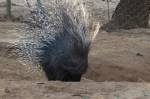
The next day we were up early. It was freezing outside. From there we took the Trans Kalahari highway to the Mamuno border post into Namibia. Again a pleasant crossing. Zelda was the campsite we were headed for. Once there we put up our 3 Second tent on grass with power to run our electric blanket. The cost to camp was exceptionally reasonable considering the facilities available. To cap it all their buffet dinner was tasty & value for money. On site were a number of interesting orphaned animals to see including Leopard, Cheetah and a huge porcupine.

The following morning we spent a bit of time enjoying Zelda before our short hop to our next campsite near Windhoek airport – Odekaremba at 1800 metres.

Ondekaremba has a small campsite with 4 spots. We had a site at the top of a hill on the only bit of level ground. It was open to the biting wind and the ground so hard it was exceedingly difficult to get the pegs into. Our ablution was very rustic and hot water only available when the staff got the donkey working – tepid water at best first thing. On top of that it was very expensive. We would be loathe to stay there again – except the birding round the camp was very good.

We had booked for 3 nights to give us a break from the long journeys and to have a base to bird around Windhoek while we were in the area.

We visited both Avis Dam and Daan Viljoen. Avis Dam was the more interesting but Daan Viljoen produced the first lifer for me – Rockrunner – Sally had seen it previously.

Sunday 16th we headed north stopping over in Kamanjab Rest Camp in our 3 Second tent again. For one night it is not worth the effort after a long days driving, to put up the trailer only to take it down again early the next day.

We were the only people in the camp. The facilities were good and clean. We managed a walk round the camp grounds late afternoon. As usual most of the birds were to be seen around the camp area – including Bare-cheeked Babblers and White-tailed Shrikes – in numbers.

The next day we arrived at Kunene River Lodge – staying for 5 nights. We had been before and it remains an oasis along the stretch of the river. Birds in camp were plentiful and special.  Cinderella Waxbills, Rufous-tailed Palm-Thrush, Swamp Boubou, White-tailed Shrikes to name a few.

No sooner had we set up camp than we were on an sunset cruise heading for the rapids up river. On the way back we stopped on the banks for sundowners. A Pearl-spotted Owlet greeted us.

During our stay Peter Morgan took 4 of us to find the Angola Cave-Chat in the Zebra Mountains. We left early to get there at dawn. Not a drive for sissies – pre-dawn.

Once there we set ourselves up for a wait hoping they would appear close by. Peter had not been there for a month so he did not know what to expect. After some time once the sun had finally generated some warmth we heard one call. A lovely melodic call slightly different from its cousins in Angola apparently. Sean from Batis Birding was with us and his recordings made in Angola were decidedly different to what we heard.

Anyway, having heard the call we soon spotted the culprit for a fleeting few seconds. Then within minutes a pair were seen slowly making their way up the steep rocky slopes. The scope was soon on them so we all had very good views despite them being some way up the slope. The Cave-Chat looks kinda like a Swamp Boubou with a white eyebrow. As an after thought I managed to get a few very poor photos. The light was poor and the birds were moving.
The Grey Kestrel was our next target bird. The area around the Lodge had not had any decent rain for 2 years so there was no food for the Kestrel – and we had no expectations of seeing it. However Sean said he was heading for the power lines in Ruacana to find the Kestrel – leaving very early one morning intending to be there at the crack of dawn. Sally and I followed but could not keep up the pace. We dipped on the bird but Sean had a fly past on arrival.

On the way back we popped in to Hippo Pools and as it happened we unexpectedly bumped into Mark Boorman who was bird ringing. Before leaving home we had been in contact with Mark about birding in Swakopmund and Walvis Bay, so this was a pleasant way to make his acquaintance. Mark was ringing his way down river to Kunene River Lodge where he and Peter intended to have another go at ringing an Angola Cave-Chat. We learnt later that he was successful.
Our next instalment will include our time in Etosha which followed on from Kunene. Second instalment to follow soon.

Paul Bartho