Following the report of a White-throated Bee-eater in Hluhluwe, Sally and I made an impulsive decision to see if we could find it.
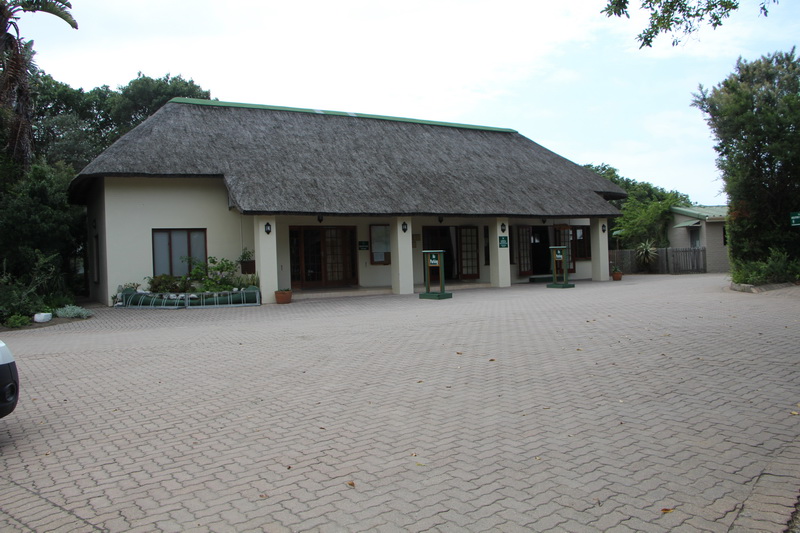
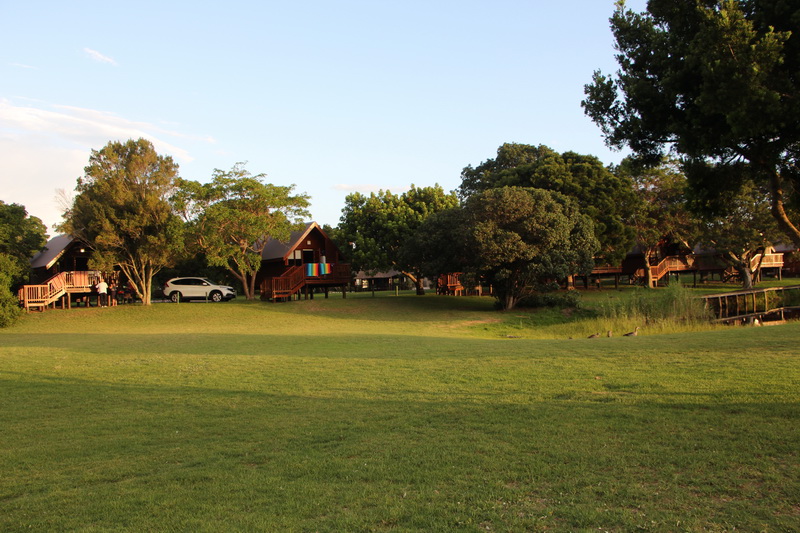
We decided to camp in Bonamanzi as a base and were allocated a site in their new campsite. Each campsite with its own ablution. Unfortunately I incorrectly heard the price quoted to Sally, so when we arrived it was not the R220 for the site as I expected but for each of us per night. Had I known this I would have gone elsewhere – like Hakuma Matata.
Following our trip to the Cape for five weeks where the most we paid for a campsite was R240 for both of us, the prices for camping in Zululand have gone crazy. R440 per night camping in Bonamanzi which is nothing special is ridiculous. Perhaps that is why there was only one other camper there and we did not see anyone using the chalets either.
Moving on. On the way there we drove through Hluhluwe and spent an hour and a half in the area where the Bee-eater was reportedly seen. No luck. The next day was also spent in Hluhluwe searching the area for over three hours – again no luck.
Birding appeared quiet in general however we were surprised to find out that we did identify 91 different species over the day and a half. Here are some of the species photographed.
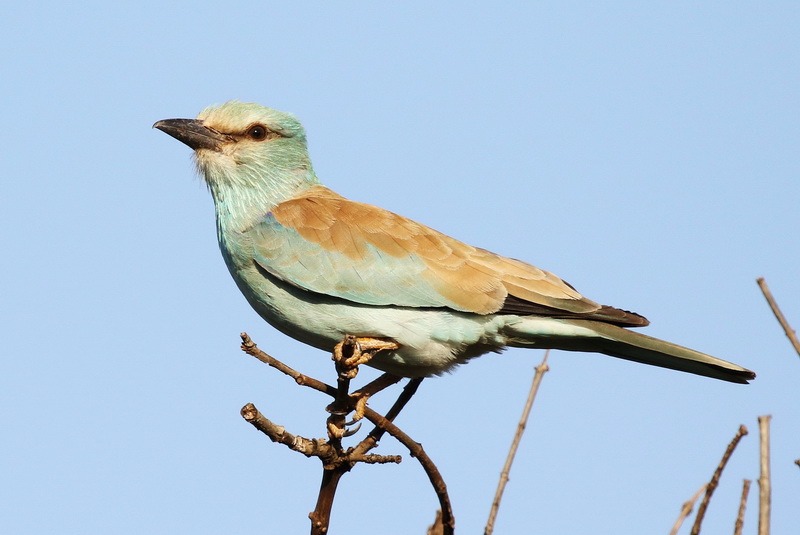
Eurasian Roller
European Bee-eater
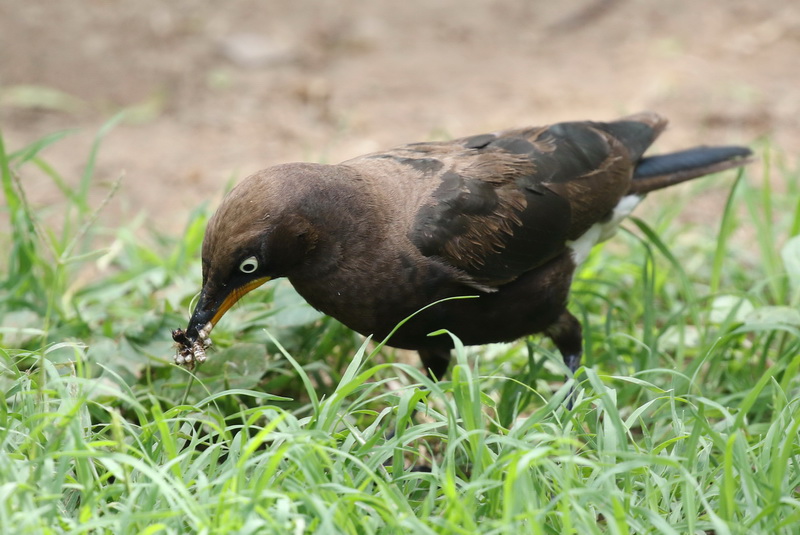
Cape Starling – love the colours
Cape Starling
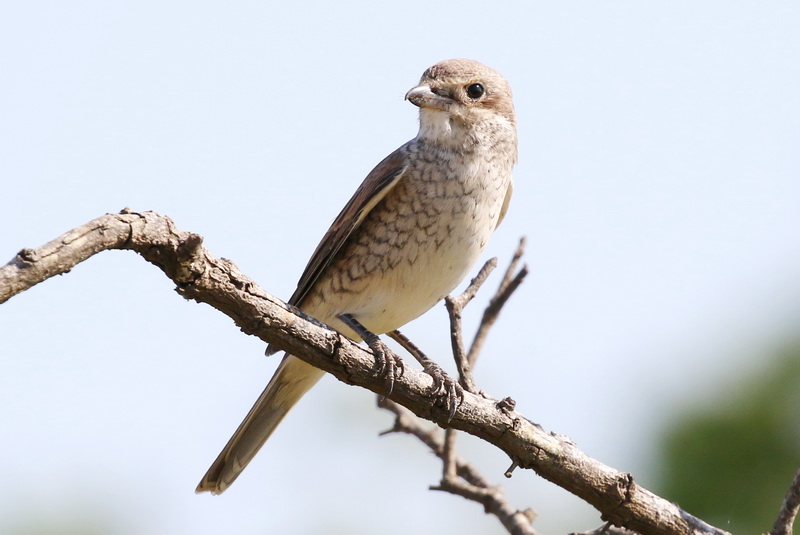
Red-backed Shrike – female
Striped Kingfisher
Ashy Flycatcher
Dusky Indigobird
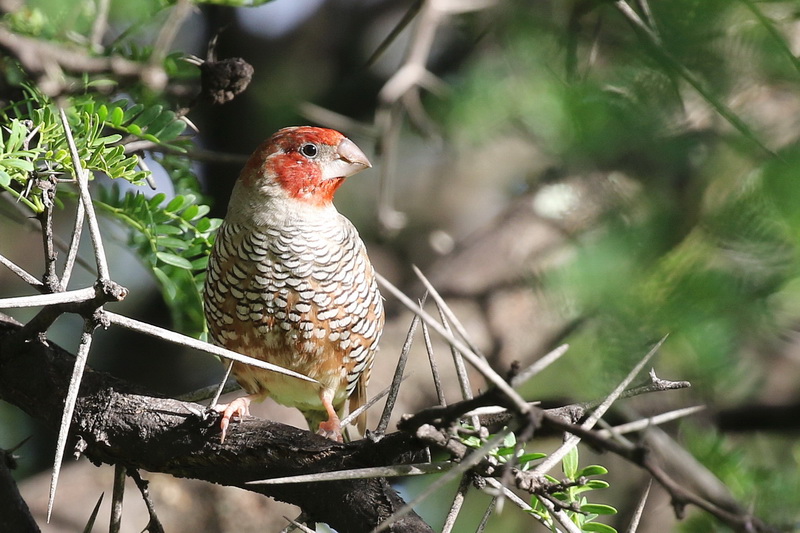
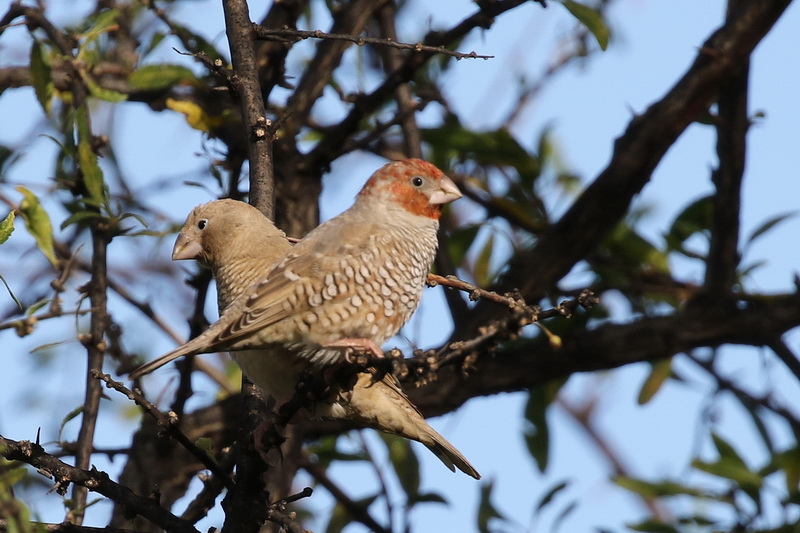
Red-billed Firefinch – male
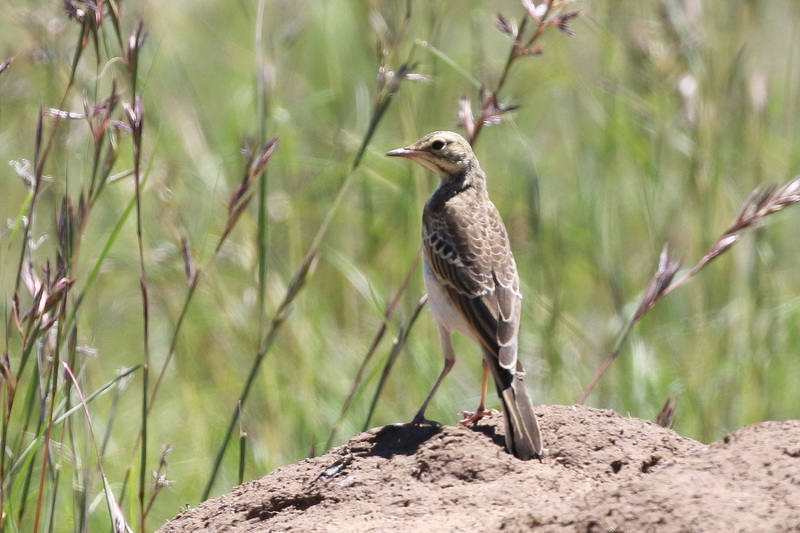
African Pipit
Bateleur
Rattling Cisticola
Brown Snake-Eagle
Martial Eagle – seen leaving the park – our Goodbye bird.
The following day we went to Isimangaliso, entering Western Shores through the north gate. The hide had water in it but was not busy, so we headed for the aerial boardwalk. At the top we could see that the water level had dramatically increased since the last time we were there.
Western Osprey flying over wetlands at Western Shores – view from the top of the aerial boardwalk
Some of the other species seen:
Senegal Lapwing
Yellow-throated Longclaw
Red Dragonfly or Damselfly
Once through Western Shores we headed for Eastern Shores and had to wait more than half an hour to check in – such a slow process.
Eastern Shores was interesting. There was water around, so we checked out the pans but nothing much was about. Then we headed round the Vlei loop picking up birds here and there. At one section we came round the corner and the road ahead was blocked. A rather large Rock Python lay in the road.
Rock Python
The Mafazana hide was closed. It was unclear why but we suspect they are making a new entrance road to the hide.
Time for tea so we went to Catalina Bay. Fortunately the wind had died down. From on high we had good views overlooking the lake. Because the water was so high there were no waders about and very little else too. However an African Fish-Eagle made a pass looking for its next meal. From the photo it looks as though he has his eye on something rather large.
African Fish-EagleAfrican Fish-Eagle with an eye on something rather large.
Then there was the Scarlet -chested Sunbird watching a White Rhino having a mud bath.
Scarlet-chested Sunbird
White Rhino having a mud bath
Lunch was fish and chips at the boat club overlooking the estuary. Across on the other side major reconstruction works were ongoing. The sand hillside is being removed. There were at least 5 diggers each with 3 dumper trucks – going back and forth to the beach dumping their loads.
Busy dumper trucks
Digger and truck being loaded
Hillside now missing from this picture
Dumping site
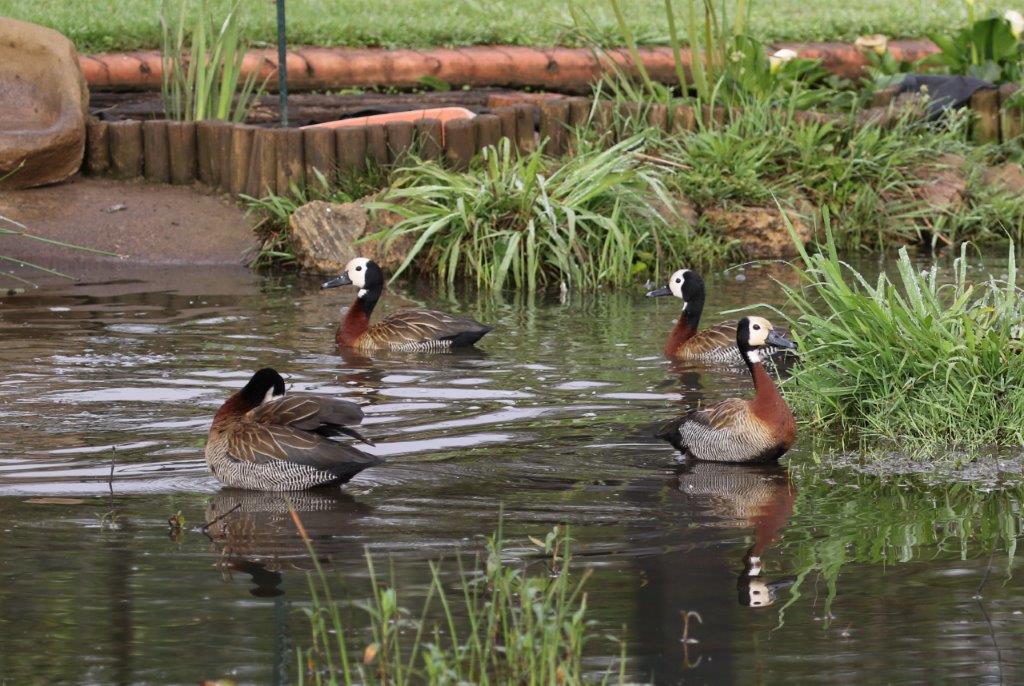
In the estuary there were many Terns, a crowd of African Spoonbills, Saddle-billed Storks, Grey Herons, White-faced Ducks, Pink-backed Pelicans, other waterbirds and numerous waders. Unfortunately it was impossible to get close – too muddy.
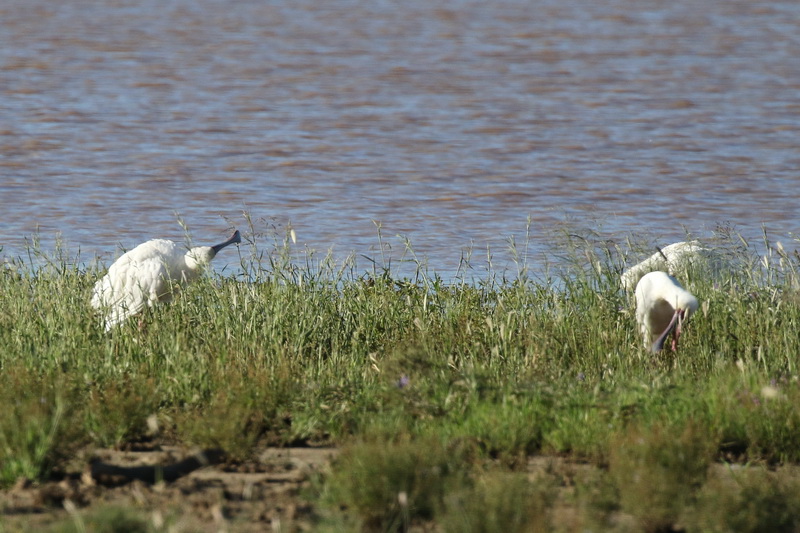
African Spoonbills
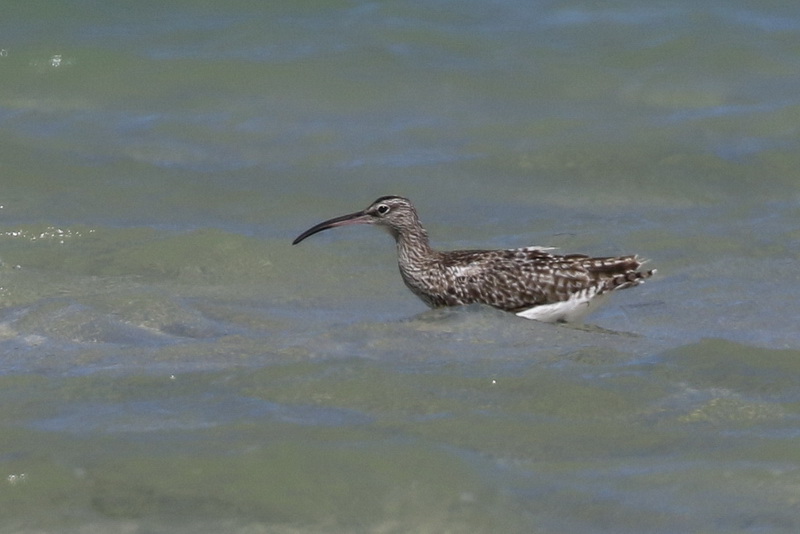
We did however manage to get to the sea shore to find a couple of Common Whimbrels.
Common Whimbrel
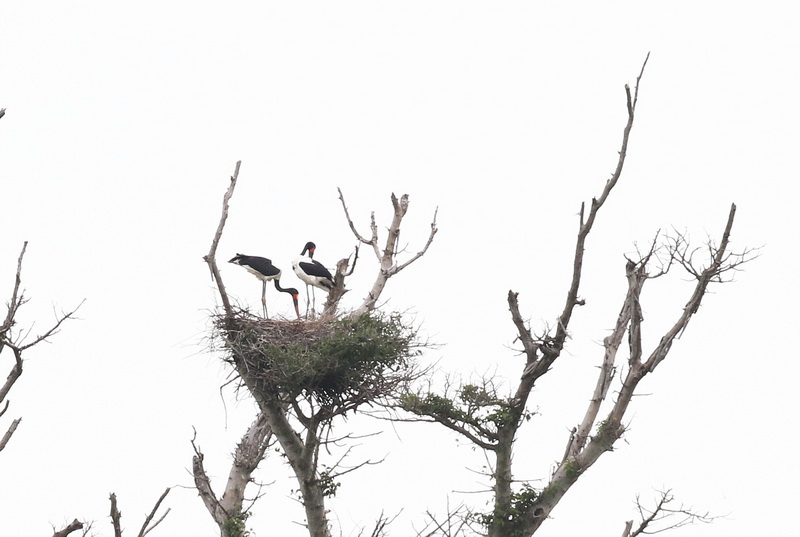
On the way back we drove through Western Shores taking the uMphathe loop road. A Saddle-billed Stork was seen close to the road. It appeared to be looking for something. After a while it flew off with a clump of bush in its beak. We wondered where it was headed. Then we saw it land on its nest at the top of a tree on the horizon. It’s mate was there to greet him.
Saddle-billed Stork looking for nesting material
Saddle-billed Storks on nest
Saddle-billed Storks on nest
At the Kweyezalukazi Lookout point there were about 11 Lemon-breasted Canaries – exactly where we had seen them before.
Lemon-breasted Canaries
Then around the corner in an open plain we noticed a rapter at the top of a dead tree. Out came the scope but it was too difficult to identify. You decide – we thought it was either an Amur Falco or an Eurasian Hobby. Most likely the former.
Amur Falcon
Amur Falcon
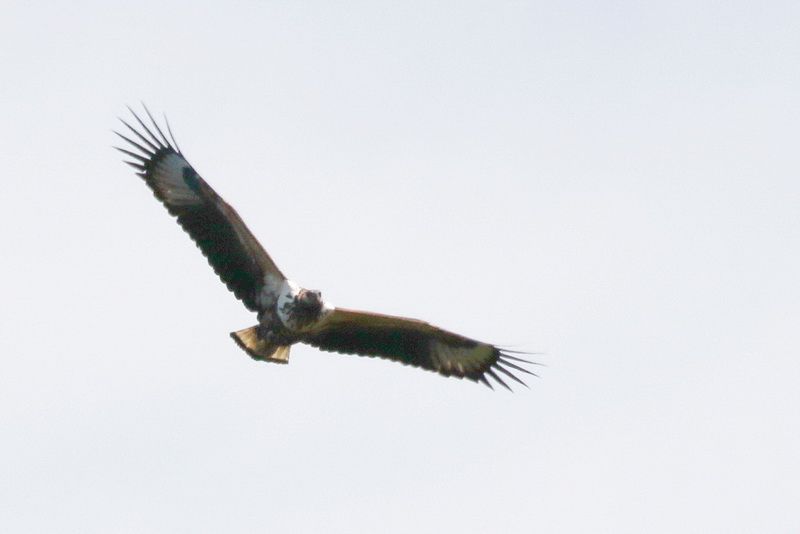
And finally as we were about to leave the park – a Brown Snake-Eagle looking remarkable like a Bat Hawk because of its posture.
Brown Snake-Eagle trying to impersonate a Bat Hawk.
And then we went to camp in Mkuze. Prices way over the mark for camping. R300 per night for the site – up to 3 people. This is just another cheap trick to generate extra income as most people either come as a couple or single. They refuse to make any concessions for groups of one or two people. The ablutions are basic and there is no power from 09h00 till 17h00 and from 22h00 to 05h00. And there is now a R10 community charge on entry plus R7 per person per night in the reserve. Camping in Zululand is becoming too expensive for most potential visitors. No wonder there are so few people in the camps.
We only stayed one night.
Impala, Nyala and Baboons were plentiful with the odd Zebra and Wilderbeest but no other animals were seen during our stay.
Nsumo Pan was very full and the hides in good condition with some having new concrete walkways.
White-winged Terns over Nsumo Pan
White-winged Terns
Nsumo Pan
Nsumo Pan
Nsumo Pan
Nsumo Pan
As usual the best place to spend midday was at kuMasinga hide. We did have one mystery bird there though. What do you think it may be?
Three-banded Plover
Red-billed Oxpecker – bath time
Red-faced Mousebird – hanging on precariously
Frog in a tree
Fledgling Pin-tailed Whydah
Fledgling Pin-tailed Whydah
Fledgling Pin-tailed Whydah
Elsewhere round the park.
Malachite Kingfisher
Little Bee-eater
Bi-plane
African Goshawk
African Goshawk starting its dive
African Goshawk in dive mode
Having dinner at Mkuze we noticed a person’s face on one of our hanging tea towels. Could it have been Donald?
Who do you think it looks like?
And then some bird droppings on the side of the car looking like an owl in flight.
Owl in flight
Overall we identified 144 different bird species. To see what we identified and where click here.
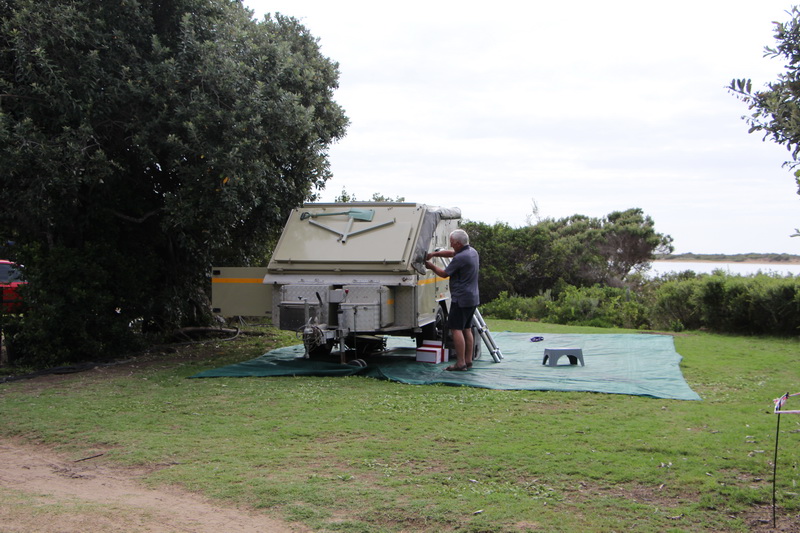
From Wilderness we headed for Plettenberg Bay and the Keurbooms LagoonCampsite. The place was very busy especially the waterfront sites. However we were in luck and found an almost private site with a view over the lagoon. The cost R240 per night – no pensioner discount despite being mid-week.
Our Campsite
Gnarly tree by our campsite
View from our campsite.
Tide is out and the cormorants are aplenty on the far spit
Initially they only had one ablution open but opened up another for the weekend. They were passable.
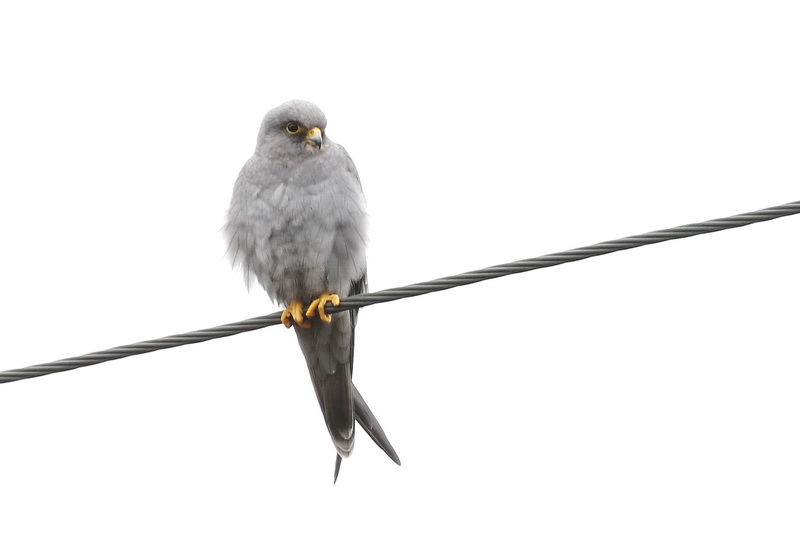
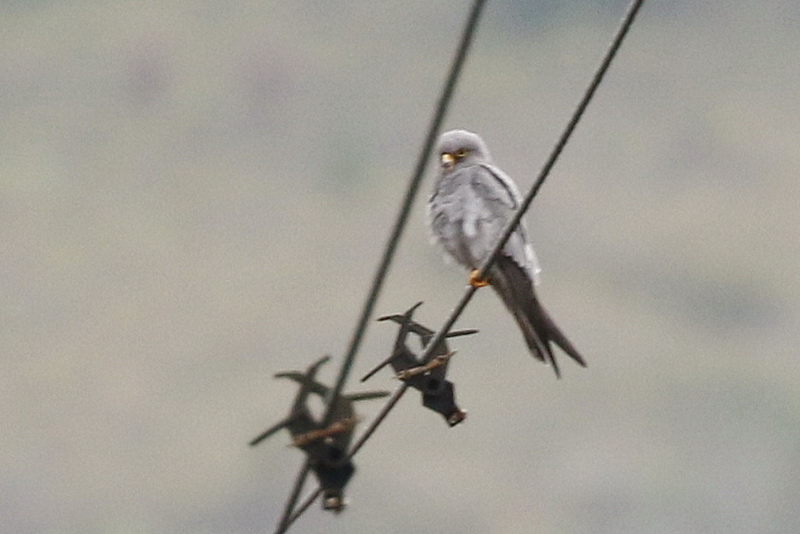
The Rare Birds Report noted that the Sooty Falcon was still present. So we went to look for it on our first morning there. We found it but the sky was too grey for photography. However the next day we were able to get quite close and managed a couple of shots enabling positive ID for ourselves.
Sooty Falcon
Sooty Falcon
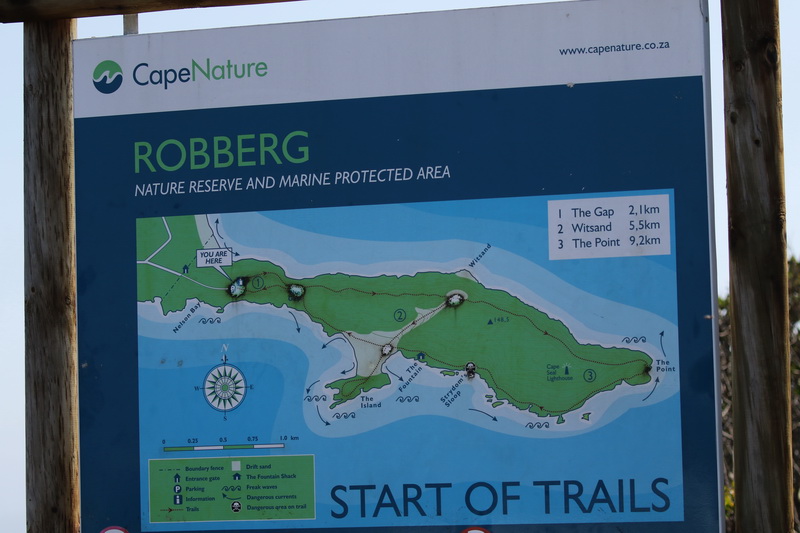
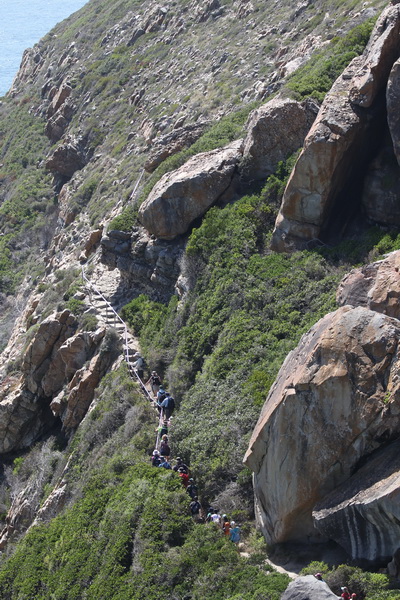
Part of our time there was spent enjoying the scenery with a visit to Roburg. Needless to say we did not walk all the way down to the beach. We got to one lookout point and stopped there – seeing a large seal swimming close to the shore and exhausted panting people passed us having climbed the steep steps up from the distant beach.
Roberg
Roberg Scenery
Daunting pathway
Not even half way down
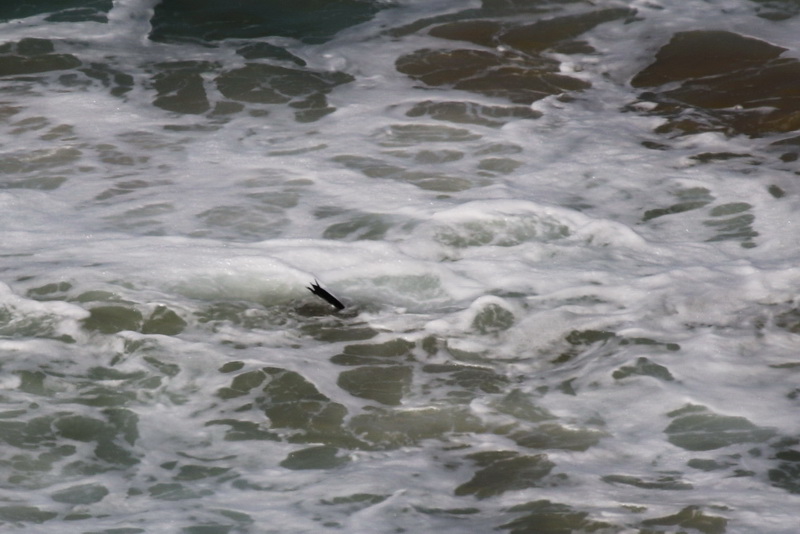
Seal flipper
Seal facing a dump
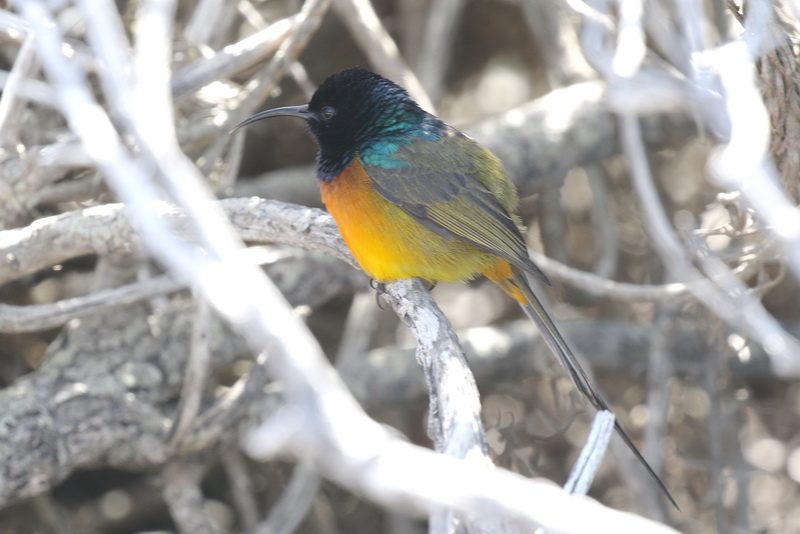
On the way back a pair of Orange-breasted Sunbirds succumbed to the heat and took shade in a bush right beside the path. Most of the time they had their eyes closed.
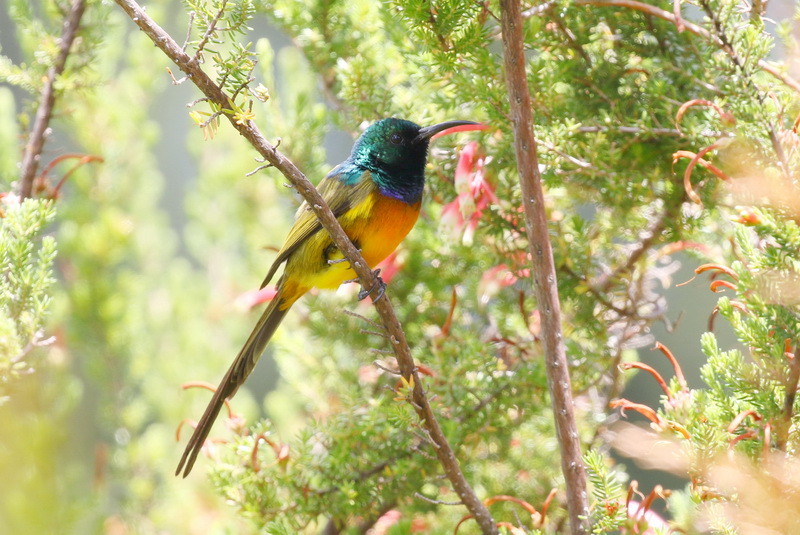
Orange-breasted Sunbird
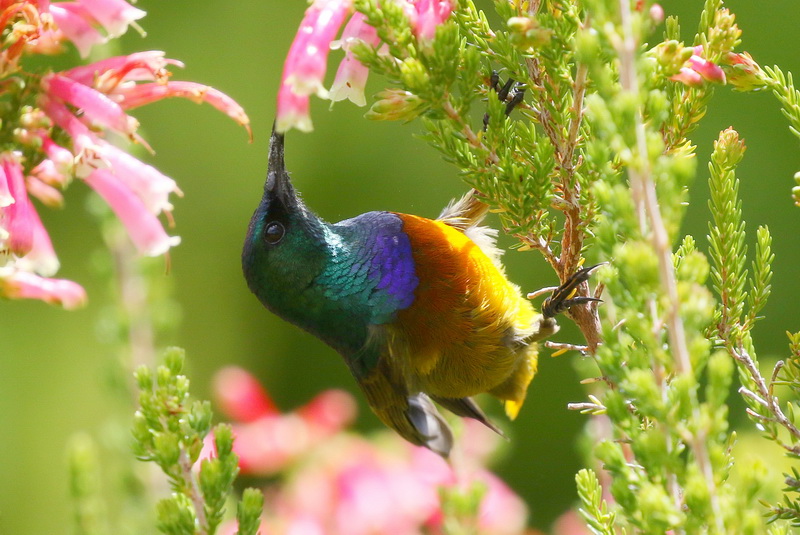
Orange-breasted Sunbird
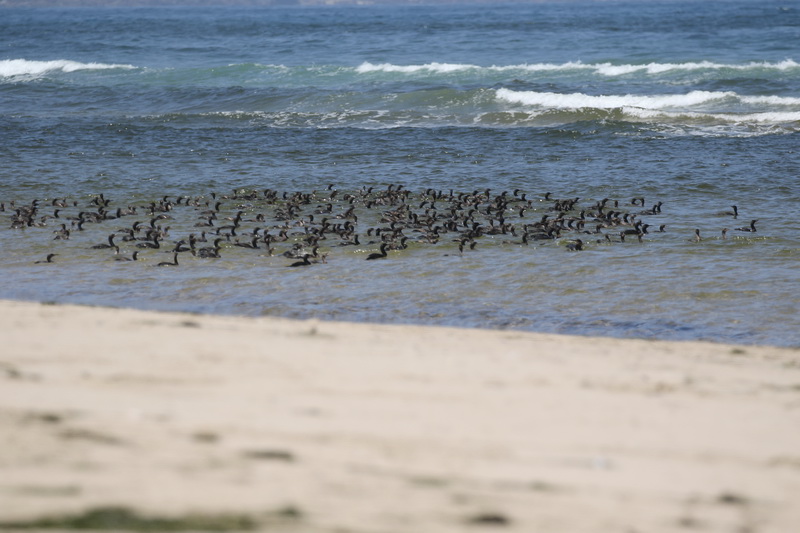
Back at the campsite we took a canoe to the opposite shore of the lagoon at low tide. There we saw almost one thousand Cape Cormorants on the spit’s edge. There was also plenty of Kelp Gulls as well as a dozen or so African Black Oystercatchers.
Cape Cormorants – a small group
Black Oystercatcher – ringed
Western Osprey
Western Osprey
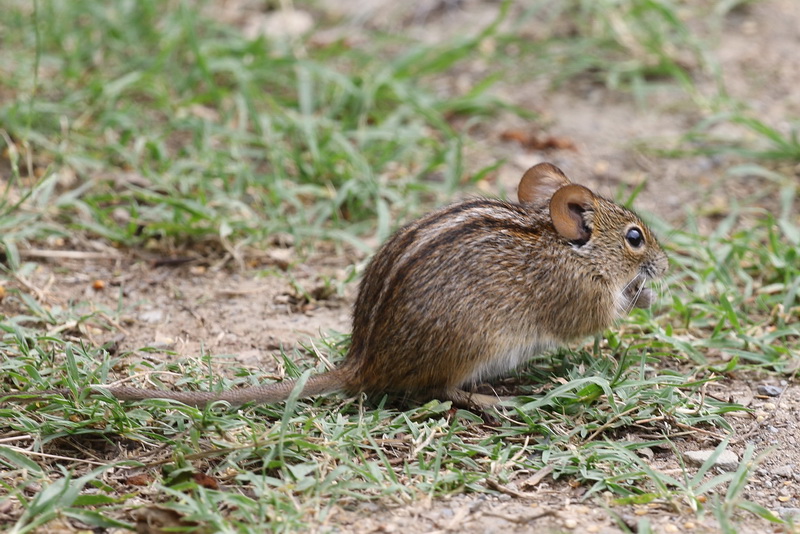
Campsite birds included Cape Turtle-Doves, Cape Robin-Chats as well as a friendly striped-backed mouse. Driving around the area we saw a few other birds which kept us interested.
Malachite Kingfisher
River Whimbrels
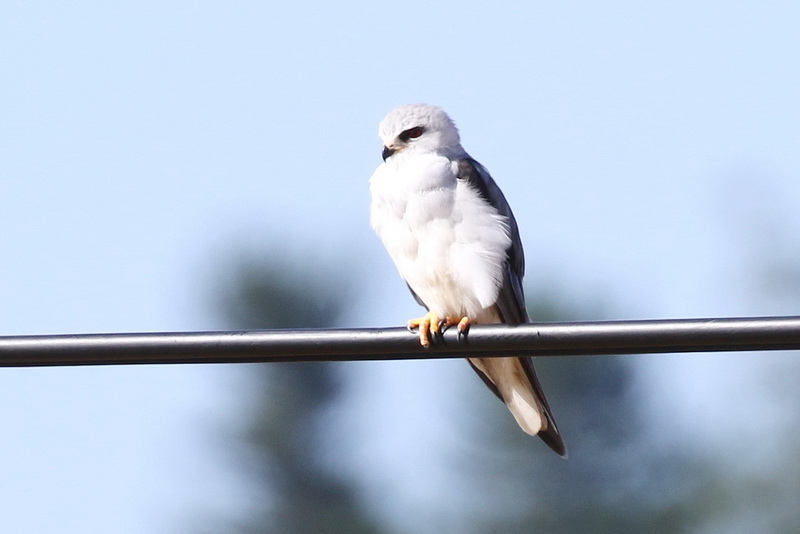
Black-shouldered Kite
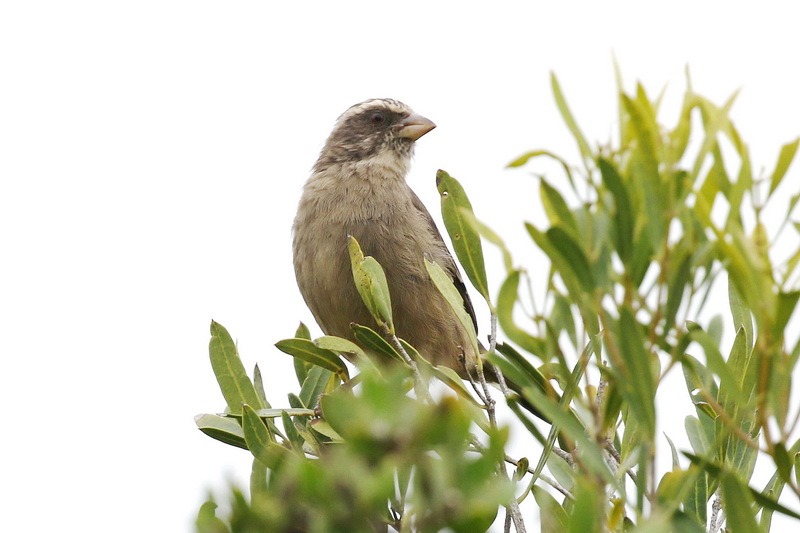
Streaky-headed Seedeater
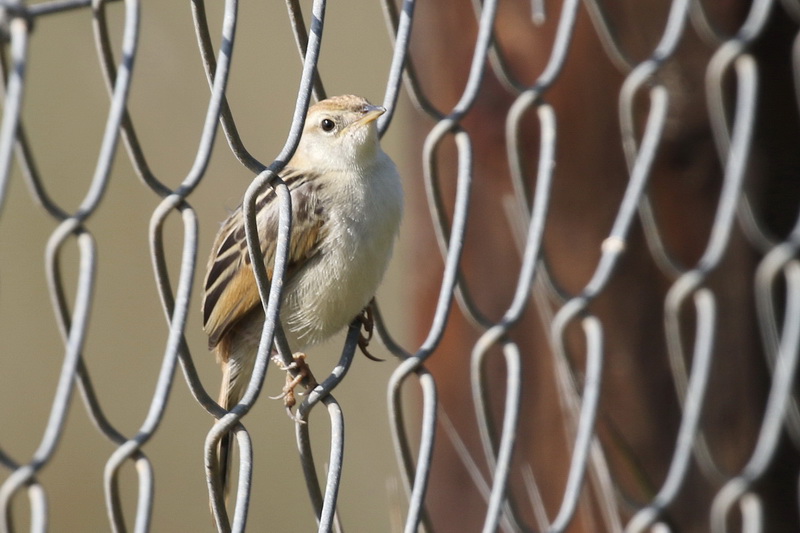
Levaillants Cisticola
From Plettenberg Bay we went to Tsitsikamma – Nature’s Valley. R248.46 for two nights which includes the 40% pensioner discount.
De Vasselot – Nature’s Valley
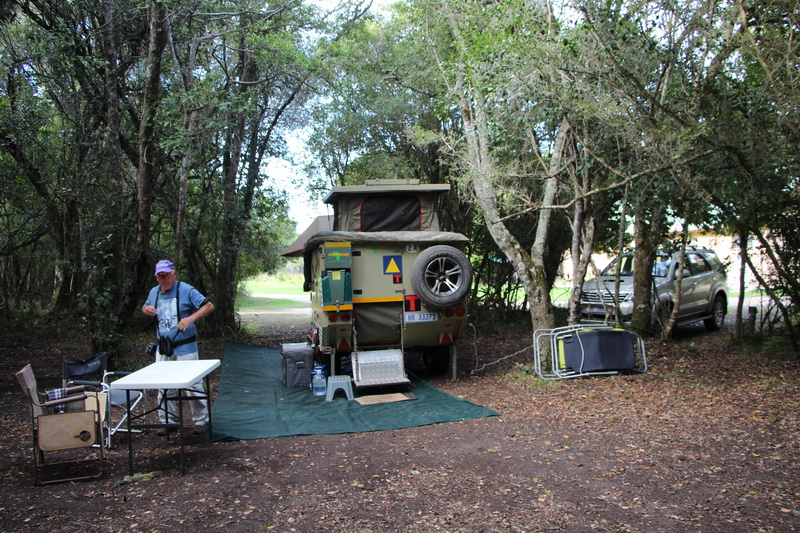
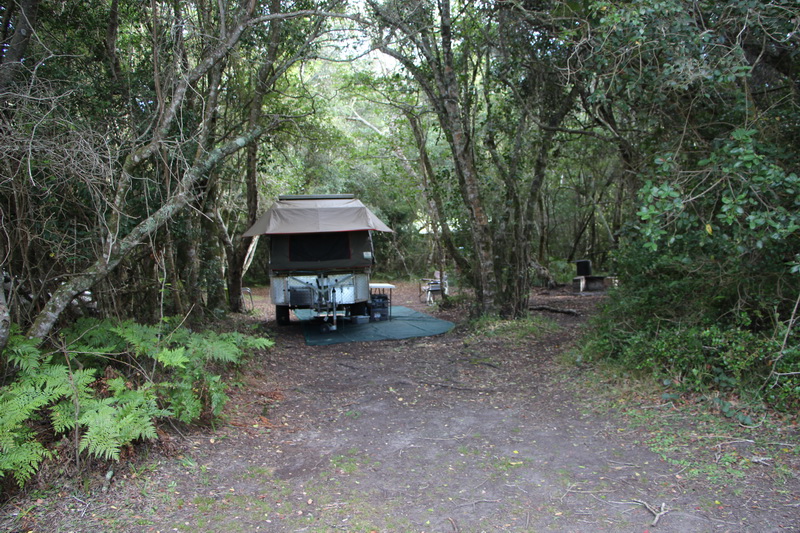
Choosing a site proved difficult. There was no power except by connecting to one of the facility buildings. We decided that we wanted to be in the woods and chose a site near the ablutions. We expected there to be no power however I managed to get a cable across the road into the scullery.
Our Campsite
Our Campsite
Our neighbours were brilliant. Once set up they came calling. First a Chorister Robin-Chat then a Lemon Dove. Each within metres of us. What a welcome.
A visit to the river mouth was unproductive birdwise but a pleasant stroll to get some exercise. On return we went for a stroll around the forested campsite which was quite quiet. We arrived back at our campsite to find four Lemon Doves and a Chorister Robin-Chat under our car. What a start to our time there.
Nature’s Valley Estuary
Looking up river from Nature’s Valley Estuary
The next day we went for a walk on one of the trails to the north of the river. The forest of well established tall trees was magnificent.
Well established forest trees.
Forest
Some idea of the size of the trees.
River crossing
At first the birding was good with Forest Canaries, Swee Waxbill and Grey Cuckooshrike all entertaining us at one spot. Further up the trail we joined the Otter Trail and birding was pretty quiet – except for what we thought might have been a Narina Trogon.
Grey Cuckooshrike
Grey Cuckooshrike
Forest Canary and Swee Waxbill
Forest Canary and Swee Waxbill
Forest Canary
Black-backed Puffback
Back in camp we relaxed and had constant visits from several Lemon Doves and the odd Chorister Robin-Chat. They were not concerned about our presence and came right up to us. Some of the other campsite birds and other visitors:
Bushbuck
Black-headed Oriole
Southern Boubou
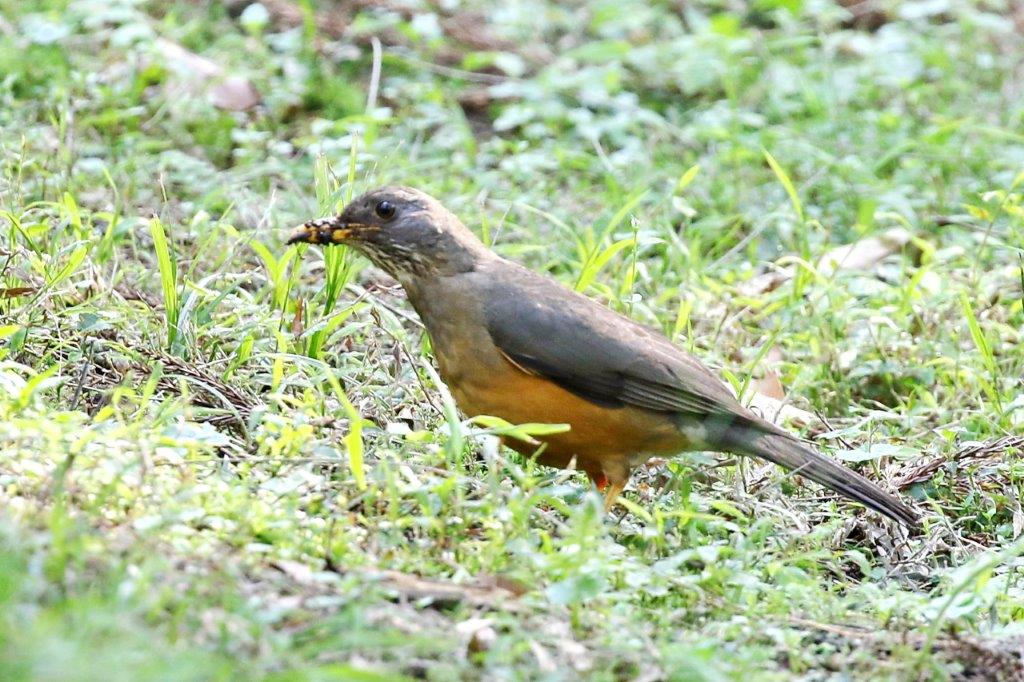
Olive Thrush
Olive Thrush
Dusky Flycatcher
Collared Sunbird
Later we went for a walk in the campsite and saw little except when we got back five Lemon doves and two Chorister Robin-Chats greeted us.
Chorister Robin-Chat
Chorister Robin-Chat
Lemon Dove – one of five wandering around us.
Lemon Dove – one of five wandering around us.
So special to see these birds up close and unconcerned about us.
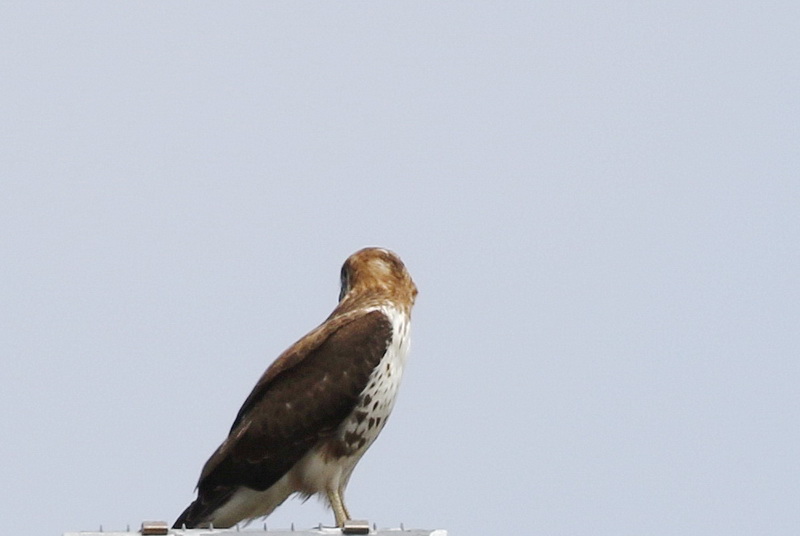
This raptor waved us goodbye from way up high – anyone care to ID this for us would be welcome.
UI Raptor ? Goshawk? Red-chested?
UI Raptor ? Goshawk? Red-chested?
Mountain Zebra NP was our next destination for 3 nights. Midweek with pensioner discount of 40% amounted to almost R500. Unfortunately we were not aware that the campsite was undergoing renovation so we had to put up with bulldozers etc when we were in camp during working hours. It meant we spent all day in the park without a break.
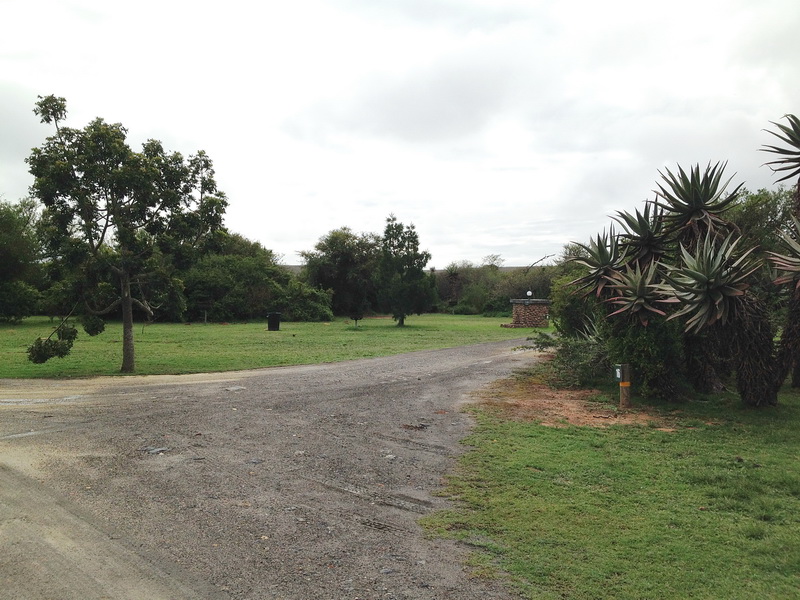
Our Campsite
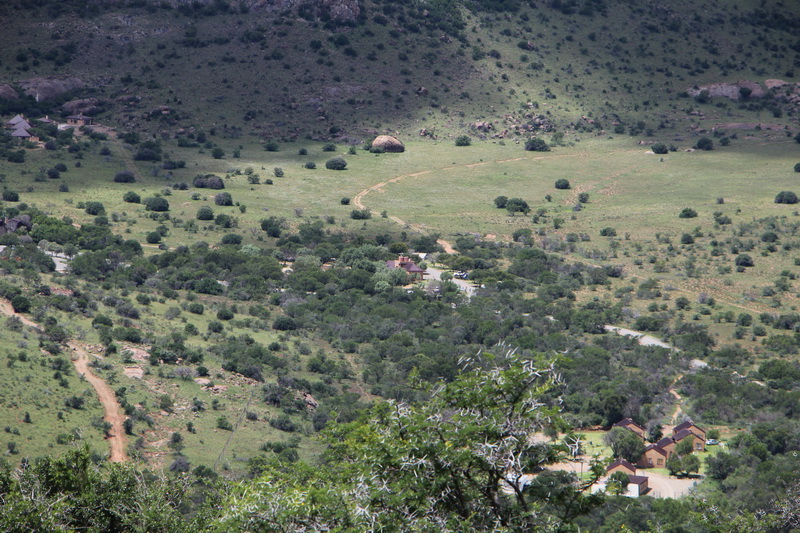
This turned out to be one of our favourite birding areas. The habitat was varied from grassland at the top of the mountains, acacia savannah lower down, dams and wetlands.
Grasslands looking up
Grasslands looking up
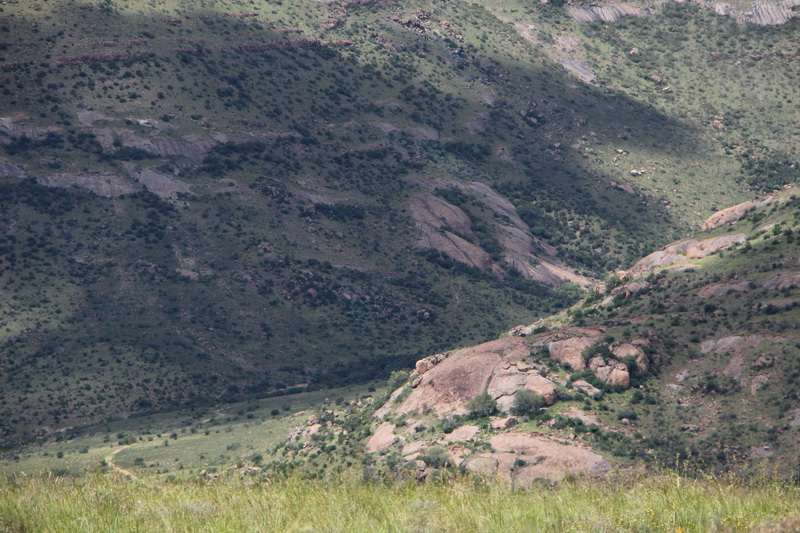
Steep hillsides
Steep hillsides
From the upper grasslands looking down
Bouldered hillsides
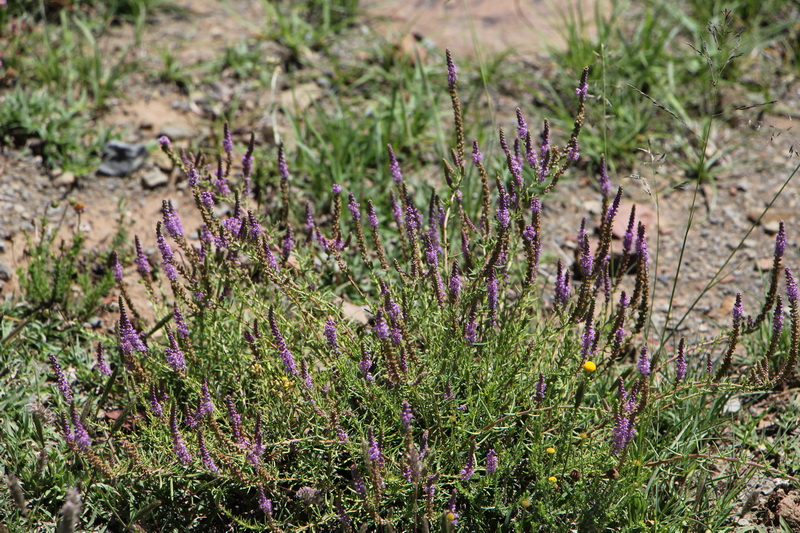
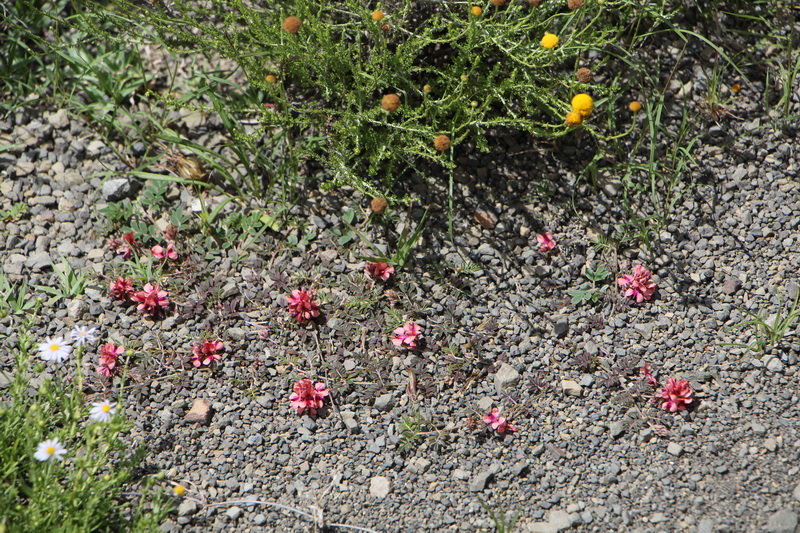
Sally was enamoured by the flowers in the upper grasslands.
Aloe Sally
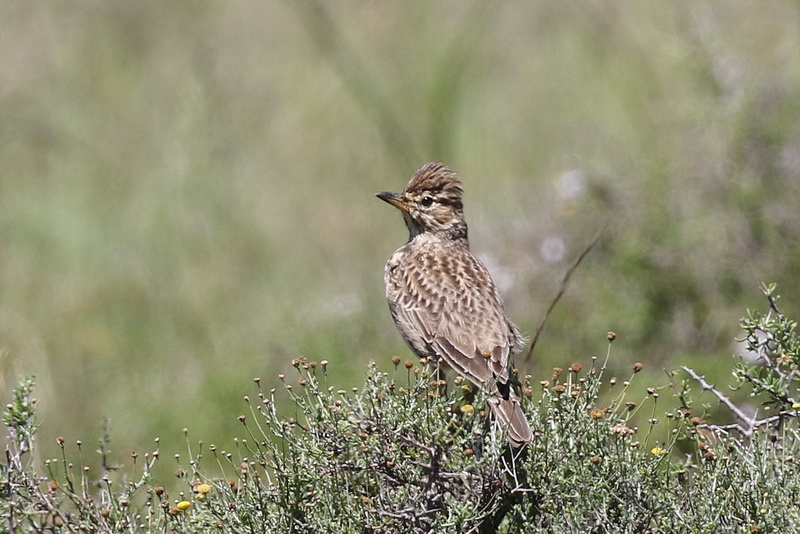
In all we recorded about 90 different bird species. Many of the birds were new to our trip – Gabar Goshawk, Black-headed Canary, Denham’s Bustard, a range of Pipits and Larks, Red-headed Finches, Scaly-feathered Warblers to name a few.
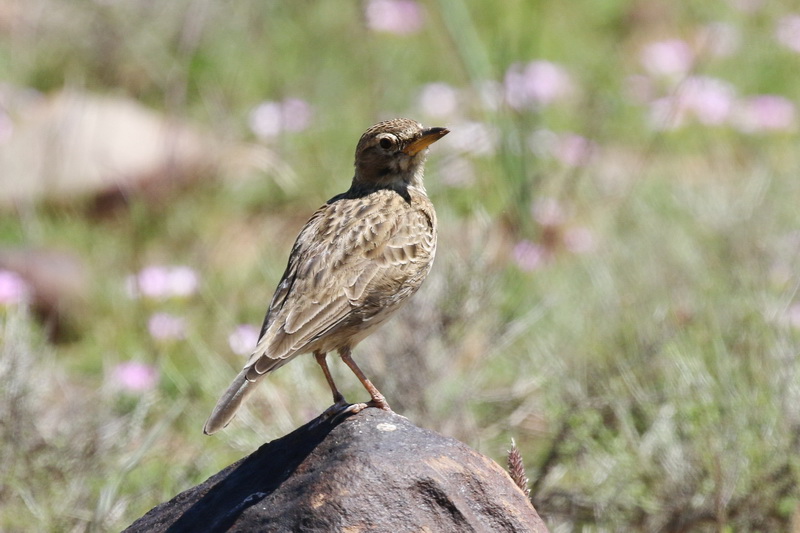
African Pipit
African Pipit
African Spoonbill
African Spoonbill
Ant-eating Chat
Ant-eating Chat showing its white in the wings
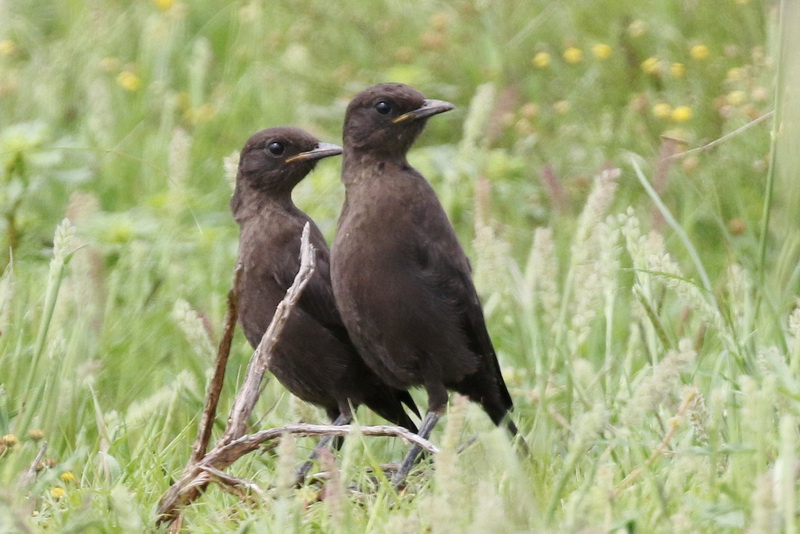
Ant-eating Chats – juveniles
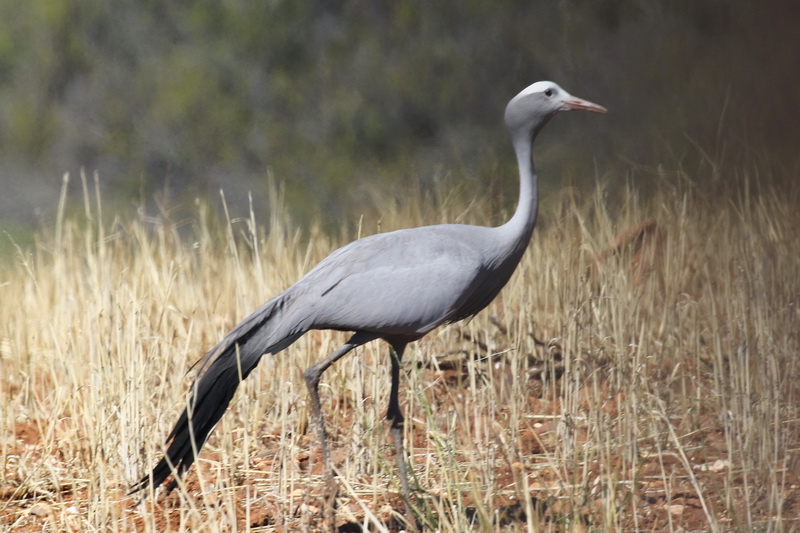
Blue Crane
Cape Longclaw
Cape Sparrow
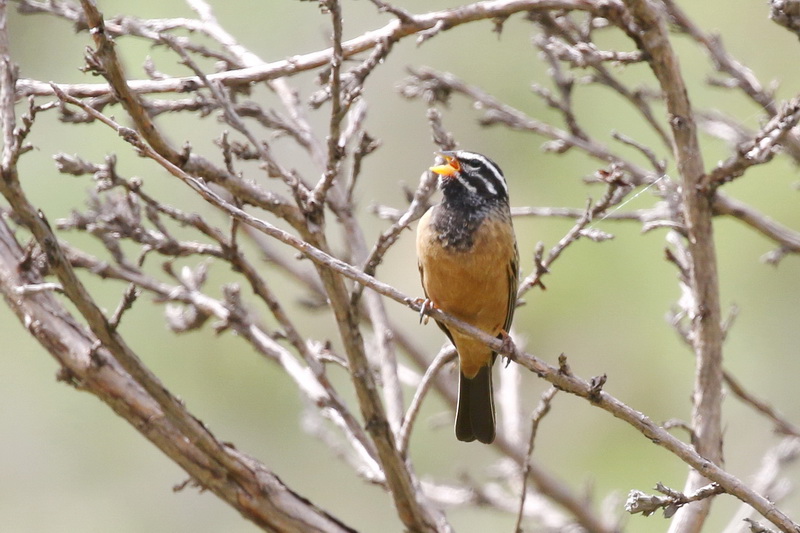
Cinnamon-breasted Bunting
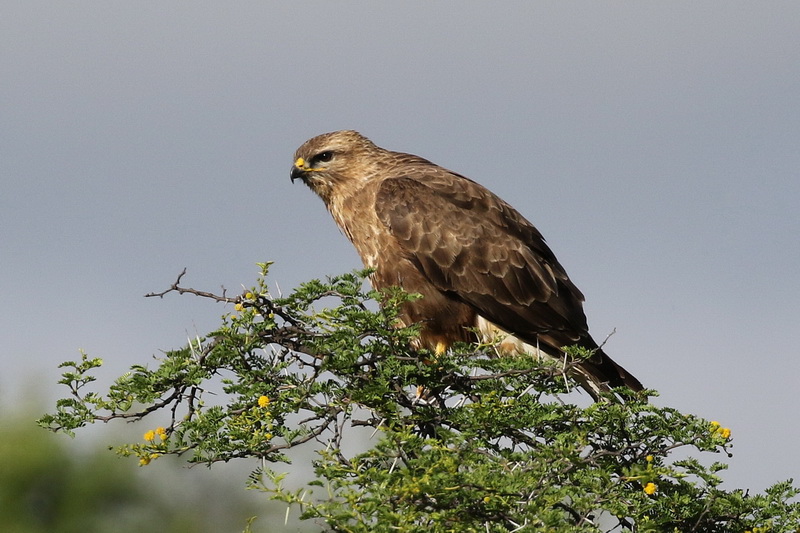
Common Buzzard
Common Ostrich
Crowned Lapwing_
Diederik Cuckoo – adult male
Diederik Cuckoo – juvenile
Eastern Clapper Lark – displaying
Denham’s Bustard
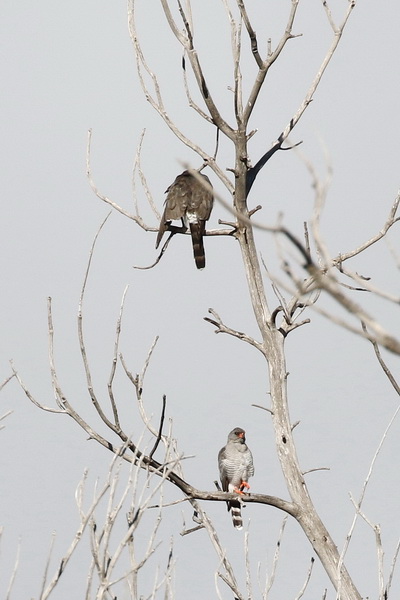
Gabar Goshawk
Gabar Goshawks – female above male below.
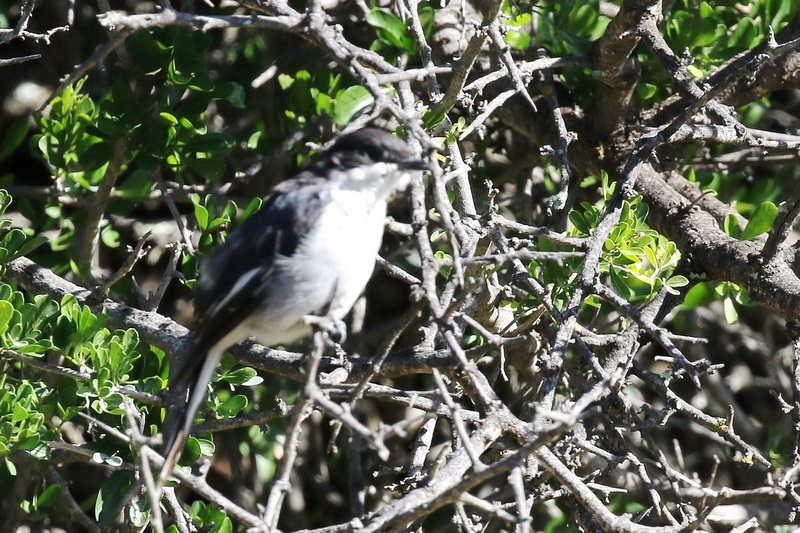
Fiscal Flycatcher
Goshawk – Pale Chanting
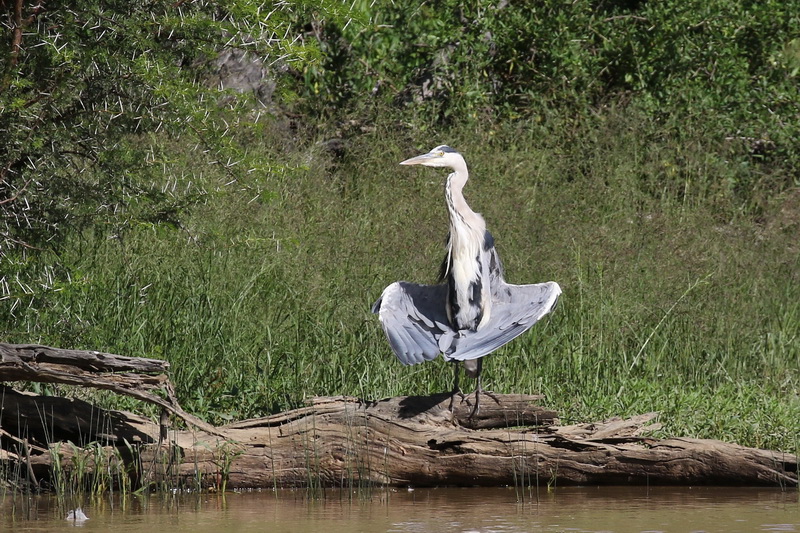
Grey Heron
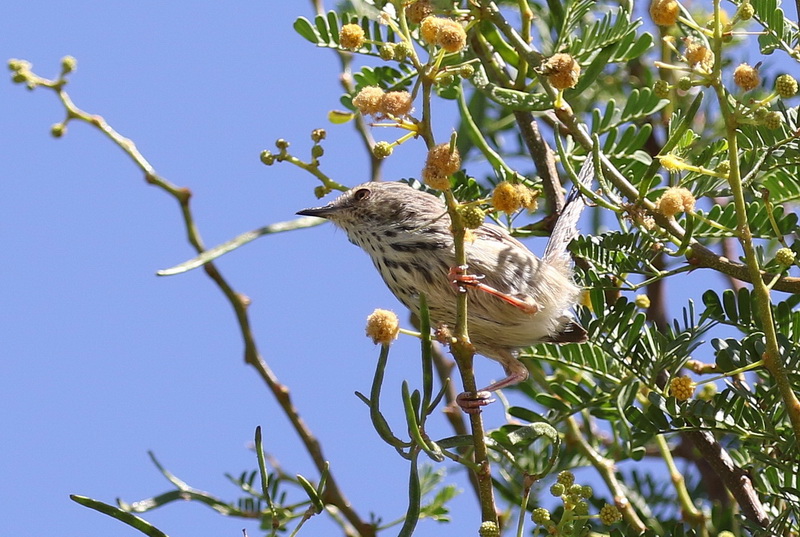
Karoo Prinia
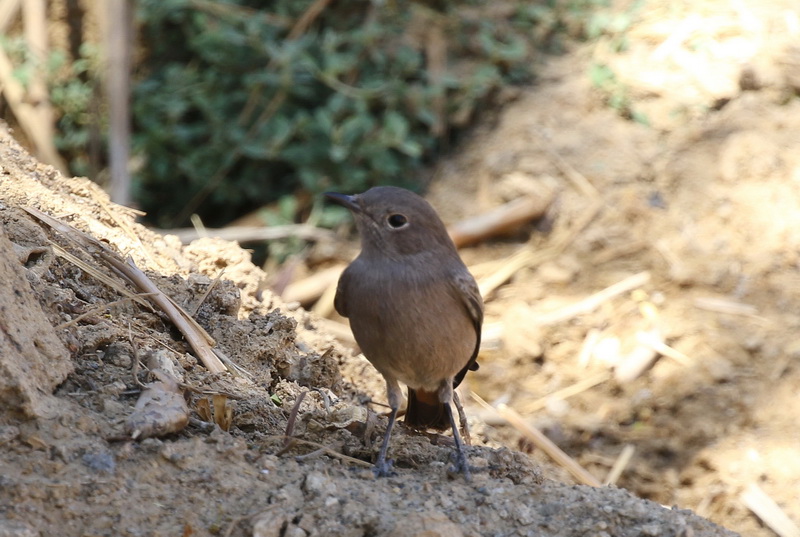
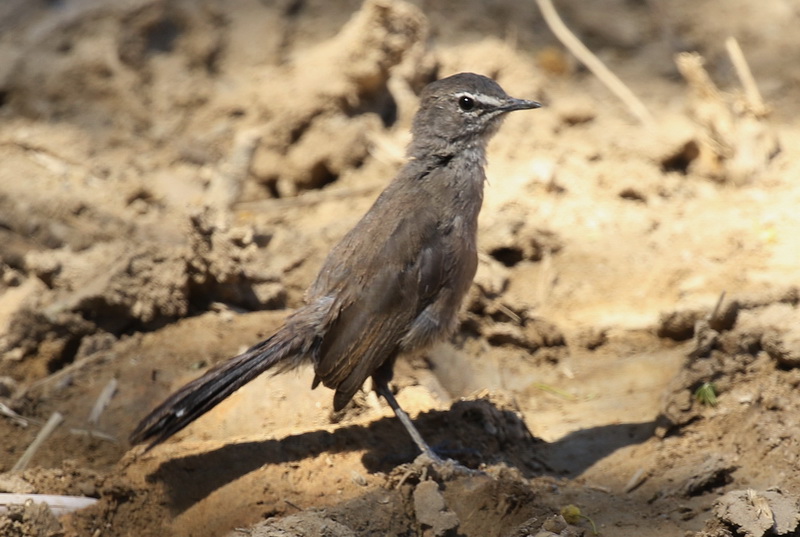
Karoo Scrub-Robin
Long-billed Pipit
Large-billed Lark
Large-billed Lark
Melodious Lark
Melodious Lark
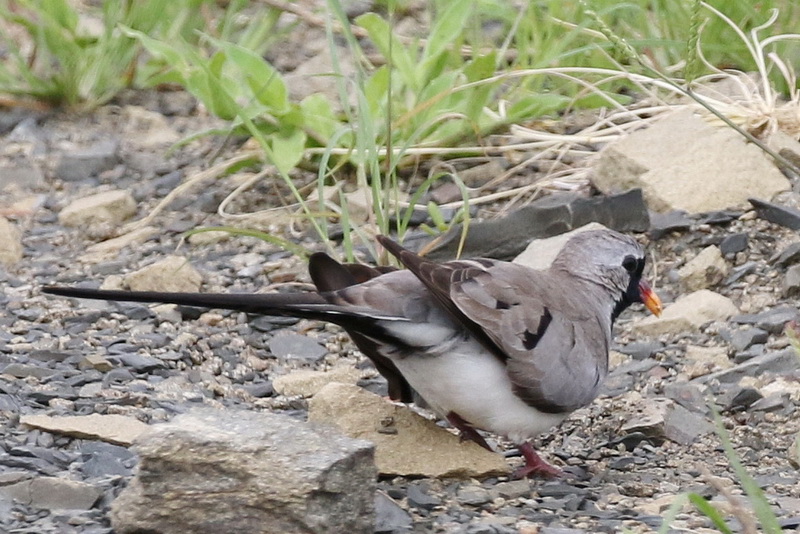
Namaqua Dove
Northern Black Korhaan
Pearl-breasted Swallow
Pied Starling
Plain-backed Pipit
Red-billed Oxpecker
Red-headed Finch
Red-headed Finches – male and female
Red-headed Finches – male and female
Scaly-feathered Weaver
Rock Kestrel
Southern Masked Weaver
Sickle-winged Chat
Sickle-winged Chat
Streaky-headed Seedeater
UI Bird
UI Bird
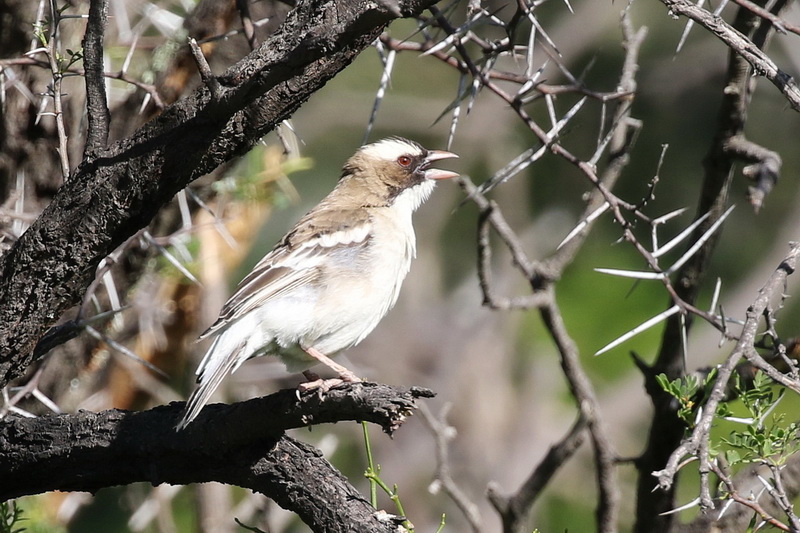
White-browed Sparrow-Weaver
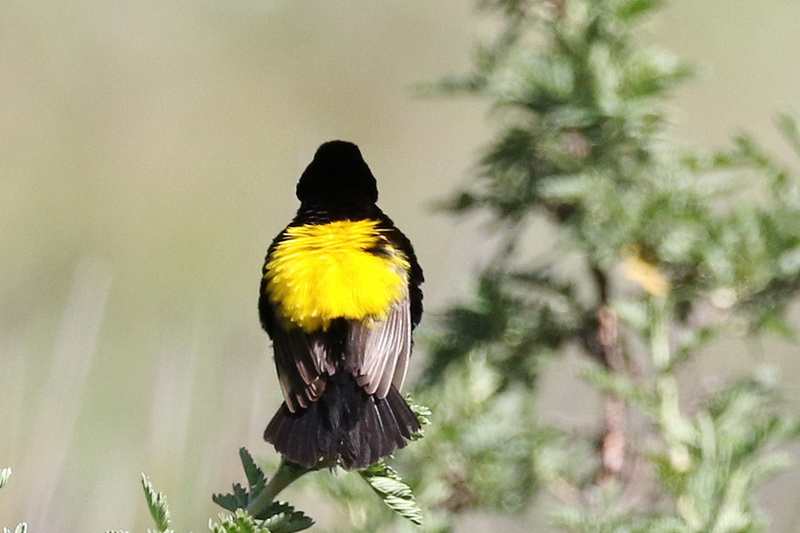
Yellow Bishop
Yellow Bishop
Pale Chanting Goshawk
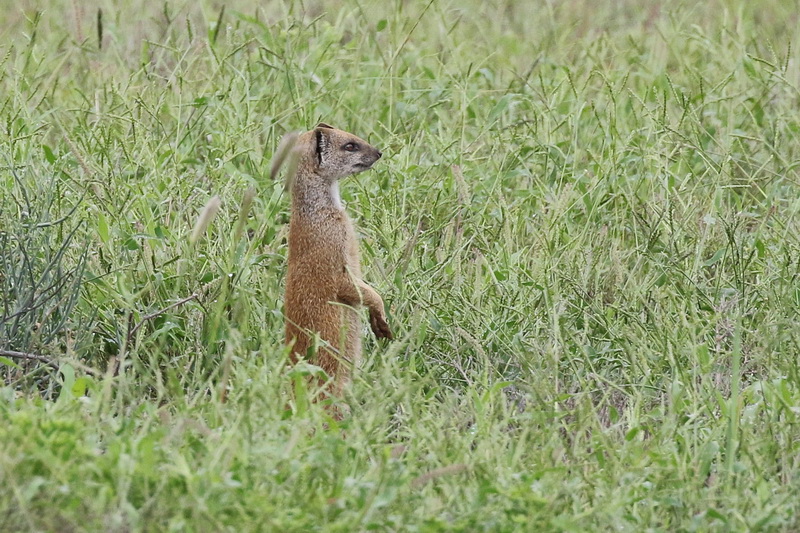
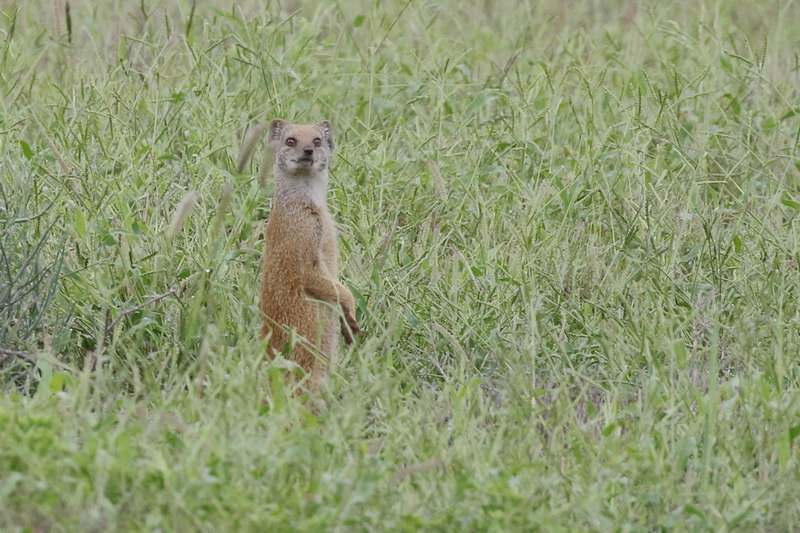
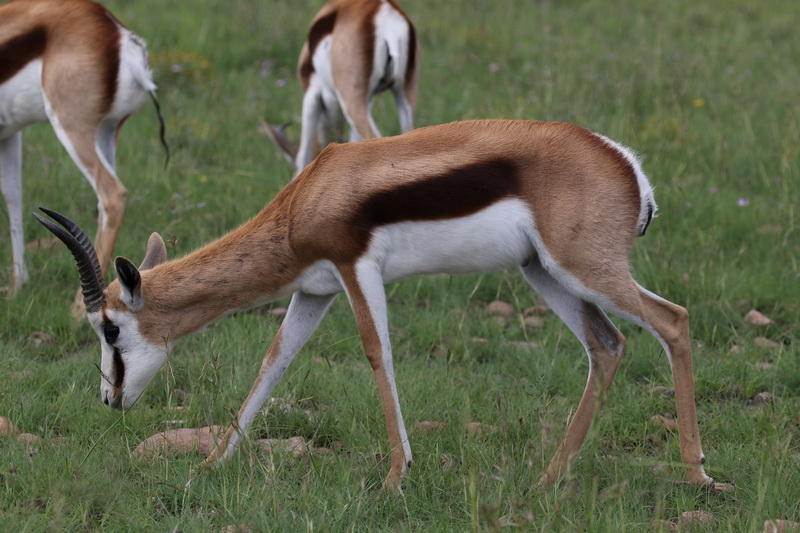
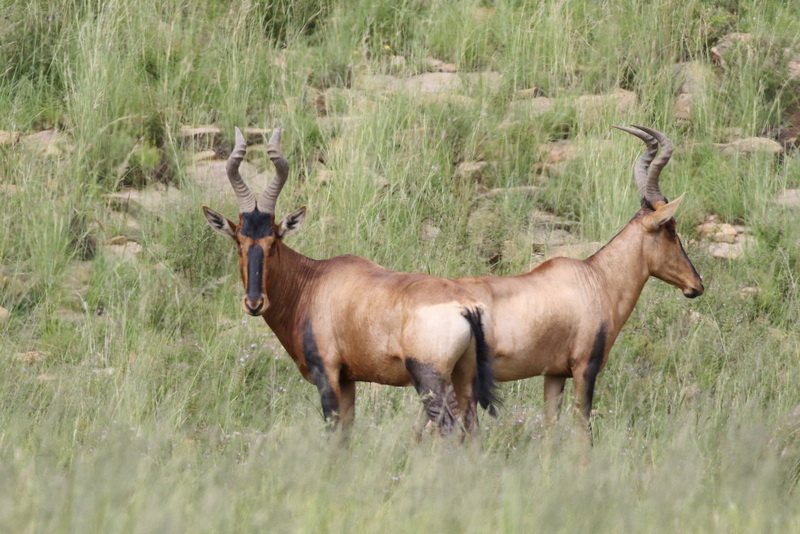
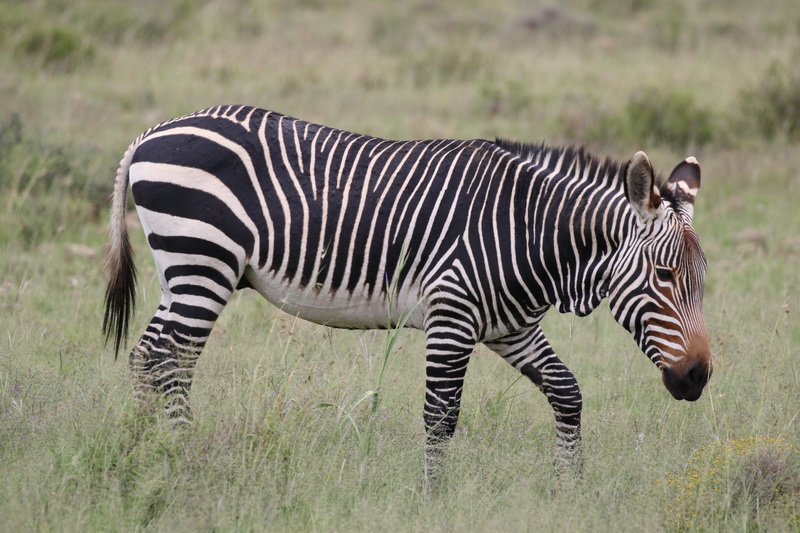
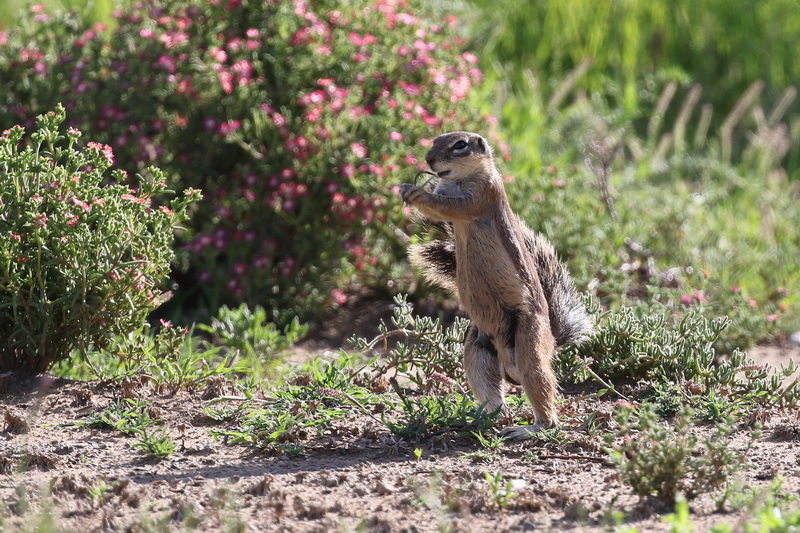
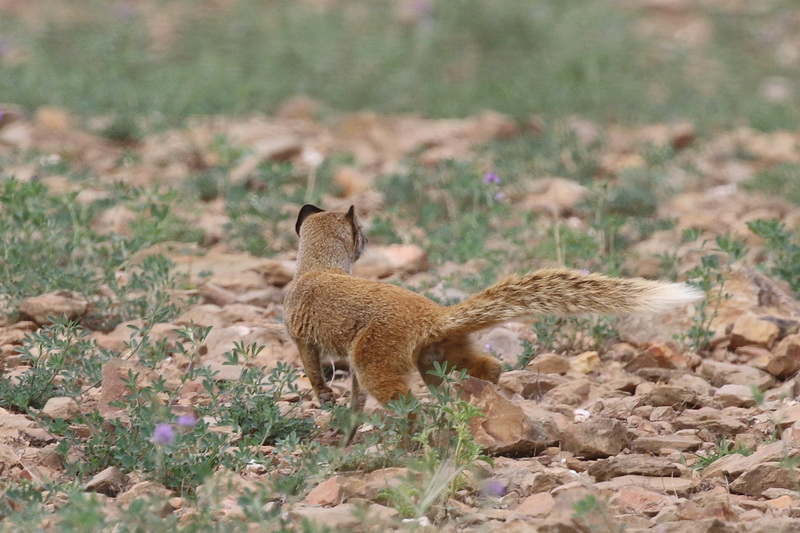
Lions were present but we managed not to encounter any. Game was plentiful – Cape Mountain Zebra, Black Wildebeest, Springbok, Eland, Hartebeest, Blesbok all readily seen. We also came across a Grey Rhebok, Yellow-tailed Mongooses, Ground Squirrels.
Yellow-tailed Mongoose
Yellow-tailed Mongoose
Springbok
Springbok and new born
Hartebeest.
Hartebeest.
Grey Rhebok
Gemsbok or Oryx
Cape Mountain Zebra
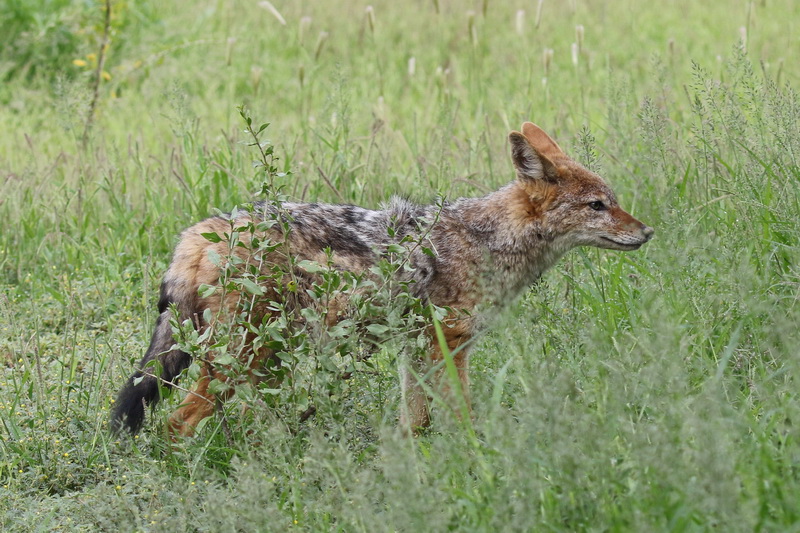
Black-backed Jackal
Black Wildebeest
Ground Squirell_
This is a place we would enjoy going back to – once the campsite renovation has been completed.
And then we headed home.
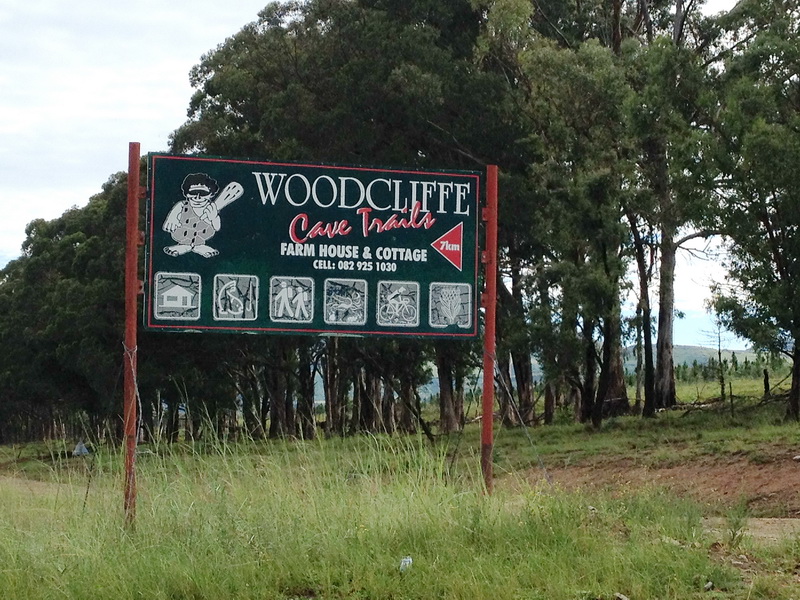
We decided to break the journey home with a stopover at Woodcliffe Country Lodge, 22 kms up the road to Naude’s Nek pass from Maclear. A self-catering cottage with a view and giving our poor trailer a rest. R600 for the night.
Woodcliffe Cottage
Woodcliffe Signage
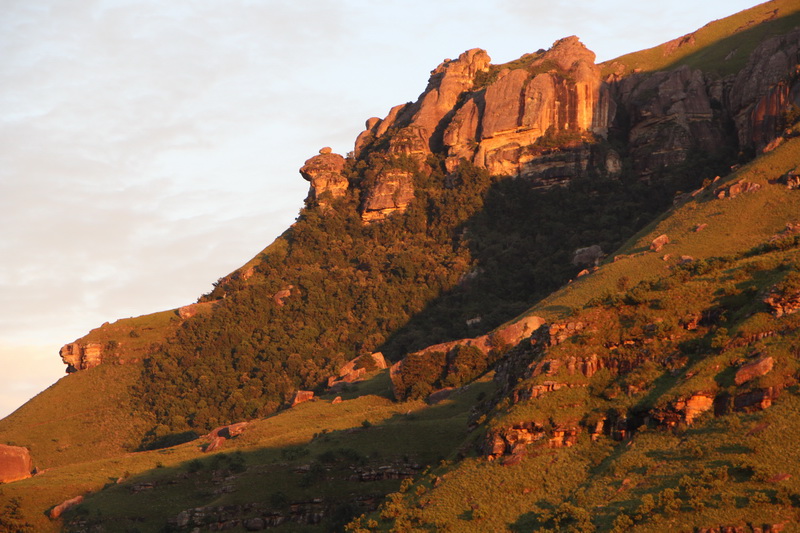
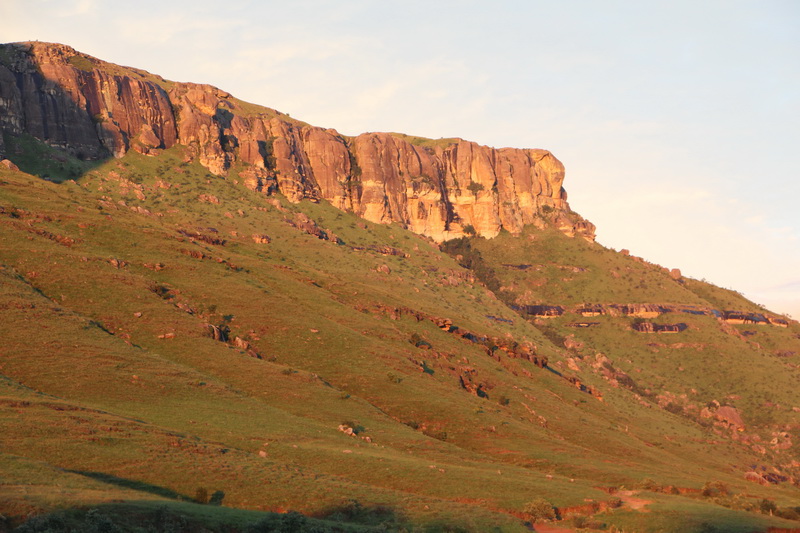
Cottage View- sunrise
Giants Castle look-alike – sunrise
Cottage View- sunrise
Cottage View- sunrise
Cottage View
Cottage View
Cottage View
Cottage View
What a drive that turned out to be. Those 22kms should have taken us an hour. We were warned that we need 4×4 as the road was muddy after the rains. However we managed to take an extra hour missing our turn off and having to find someplace where we could safely turn round with the trailer!
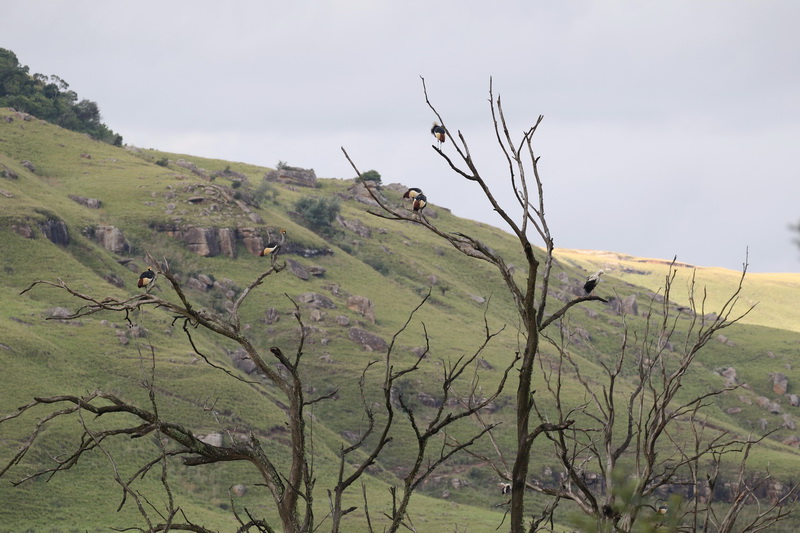
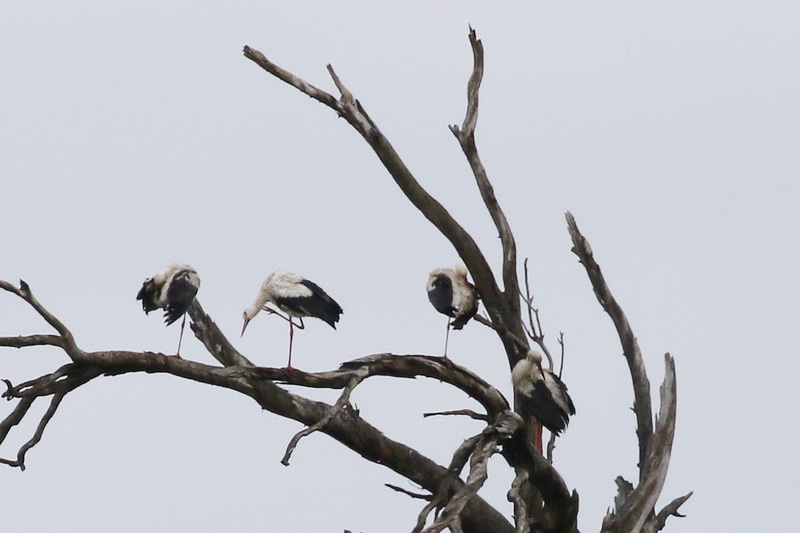
On the way in we saw a number Grey-crowned Cranes and many White Storks. In the evening they roosted in the trees near our cottage.
Grey Crowned Cranes and White Stork
White Storks
A bull decided to come through the fence to eat the mown grass round the cottage. Although he got chased out and the wire repaired he burst through again the next morning.
White-throated Swallow
Black-collared Barn Swallow
More rains came and went giving us cause for concern as to whether we would get out the next day!
We left early but not before seeing 13 Grey-crowned Cranes together in the field by our cottage. On the way back to the main road we saw at least 12 more.
Grey Crowned Cranes
Grey Crowned Cranes
Grey Crowned Cranes
The road was as soggy as expected and we had to use low range in numerous spots. Then the rest of the journey home was a slow ride through the Transkei.
In all, we had an unexpectedly pleasant trip with the bonus of missing all the rain back home. In all we saw 244 different bird species and 100 of these species were only seen in one location. If you are interested click here to see our complete bird list at each location we visited.
After three nights in Dwarskersbos and exploring Velddrif and West Coast National Park we wondered where to go next. Eventually we decided to head inland to see the Cederberg mountains. Sally had previously camped in a pretty place called Algeria – in the Cederberg. She was keen to return so that is where we headed for two nights.
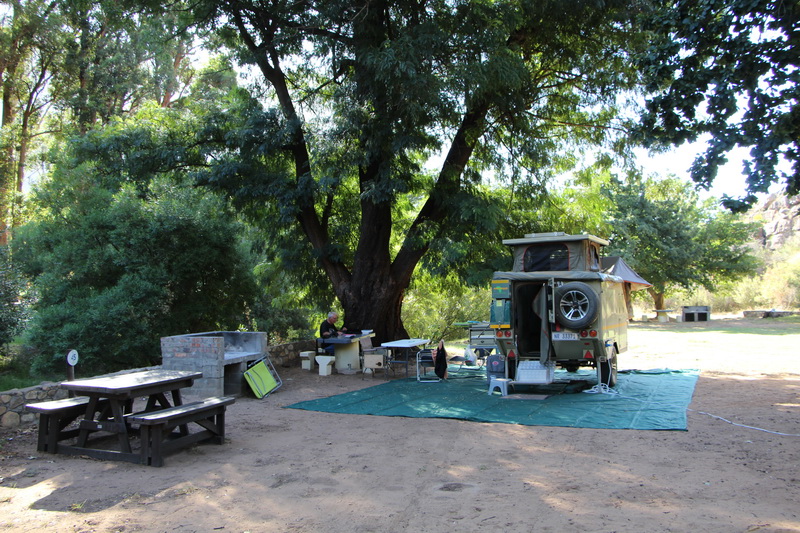
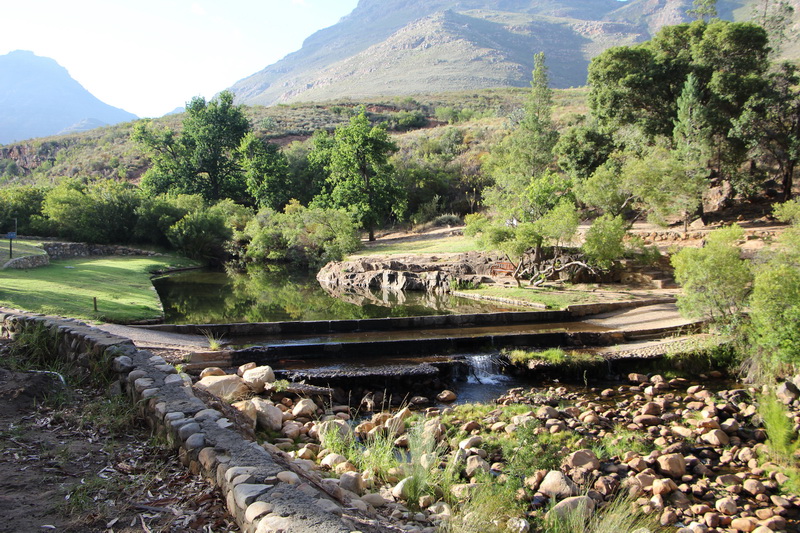
The site is run by Cape Nature. The campsite was relatively empty with about only 4 other camps taken. Most of the sites are well treed, some on grass but the more popular on sand or stone for the views and shade. Several nice sites overlook the stream and rock pool where you can take a dip.
Sign to Algeria
Reception
Our Campsite
Camp view of the swimming pool
Shaded campsites
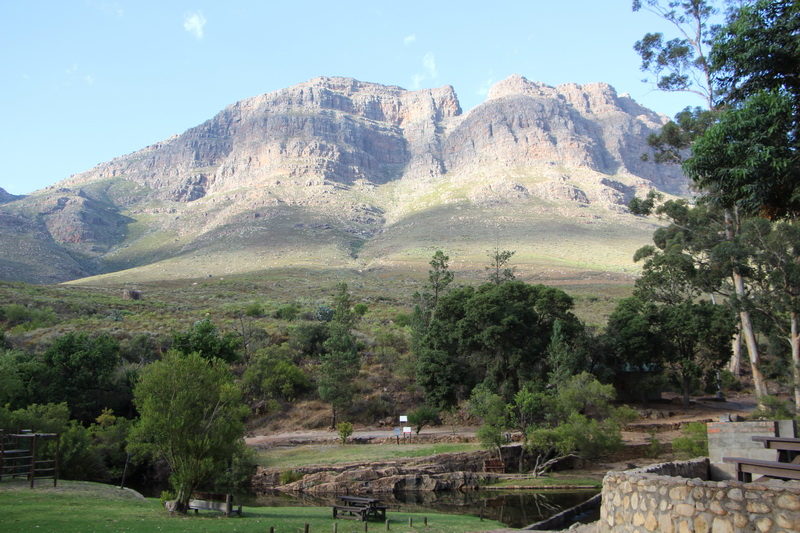
Countryside
Countryside
View from the campsite
Each night cost R240 – a bit of expensive for what it offered. The campsite ablutions also had no toilet paper. It is a drastic drive to get there up a stony pass for 18 kms. A long way back down to get toilet paper in Clanwilliam!
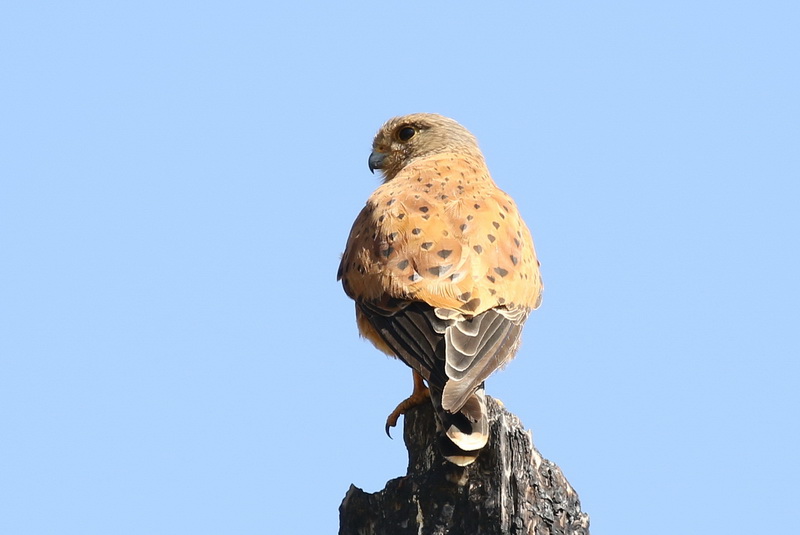
Birding here was limited to around the campsite, its trails and along the stony roads. Needless to say we did not record many species in the two days there. Our best sighting was a Greater Kestrel. The Southern Double-collared Sunbirds next to our campsite were special to hear but virtually impossible to spot as the tree foliage was well dense.
Cape Robin-Chat
Rock Kestrel
Greater Kestrel
Greater Kestrel
Black Sparrowhawk
Southern Fiscal juvenile
Cape Batis
Cape Robin-Chat
Another bird we wanted to see was the Cinnamon-breasted Warbler. Out came Birdfinder. Skitterykloof Pass it said was the best known place to see it. So that was where we had to go next.
Skitterykloof Pass is about half way along the R355 from Ceres to Tanqua Karoo – about 80 kms from Ceres. Our choice was to stay in Ceres and drive out from there or alternatively stay in a small self-catering cottage within a 20 km drive.
We chose the latter and stayed at Gezellig Genot at R330 a night – bring your own bedding – also limited power available. We parked the trailer beside us and despite the heat (41 C) for two days the batteries were only half depleted keeping our fridge/freezer to temperature.
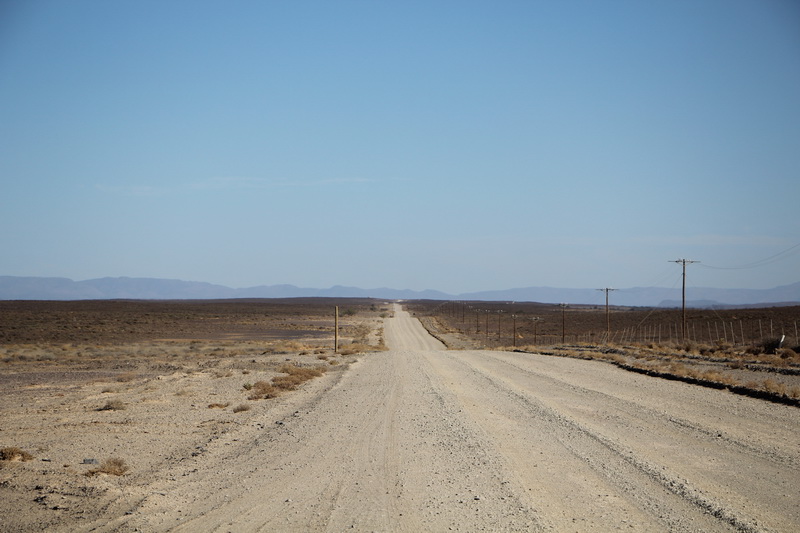
R335 – 80 kms of reasonable gravel.
Sign to our cottage
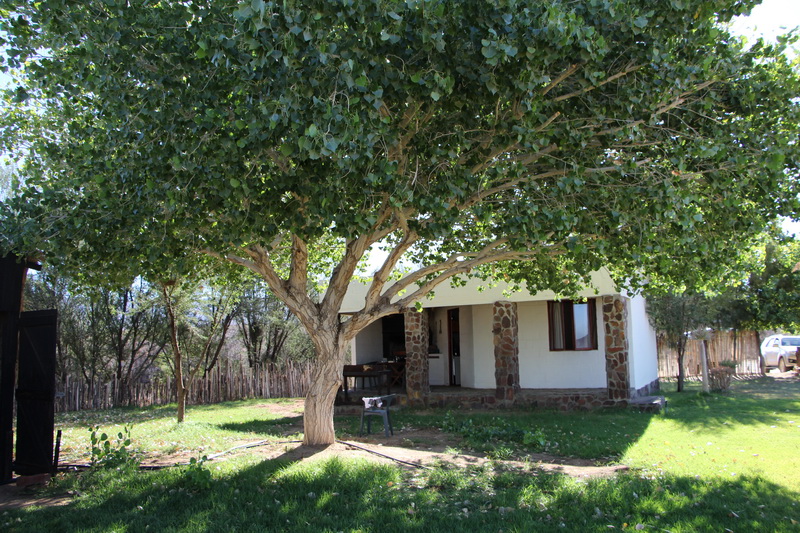
Gezellig Genot Cottage with a birder’s garden
Aloe outside cottage
A quick exploration was called for on the afternoon of our arrival. Despite the heat we went to find Skitterykloof Pass. Driving south we passed the Tankwa Padstal and took the first right after it. A further three kms and we were there.
Tankwa Padstal
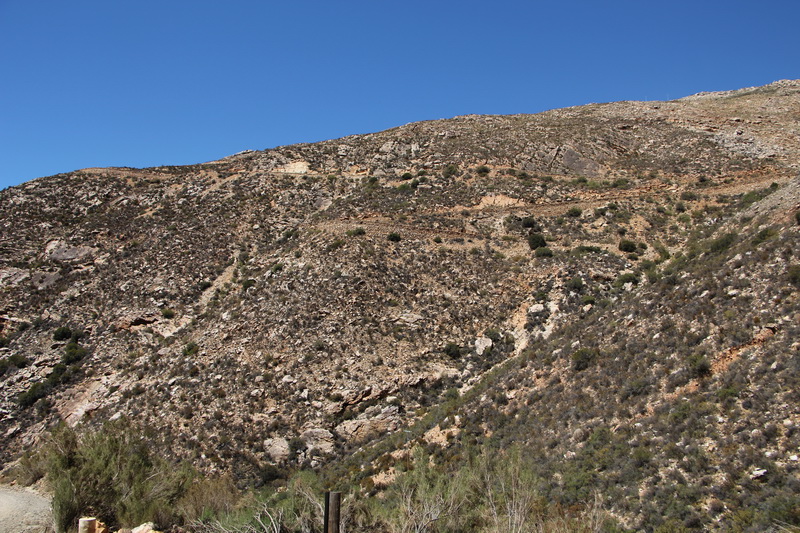
Steep hillside to the right and the picnic site on the left. We searched up and down the rocky slopes for several hours with not a sign of anything – nothing calling. Most unlikely to succeed – after all Birdfinder is over 10 years out of date. Disappointed – we headed back to the cottage.
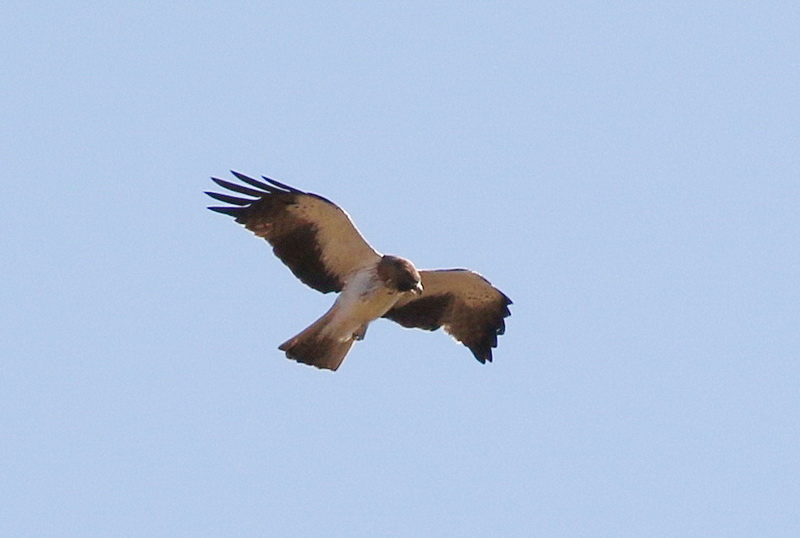
The next morning we were up bright and early getting back at Skitteryskloof Pass at 06h30. Passing several Black-chested Snake-Eagles, a Booted Eagle – pale phase and a family of Karoo Korhaans on the way.
Booted Eagle – pale phase
Karoo Korhaan
The hillsides were still in shadow as we traipsed up and down the road for more than an hour. The sun started to hit the sides of the cliffs and it was getting hot. Back down the road again to the bridge – nothing then back up again.
Skitterykloof Pass
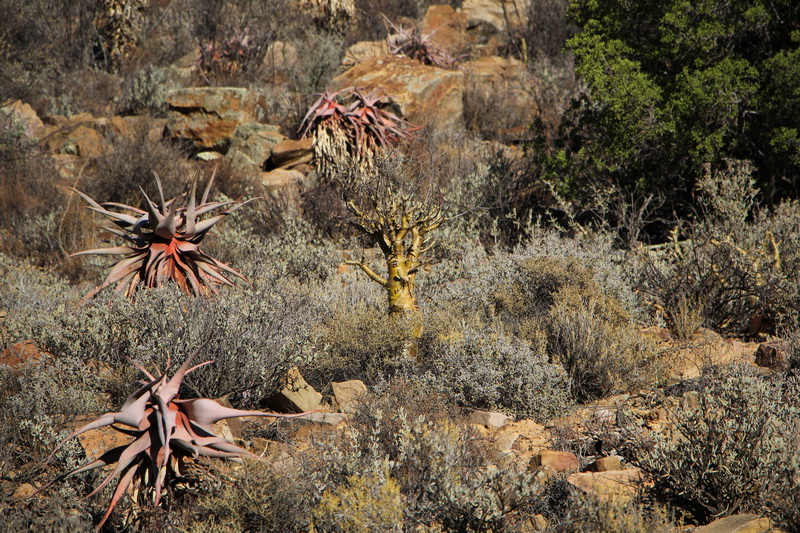
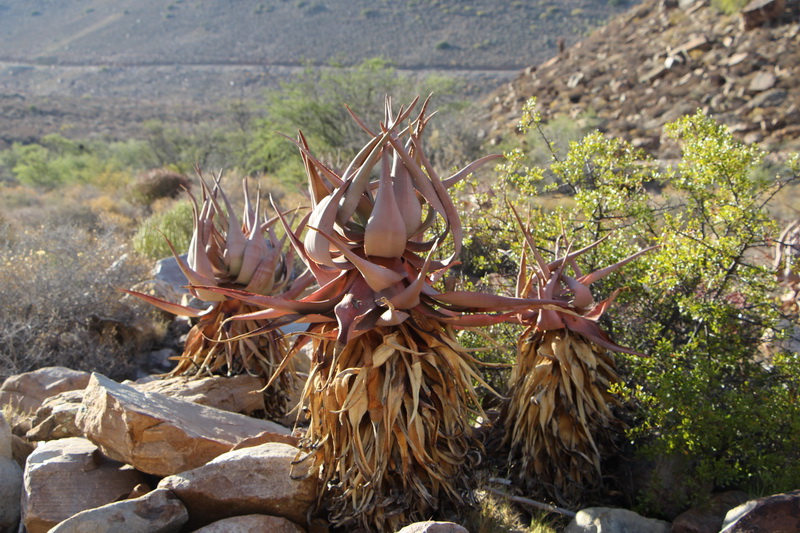
Aloes on rocky hillside
Aloe
Donkey cart with a misbehaving donkey nearly drove us off the road!
Suddenly we hear its call (having studied it before going). Well that is the first step – now to find it.
Out of the blue we saw it flitting from one Aloe to the next sucking nectar we assume. As we follow it, it gives us chances to positively identify it but never stops long enough for a decent photo. As we head back up to the picnic site we spot several more. In all we were lucky to see the bird 5 or 6 times. What a beautiful bird – our Aloe flitter.
Cinnamon-breasted Warbler
Cinnamon-breasted Warbler
Cinnamon-breasted Warbler
A few other species were heard and some seen in Skitterykloof.
Tractrac Chat
Southern Masked Weaver
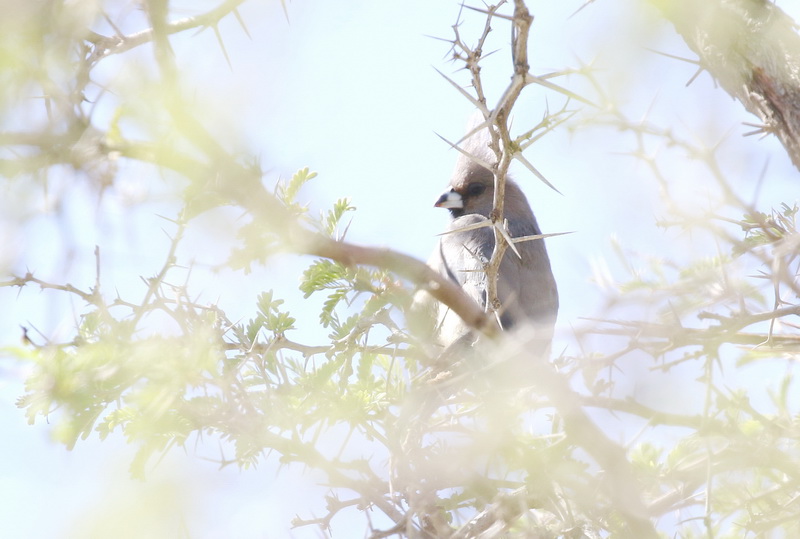
White-backed Mousebird
Long-billed Crombec
Sickle-winged Chat
Mountain Wheatear – grey form
Back at the cottage we luxuriate on the patio and spend the afternoon spotting from there. The nearby trees were constantly being visited by birds all day long – even in the middle of the day. There were Pririt Batis, Fairy Flycatchers, Namaqua Warbler, Karoo Scrub-Robin, White-backed Mousebird, Karoo Prinia, Cape Bulbul, Cape Spurfowl and most entertaining a gang of White-throated Canaries with their huge beaks almost the size of their heads.
Namaqua Warbler
White-throated Canary
Pririt Batis female
Pririt Batis male
Yellow Canary
Cape Bunting
Cape Spurfowl
Chestnut-vented Warbler
Fairy Flycatcher
Karoo Chat
Karoo Prinia
Karoo Scrub-Robin
Then to cap it all, with the close of the day, a pair of Rufous-cheeked Nightjars flew about us calling.
Rufous-cheeked Nightjar
As hot and dry as it was we much enjoyed our stay there.
On leaving we stopped at the Tankwa Padstal for some more of their explosive home-made Ginger Beer. The bottles took three minutes to open painfully watching as the gas escaped. Open it quickly and the contents explode all over you. Fortunately the sales lady informed us in time.
So where to next? Head back to Stilbaai we decided. But first to drive the dirt roads from Swellendam to De Hoop – loads of Blue Cranes seen the last time 9 years ago.
Best stay at Bontebok NP as the campsite in De Hoop, as we remembered it, was not only double the price but also in a very poor state. Apparently they have done up the ablutions but the campsite is now closed for restoration. They still take passing trade at a whopping R370 per site.
Bontebok was at R245 per night and R150 for the non-weekend third night.
Bontebok Campsite
Bontebok -getting out to select a campsite
Campsite No 9 chosen
Ablutions
We planned to pay a visit to De hoop to see what birding they would offer (being next to the river and sea).
The dirt roads did not disappoint – there were Blue Cranes in every large field, Buzzards a plenty – Common and Jackal and numerous Capped Wheatears. After a couple of hours and little distance driven we realised that if we want to see De Hoop before 15h00 we had to get a move on. Of course our GPS took us through farmers fields before we turned around and found our own way!
Black-shouldered Kite
Black-shouldered Kite
Jackal Buzzard
Blue Crane with 2 juveniles
Capped Wheatear
Dassie (Rock Hyrax)
Pearl-breasted Swallow
Pearl-breasted Swallow
Pied Starling
Striped Mouse
At De Hoop birding was limited. Most of the area to get to both the sea and the river was through low dense scrub.
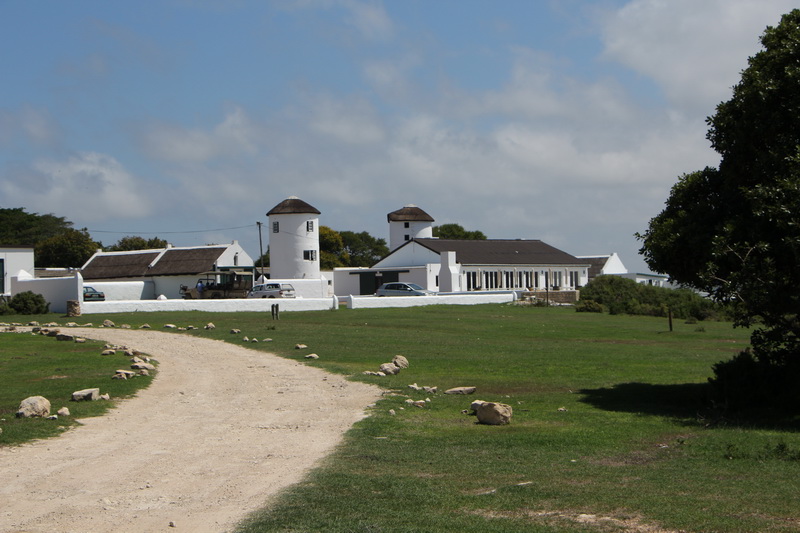
De Hoop Accommodation
De Hoop Accommodation
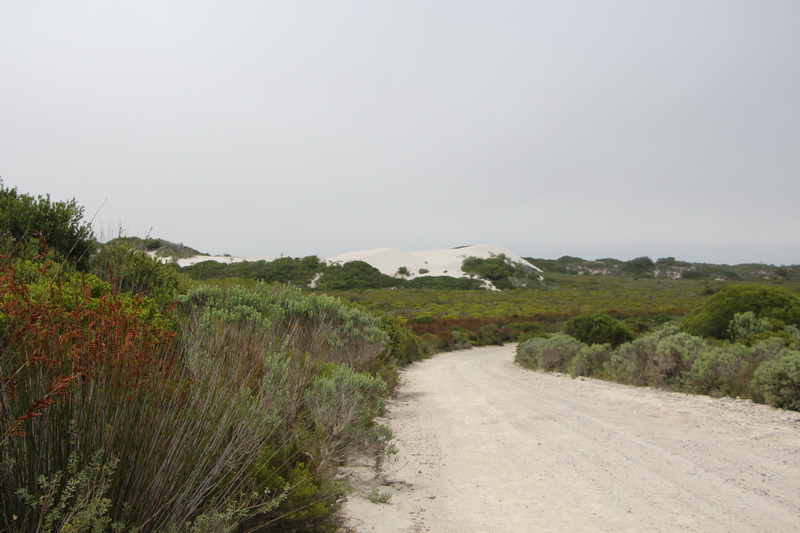
Road to Sand Dunes
Road to Sand Dunes
Sand Dunes
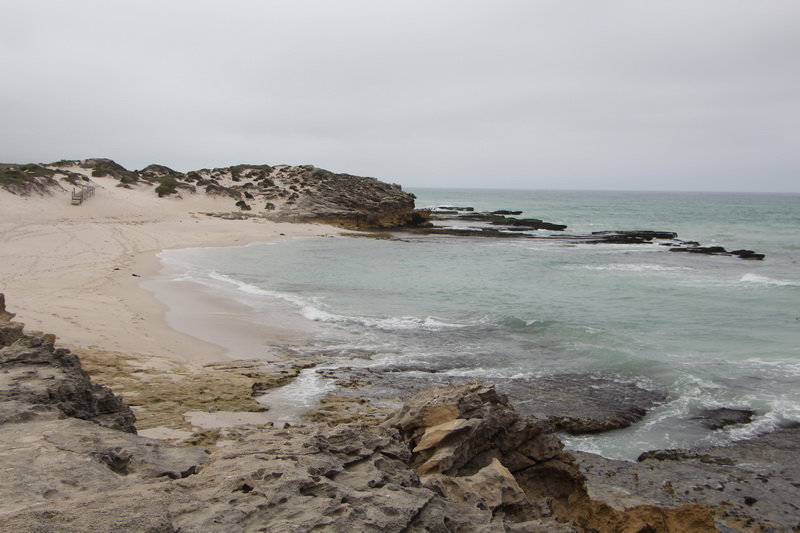
Beach with African Black Oystercatchers
Birds were heard but seldom seen. The Southern Double-collared Sunbird called everywhere and we were lucky enough to see it briefly. The Cape Grassbird however was not so shy and it was seen several times displaying nicely.
Cape Grassbird
Southern Double-collared
Baboons were on Sentry duty and other critters seen included Cape Zebra, Bontebok, a rather forlorn Eland, a Striped Mouse and White-tailed Mongoose.
Redwinged Starlings – male and female
Baboon Lookout -shocking
Cape Zebra
Bontebok
Eland
Yellow Mongoose
Yellow Mongoose
Striped Mouse
Candlestick
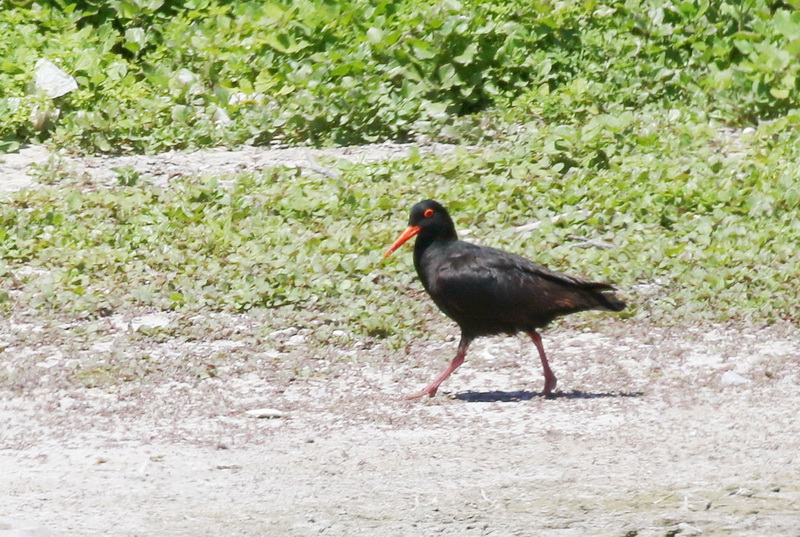
African Black Oystercatchers were seen on the rocks and in the coves at the seaside but not much else.
On the river frontage there were Great Crested Grebes and the occasional South African Shelduck.
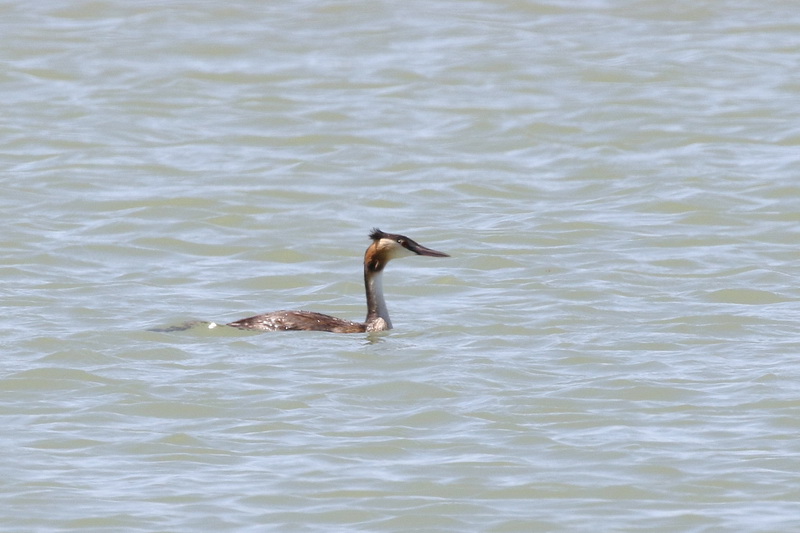
Great Crested Grebe
And this unidentified Sunbird.
Which Sunbird
Which Sunbird
Our second day at Bontebok started reasonably brightly so we took the chance to catch up on the laundry – all by hand. However by the time we had finished washing up the sky was looking ominous. First a dribble then wind and rain. Luckily the sheets had more or less dried but the rest waited patiently for 2 days to get to a tumble drier..
The rest of the day was spent with shopping and catching up on housekeeping tasks. The rain kept up and we expected to leave the next day in the rain – not much fun decamping in the rain.
Yellow Moon
But we were fortunate. The rain had stopped during the night and we hung out the washing to get as much drying time as possible.
Then we packed up and headed for Stilbaai to get a second chance to see the Red-necked Buzzard. Weather predictions were not favourable and we expected to have to stay a couple of nights to get any chance of seeing the bird.
We knew they were renovating the road from the N2 to Stilbaai but it was a shock to see how much they had achieved and more sections of the road with Stop and Go – up to 20 minutes wait at each. And there were three – all of which we hit at the head of the line.
Half way along the third Stop and Go we turned off to Melkhoutfontein towing our trailer on the off chance we could find the Buzzard.
We get to the power station on the left and stop, blocking the bus station entrance. Out we get and scour the poles etc with no luck.
So we decide to head into Melkhoutfontein on the off chance of finding it there. After a short distance as we headed that way, Sally saw a faded blue sign on the left indicating the direction to both the old and new St. Augustine’s Churches. The old was on the right down a narrow track. We gave it a miss as we were towing. So into town. Nothing.
On the way back out, I see my GPS promises me that there is a way out from the narrow dirt track and I take it – with Sally in trepidation. After about 500 metres we get to an open area with a cemetery and the old church on our left.
The pine tree next to the old St Augustine’s Church – the perch for the Red-necked Buzzard.
And a Bokmakierie to greet us.
Bokmakierie
We stop and within a few minutes we see a Buzzard flying overhead – Common. Rats.
Then as I am thinking of turning the trailer round I see another Buzzard. Very pale undersides. Could be it. Out for a photo as it circles around and I get several shots then it flies and perches in the pine tree by the old church. That was the bird we wanted to see.
Red-necked Buzzard
Red-necked Buzzard
Red-necked Buzzard
As I tried to get closer to get some better photos it took off and disappeared out towards the sea. Well we had seen it but I was keen for a second chance to photograph it. We waited half an hour but I wanted another 15 minutes. As we waited another couple of birders arrived.
As we chatted one of them – the wife – said “What’s that bird on the pole?” on the path to our right going in the direction of the blue-roofed school. Sure enough it was back and it allowed us to get several grey sky shots before it flew.
Red-necked Buzzard
Red-necked Buzzard
Well we had achieved our goal for Stilbaai. So we decided to head on to Wilderness and try to get ahead of the weather. During the first Stop and Go back out of Melkhoutfontein there is a dirt road to Albertina and a shortcut to the N2 – about 20 kms of dirt and gravel but better than hanging around in the Stop and Goes.
We settle for several nights in Wilderness NP.
Reception
Our campsite view up river
Ablutions
Campground – away from the crowded river frontage
Hurray they have a drier for our damp clothes. Our campsite is right by the river.
Campsite View
Camping in the Wilderness
Three weekday nights here in camp with power on the river R525 (includes the 40% pensioners discount). The ablutions work well although a bit away from the site we chose.
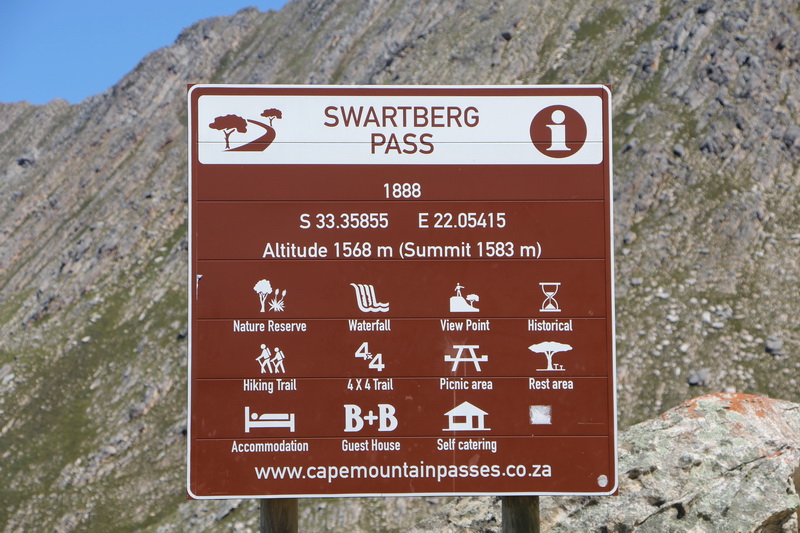
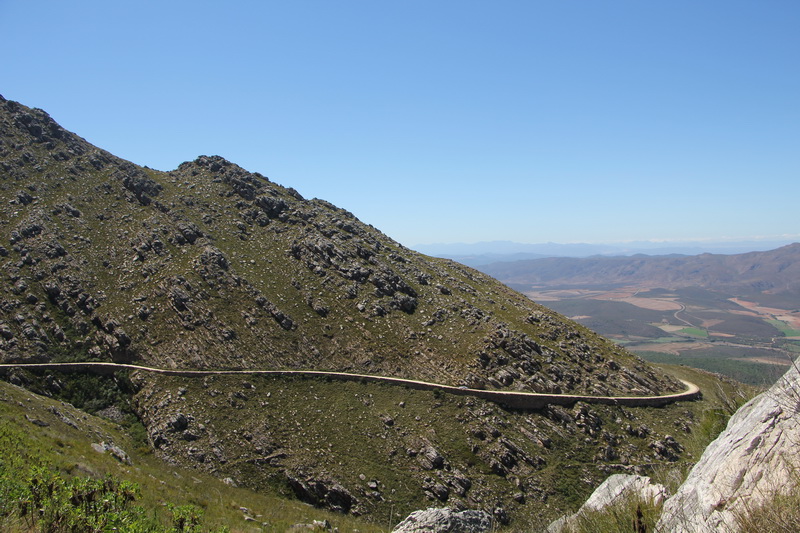
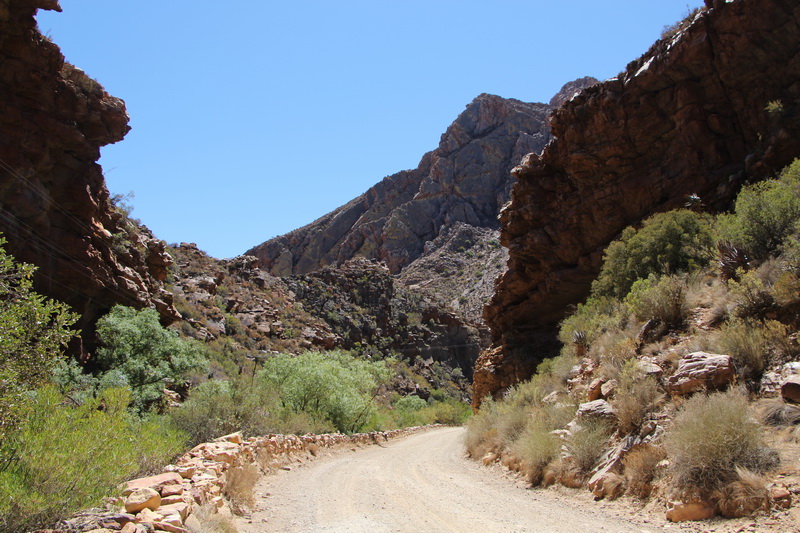
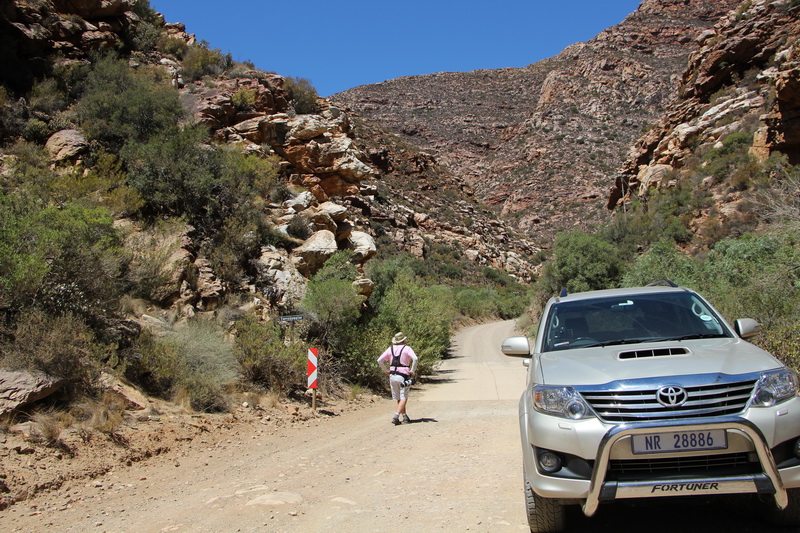
The next day to celebrate Valentine’s Day we decide to head for Prince Albert to have lunch – via Swartberg Pass! Quite a scenic drive but a bit nerve-wracking at times – especially going downhill – numerous tight hairpins and the stony road wide enough for one and a half cars.
Sign
Coming up Swartberg Pas
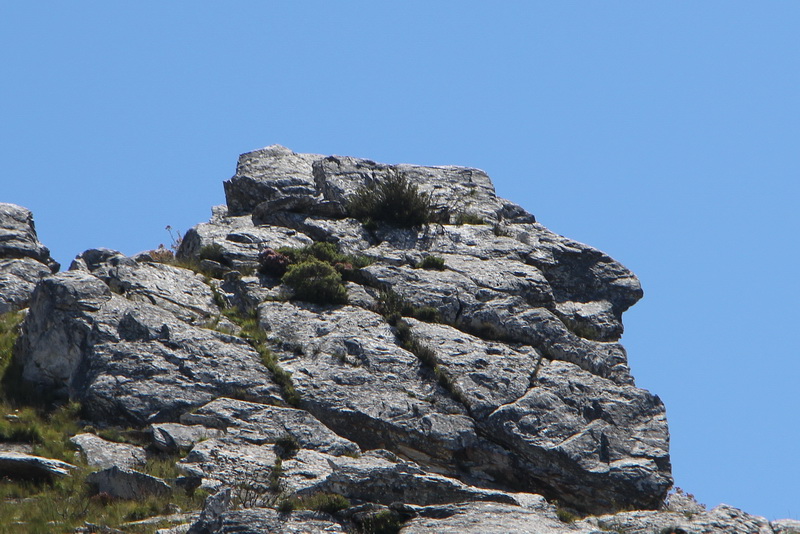
Rock Man
Crocodile Rock
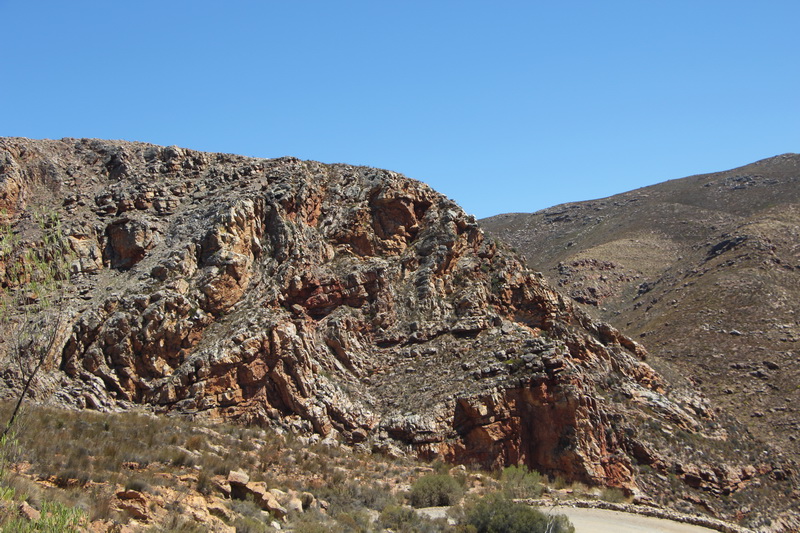
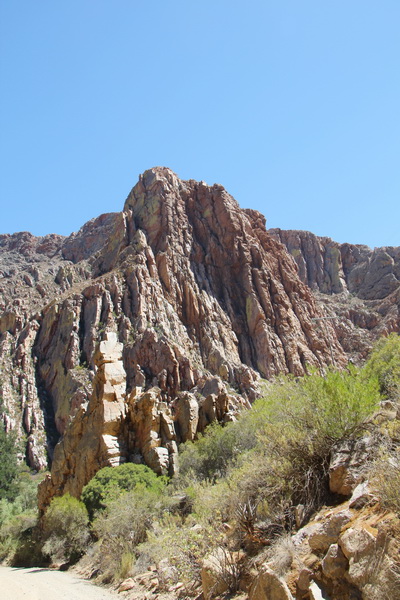
Rock formation
Rock formation
Rock formation
Rock formation
Going down
Looking up going down
And now to the river crossing
River crossing
Birds were few and far between but we did see a Dusky Sunbird near the top as well as a Blue Crane and chick on the way up.
Blue Crane – parent
Blue Crane – juvenile
Dusky Sunbird
African Stonechat
Lunch at “O is for Olive” four kms north of Prince Albert – Lamb chops – delicious. We take the longer (distance) route back and save ourselves a couple of hours on the Swartberg Pass alternative.
The following day was spent birding in the camp and going to the lakes and their two hides.
Hide
View from hide
View from hide
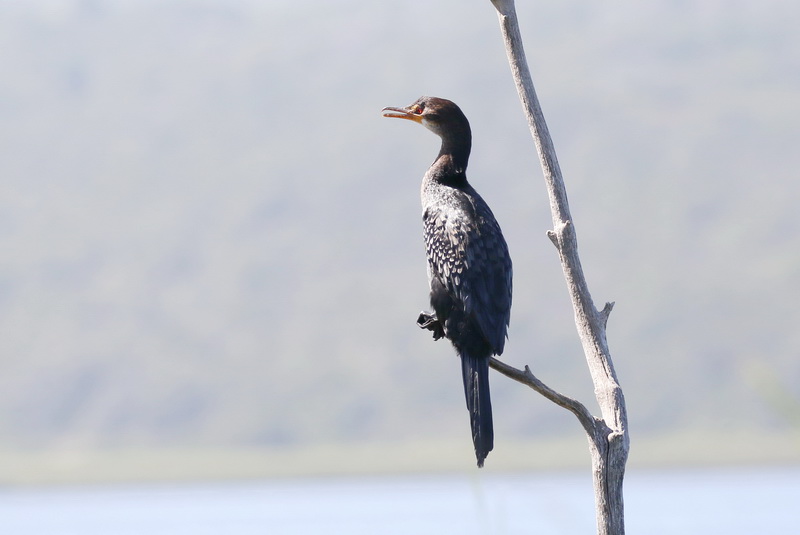
Reed Cormorant
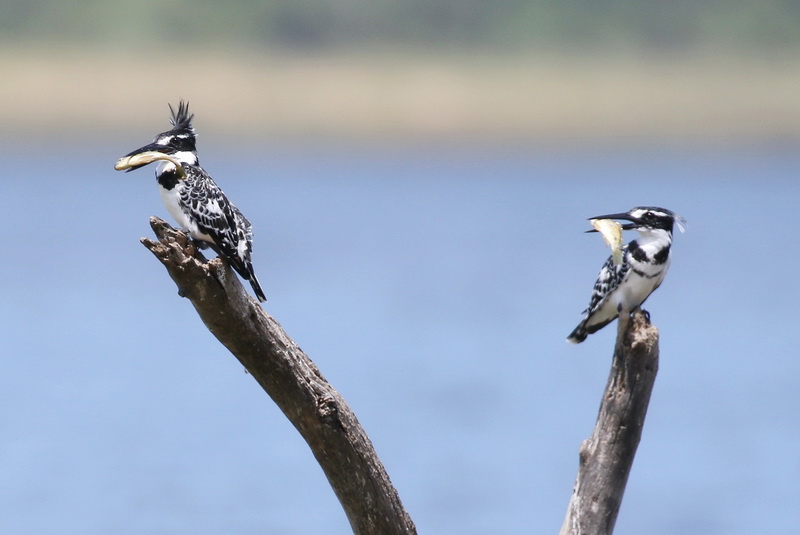
Pied Kingfishers -male and female with fish
Pied Kingfisher – female with fish and hairstyle
Pied Kingfisher – male twisted with fish
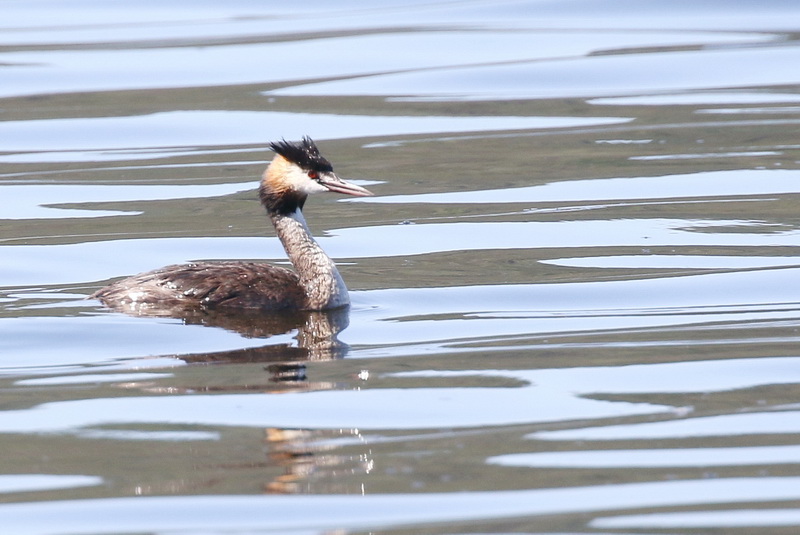
Great Crested Grebe
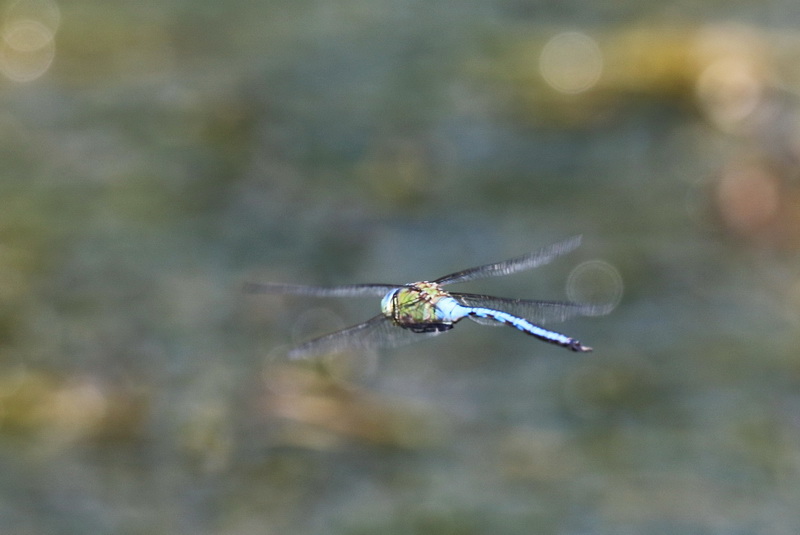
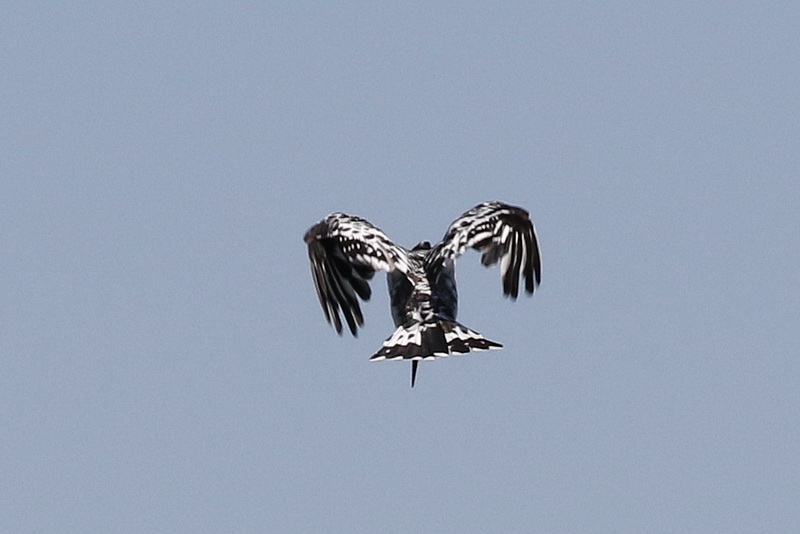
Humble Hoverer
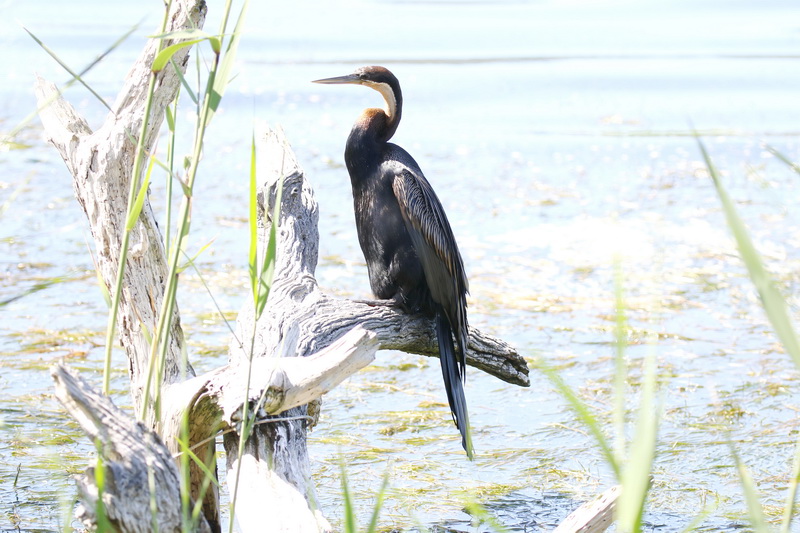
African Darter
White-breasted Cormorant with not so white a breast
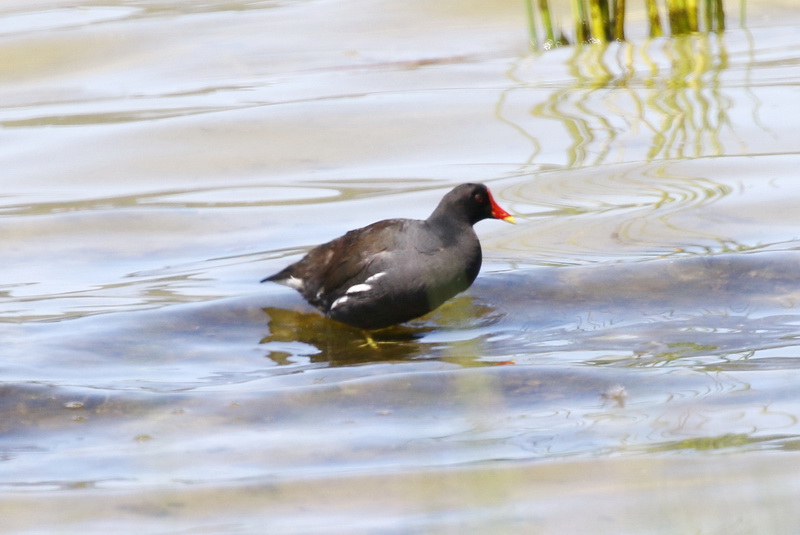
Common Moorhen
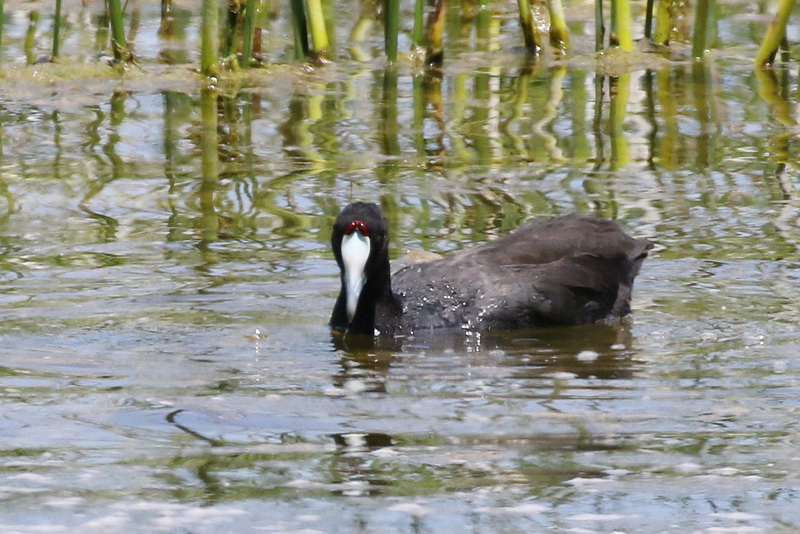
Red-knobbed Coot
Campsite birding however was the most productive.
African Fish-Eagle
African Fish-Eagle
Olive Woodpecker
Olive Woodpecker
Malachite Kingfisher – juvenile
Malachite Kingfisher – juvenile
Malachite Kingfisher – juvenile
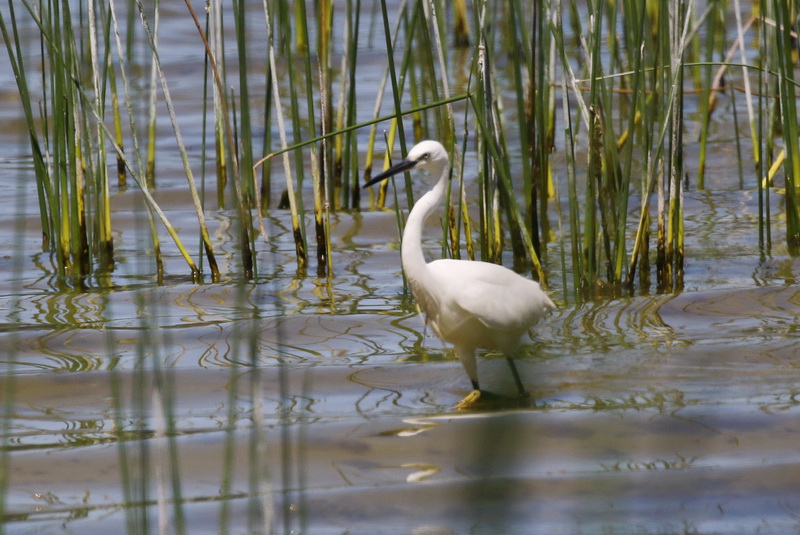
Little Egret
Levaillant’s Cisticola
Common Waxbill
Black-winged Stilt
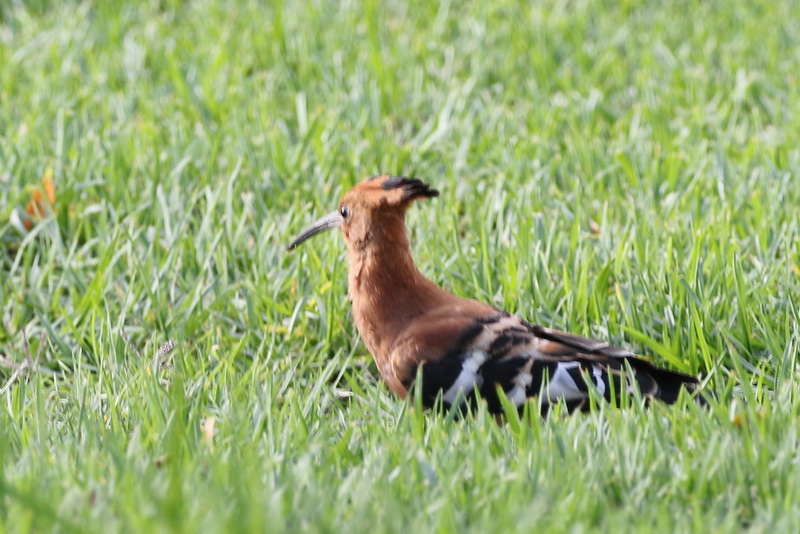
African Hoopoe
Streaky-headed Seedeater
Giant Kingfisher – male
Dusky Flycatcher
Bar-throated Apalis on the move
A point to note. After eventually finding the Half-collared Kingfisher Trail we were surprised to find we either needed a campsite permit, Wild Card or R40 per person. We had none of the these on us so ended up not doing the trail. We had heard it lived up to its name the day before with a Narina Trogon also making an appearance.
The campsite had a resident Black-headed Oriole and many Knysna Turacos. Seventeen were seen together in one tree on the opposite side of the river from us.
Knysna Turaco
Knysna Turaco
We enjoyed being next to the river despite the campsites around us being busy.
River frontage campsites
Nothing like a dip to cool you down!
Sally enjoying a dip in the river.
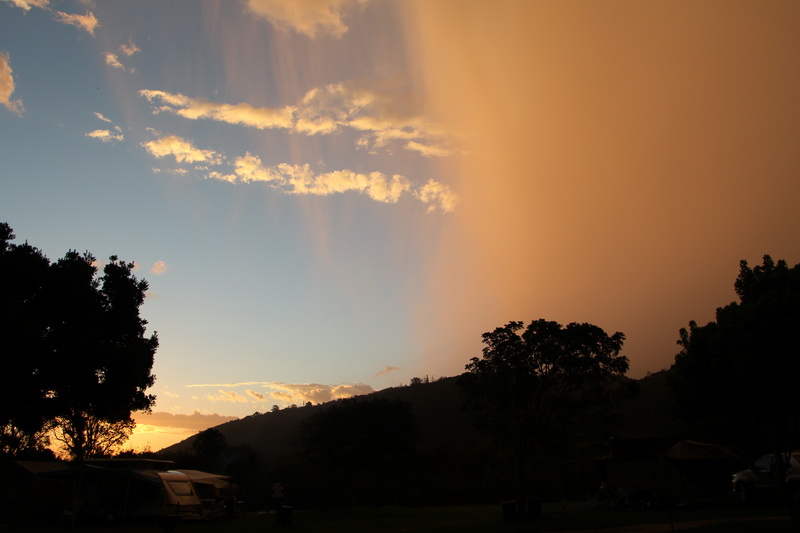
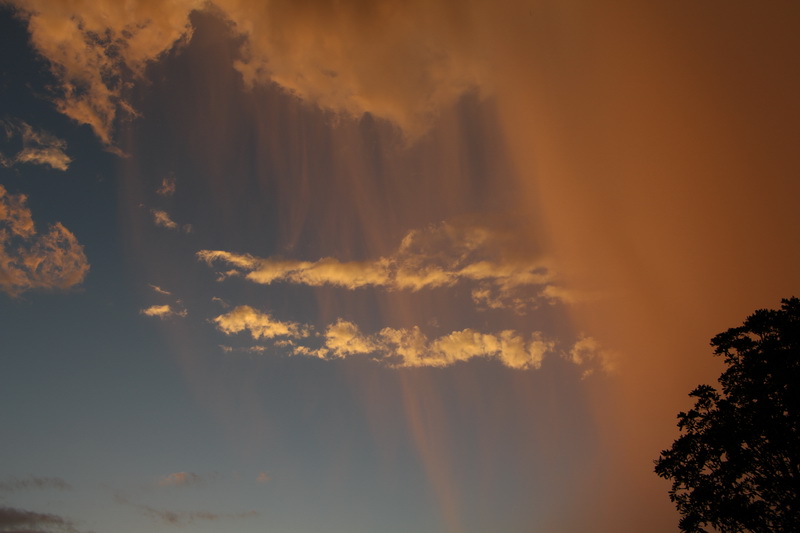
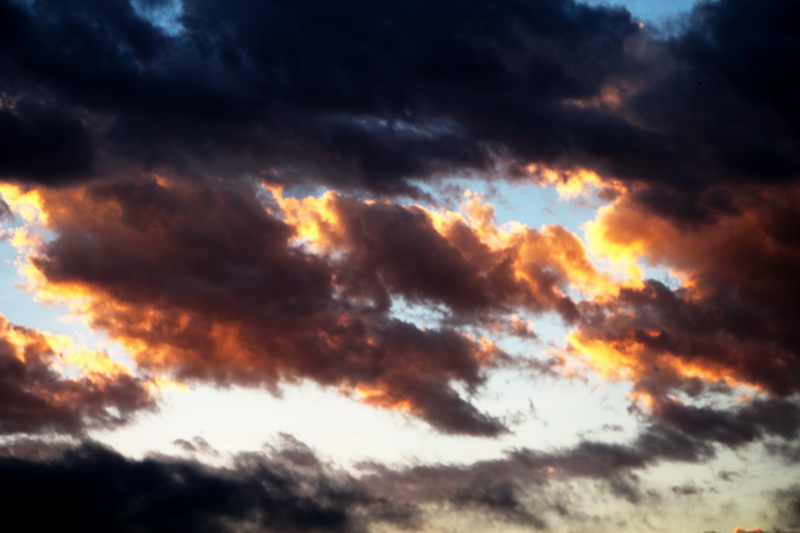
The evening before we left, the clouds above developed a red glow with a straight band of red moving towards the sea. Strange and interesting. Out came the camera to capture the picture. Then no sooner than the pictures were taken the sky opened with rain and hail. We had to move fast to get everything under cover.
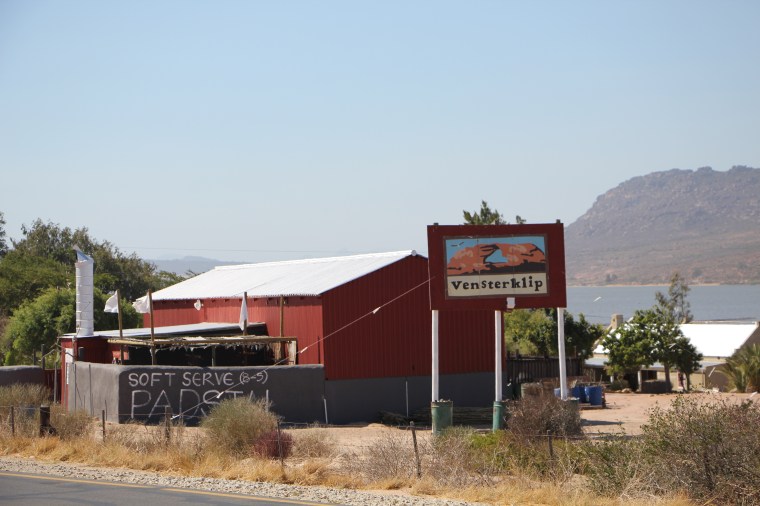
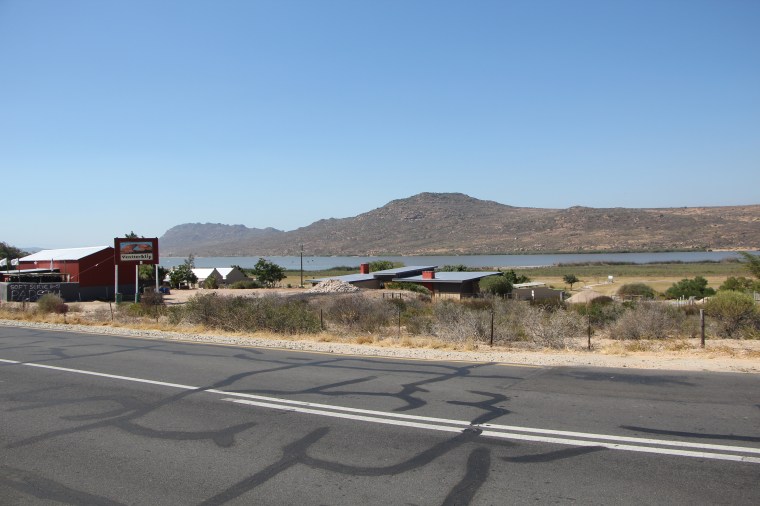
From Cape Town we headed for Eland’s Bay and a campsite Sally had read about in the Caravan and Outdoor Life Feb issue – Ventersklip overlooking Verlorenlei (the lost marsh) leading into the sea. Negotiated price from R480 to R300 for 2 nights.
View of Eland’s Bay
Ventersklip Campsite
Ventersklip
View of Verlorenlei ( the lost marsh)
Campsite – rather open to the wind.
Campsite a bit wind swept
Unfortunately the water level was low so water bird sightings were few at the campsite.
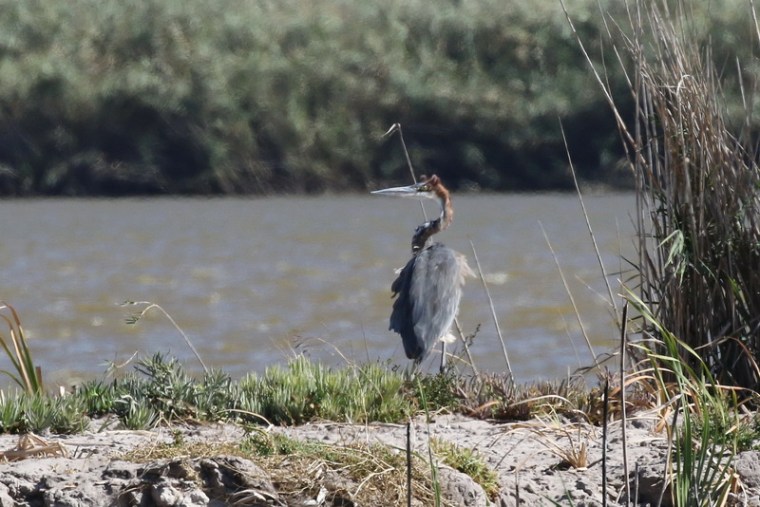
Goliath Heron
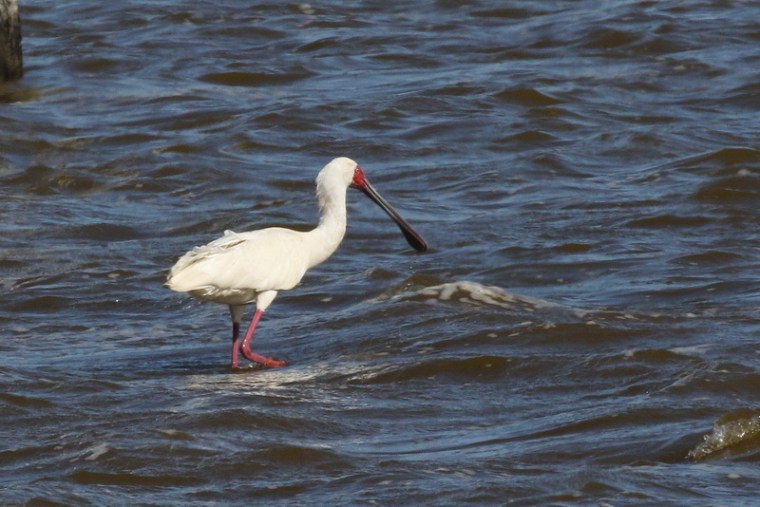
African Spoonbill
We decided to stay two nights and use it as a base to bird in the area in particular to try and find the Protea Canary along the Paleisheuwel Road (off the N2 eight kms south of Clanwilliam) and to visit Lambert’s Bay to see the Cape Gannet colony.
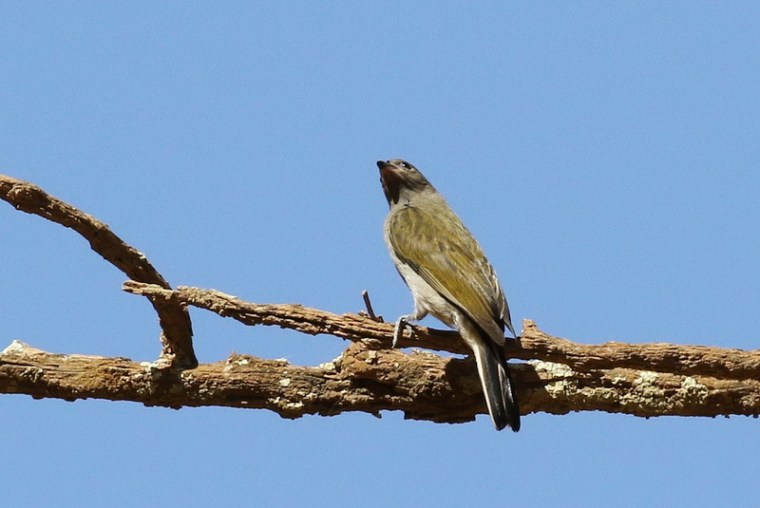
Protea Canary first – a lifer for me but not Sally. Sally had seen it when we visited Betty’s Bay some years ago. I was too slow carrying my binoculars, scope and camera at the time.
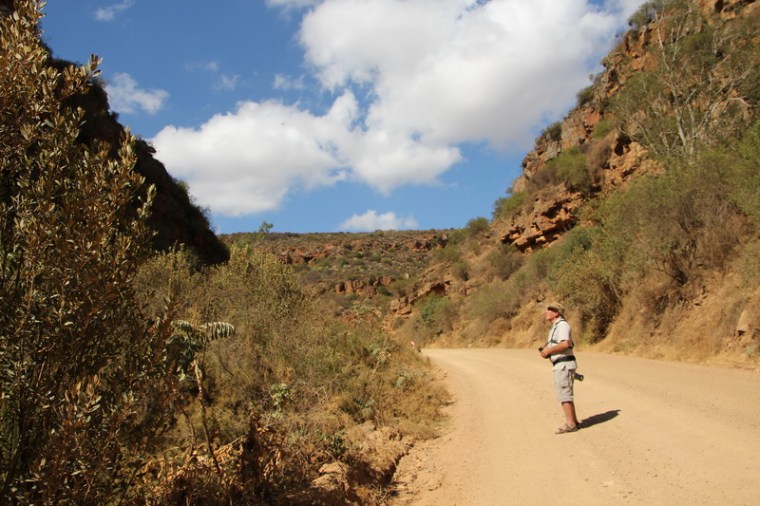
We drive along the Paleisheuwel Road to the craggy gorge, stopping and searching for some time. Then at one spot we stop. I let Sally out and park out of the way of the traffic. As I get out Sally calls me – she has it in her binocs. Sure enough by the time I get there it has gone!
Paleisheuwal birding
Paleisheuwal birding
Paleisheuwal – interesting outcrop
Paleisheuwal birding
Another hour traipsing up and down the road in the area getting dust blasted as the traffic seemed unnaturally heavy on this off-road dust bowl. It seemed there were White-throated Canaries everywhere and no Proteas. We saw Cape Buntings, a Verreaux’s Eagle overhead and a Lesser Honeyguide foraging. No Protea Canary.
White-throated Canary
Cape Bunting
Verreaux’s Eagle overhead
Lesser Honeyguide foraging
And then as we were about to give up and after much persistence we spot a Protea Canary, get a good look at it. Unfortunately not able to get a photo as it was not stationary long enough. This is the tree it was seen in.
Paleisheuwal Protea Canary tree
On the way back we head for Lambert’s Bay and the Cape Gannet colony.
View of entry into Lambert’s Bay
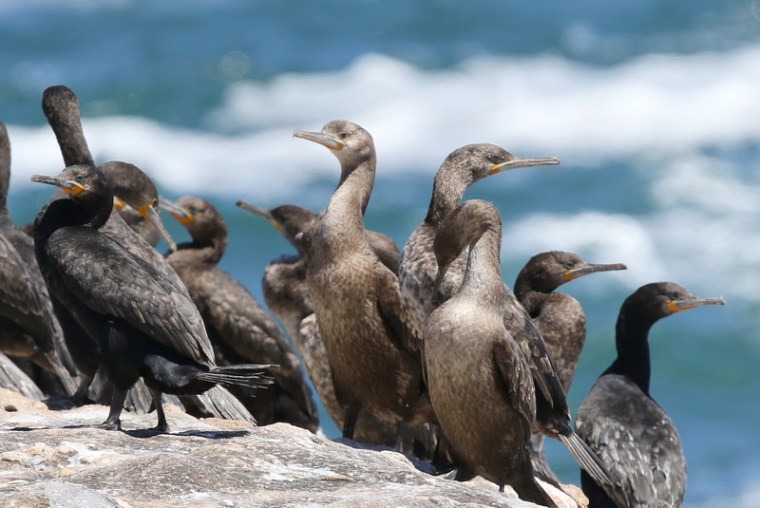
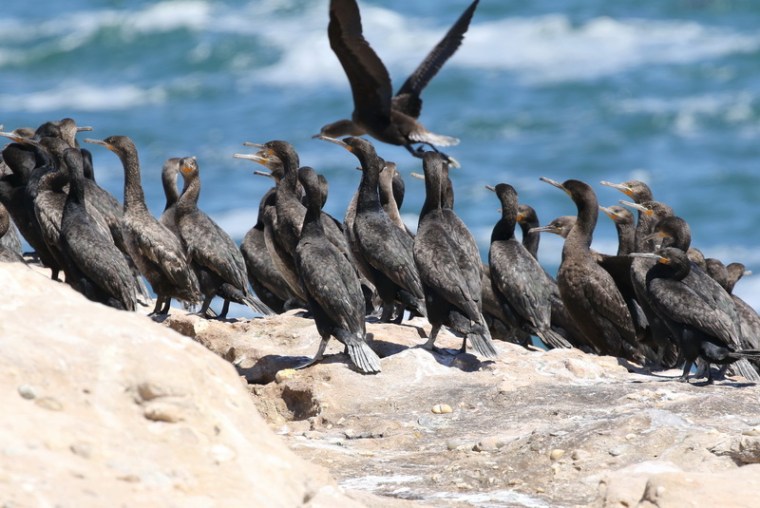
Once in Lamberts Bay we stop and look at the hundreds of Cormorants on one of the rocky outcrops. Virtually all were Cape but we did spot one Crowned Cormorant.
Crowned Cormorant
Cape Cormorants
Cape Cormorants
Cape Cormorants – Lamberts Bay
Then to the bedlam of the Cape Gannet colony. Now a R5 parking charge and R40 per person to visit unless you have a Wild Card.
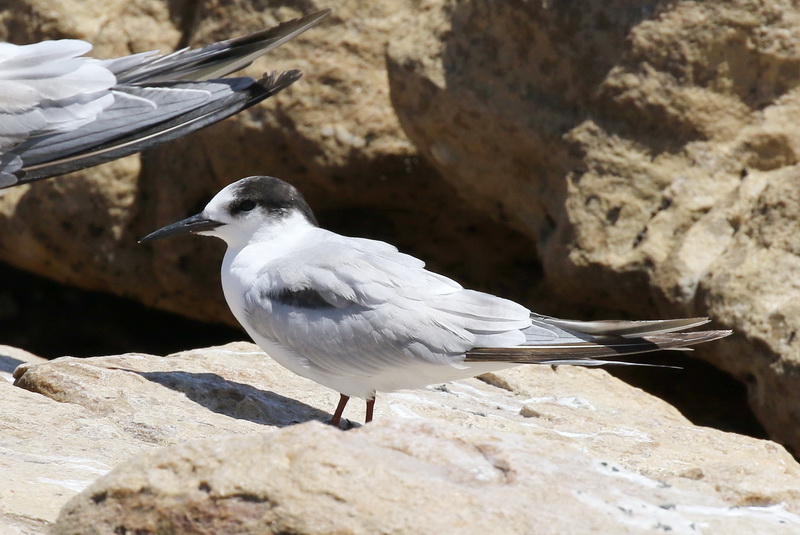
On the way in there were many Terns (Common, Sandwich and Swift) on the rocks leading to the Gannet colony. And some White-breasted Cormorant youngsters.
Common Tern
White-breasted Cormorant – at first glance we thought it was a Penguin
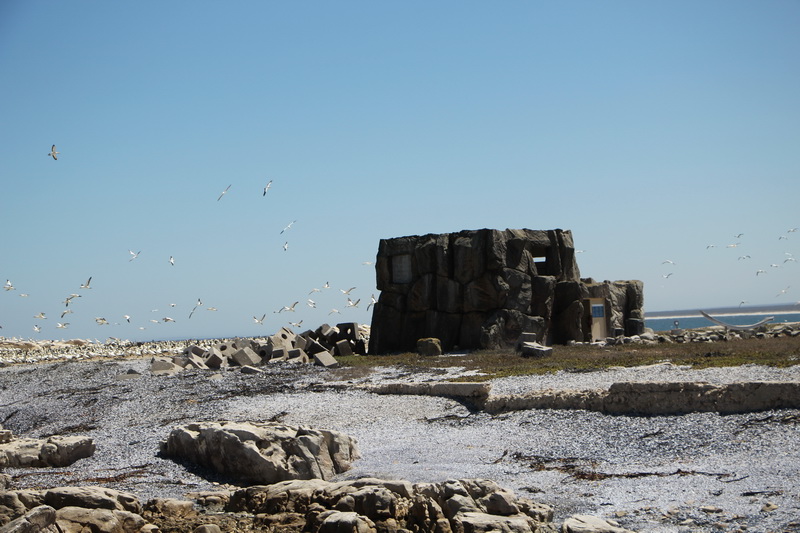
We headed for the Cape Gannet viewing hide. It looks like an out of place rock which gives it character.
Bird Island – layout map.
Bird Hide Cape Gannet colony
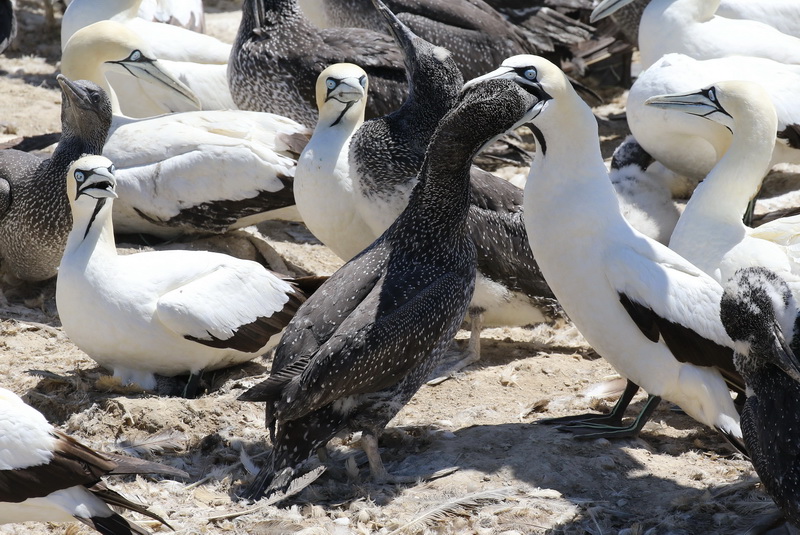
The rock was strewn with a heaving mass of adults and juveniles. The juveniles a very dark fluffy grey in contrast to their parents.
Cape Gannet Colony – a heaving mass
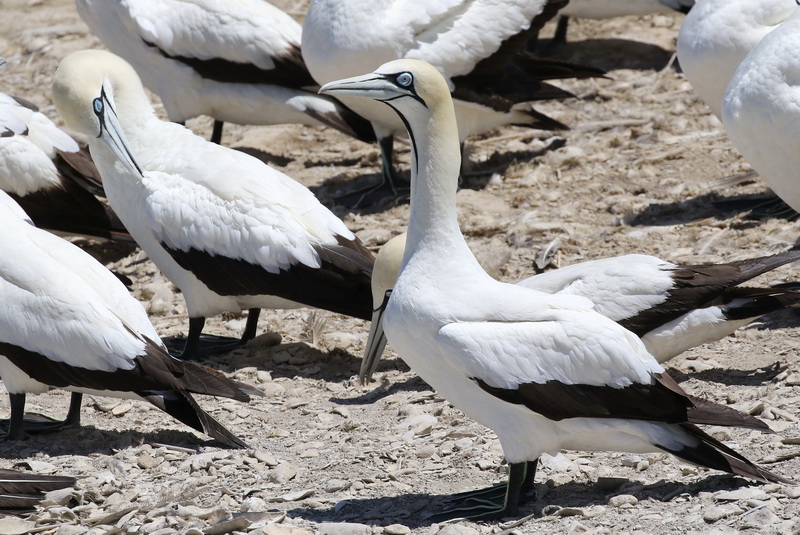
Cape Gannets
Cape Gannet being fed with angry onlookers
Cape Gannet
Cape Gannet juvenile calling for food no doubt
Cape Gannet juvenile – rather lonely
Birds were everywhere in the air circling around perhaps to get away from their demanding young. Interesting to watch their behaviour towards each other. But also interesting to see how they landed. They would come down to land, put on the brakes, carriage down, feet on the ground, still too fast forward so using their nose/beak to the ground to counterbalance their forward motion.
Even a seal put in an appearance sticking one flipper out of the water.
Seal with one flipper out of the water
On the way out we were amazed at the size of the dolosse- put there as an effective sea break.
Dolosse
And then we were sent on our way by the Man of the Sea – an eight foot giant,
Man of the sea – created from sea debris.
We might have stayed another night at Ventersklip but the wind coming off the vlei was excessively strong and cool especially at night. Our canvas took a right beating in the wind.
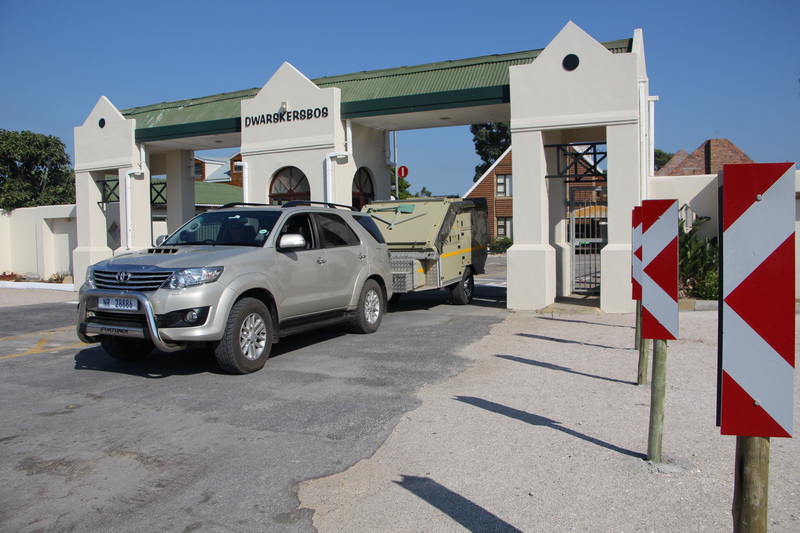
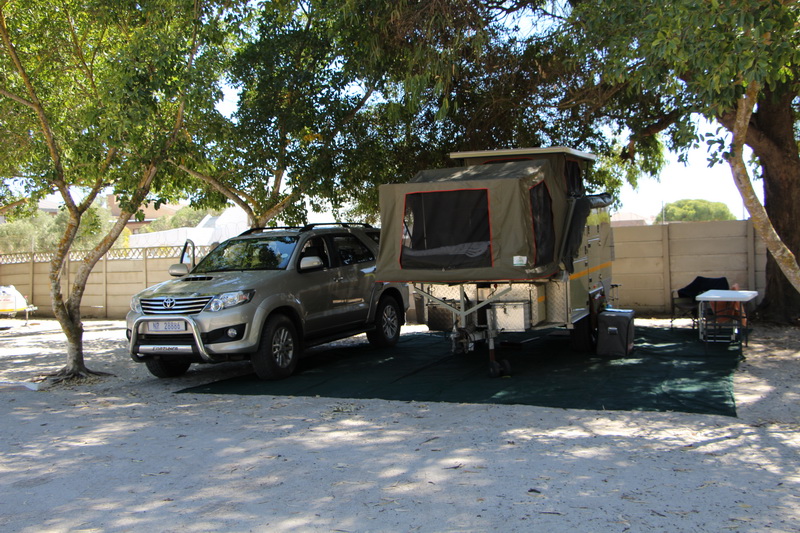
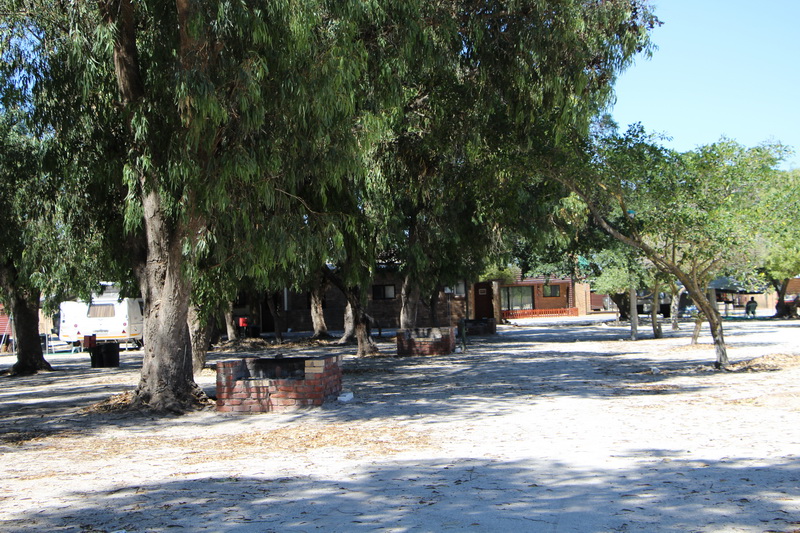
Not having a planned itinerary we headed south towards Velddrif and the municipal campsite in Dwarskersbos – just over 12 kms north of Velddrif. Weekend rates R201 per night and the third night R100. This is a well shady campsite right by the sea so sometimes a bit windy. Another quirk – bring your own loo roll.
Entrance
Our Campsite
Campsite view
Beach view
Our plan using Birdfinder was to bird the area around Velddrif and to meet up with friends in the West Coast National Park. They were staying in Langebaan.
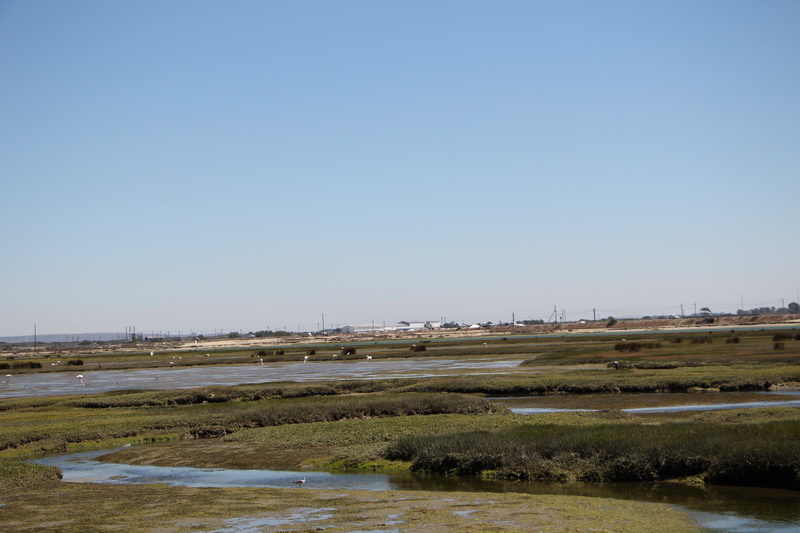
We gained access to the local Cerebos salt pans, however they were very disappointing – some Greater and Lesser Flamingos and not much else. No waders, a few Great Crested Grebes, the odd Cape Wagtail.
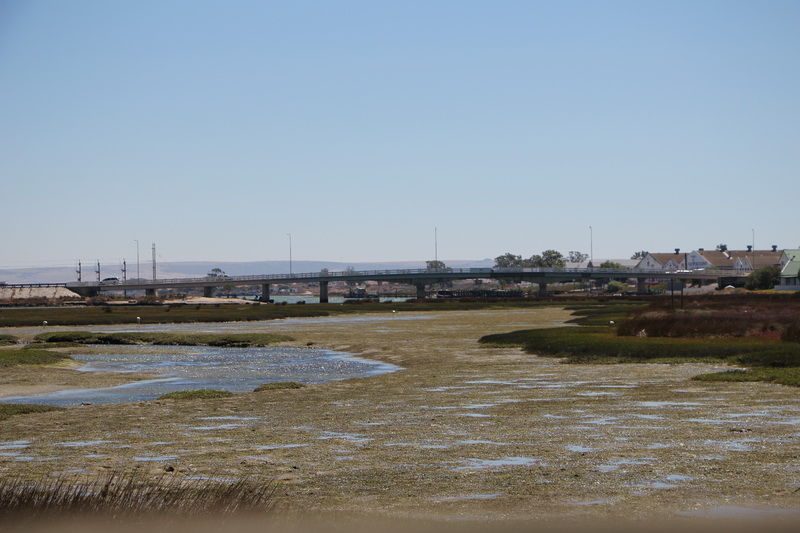
We visited the rundown hide on the north bank of the Berg River in town. It is important to visit when the tides are low as the mud flats become more visible.
Velddrif at low tide
Velddrif at low tide – view from the hide.
There was a greater variety of birds to be seen from the hide. Many Flamingos of both varieties, numerous Greenshank, the odd Marsh Sandpiper, Black-winged Stilts, Great Crested Grebe, Three-banded and Kittlitz’s Plovers, Gulls – Kelp and Grey-headed or Hartlaub’s, Grey Heron, Karoo Prinia, Cape Wagtail, Little Egret, Southern Double-collared Sunbirds, Sacred and Hadeda Ibis, Terns – Swift, Sandwich, Little and White-winged, Great White Pelican, Grey Plover, Avocet, Cormorants – White-breasted and Reed, Pied Kingfisher.
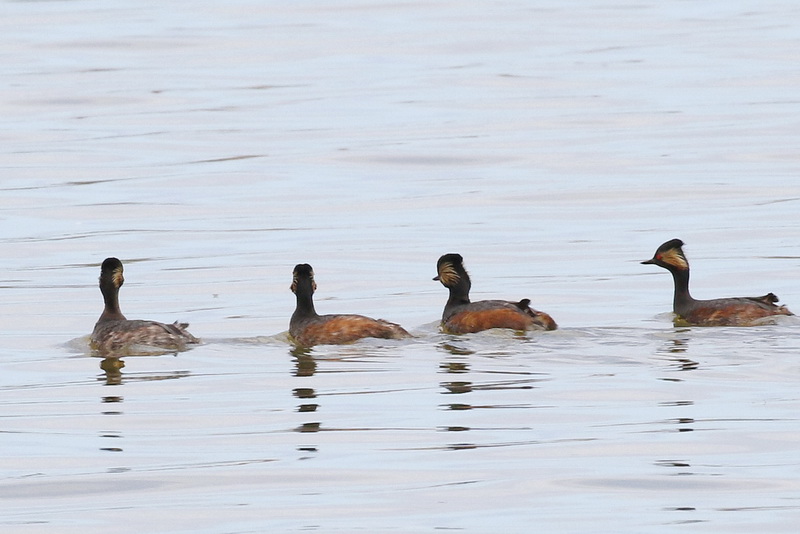
Black-necked Grebes
Great Crested Grebe
Avocet
Pied Kingfisher
Marsh Sandpiper
Common Greenshank
White-fronted Plover
Kittlitz’s Plover
Grey Plover
Kelp Gull
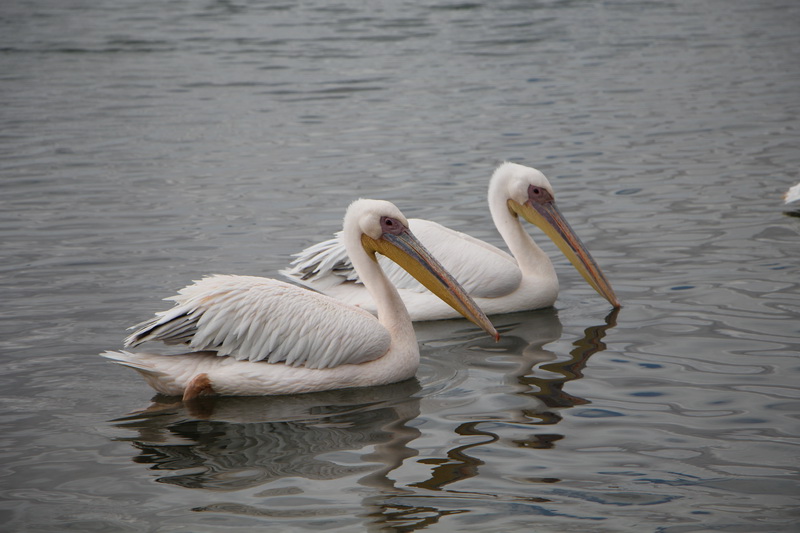
Great White Pelicans
We also explored the area behind the salt pans. Heading south over the bridge we turned right and drove three kms to a dirt track leading up to the pans. At the first corner we started to see some waders – Common Greenshank, Kittlitz’s and White-fronted Plover, Grebes – Great Crested and Black-necked. Also on the inside of the corner there were Chestnut-vented Warblers and several Karoo Scrub-Robins. A worthwhile excursion close to town.
Karoo Scrub-Robin
White-throated Canary
Malachite Sunbird
Fiscal Flycatcher
On our drive to Velddrif Buzzards were commonplace on the poles by the road – Common and Jackal Buzzards. We took the road along the north side of the river beyond the bird hide and on the way back explored some of the beachside tracks.
On one stretch there were several cosy and rustic fish restaurants (which we tried out the following day), some with decking over the water.
Die Vishuis
At one point along there we spotted the Yellow-billed Stork previously reported in Trevor Hardaker’s Rarities reports. We took a photo and sent it to Trevor as an update.
Yellow-billed Stork
Then we headed for Langebaan and the West Coast NP travelling via Paternoster. Along the way we had a great nearby sighting of Blue Cranes and their two juveniles. And at another stop Namaqua Sandgrouse and Namaqua Doves.
Blue Cranes and chick
Blue Cranes and chick. Chick using its tiny wings to stay upright in the stubble
Blue Cranes and chick
Namaqua Dove
Namaqua Sandgrouse
Namaqua Sandgrouse – male and 3 females
White-throated Canary
Grey-backed Cisticola
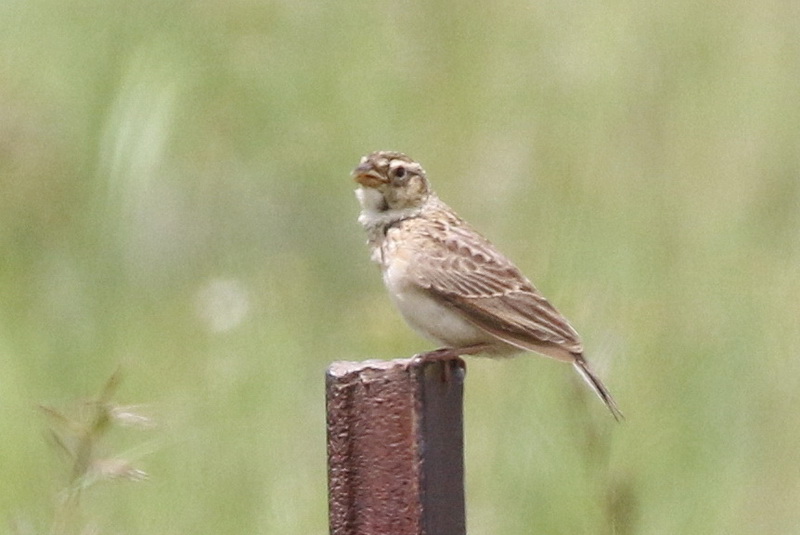
Then there was one mystery bird which we still find difficult to identify. If you do, then please let us know – (p.bartho@gmail.com). Could it be a Large-billed Lark?
Large-billed Lark – juvenile
Large-billed Lark – juvenile
Large-billed Lark – juvenile
In West Coast NP, we met our friends from Durban at the Seeberg Hide.
Entrance to Seeberg Hide
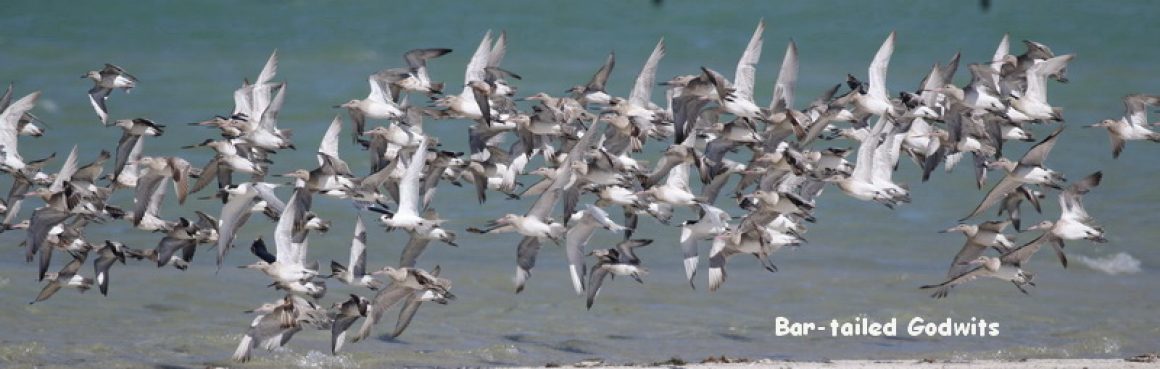
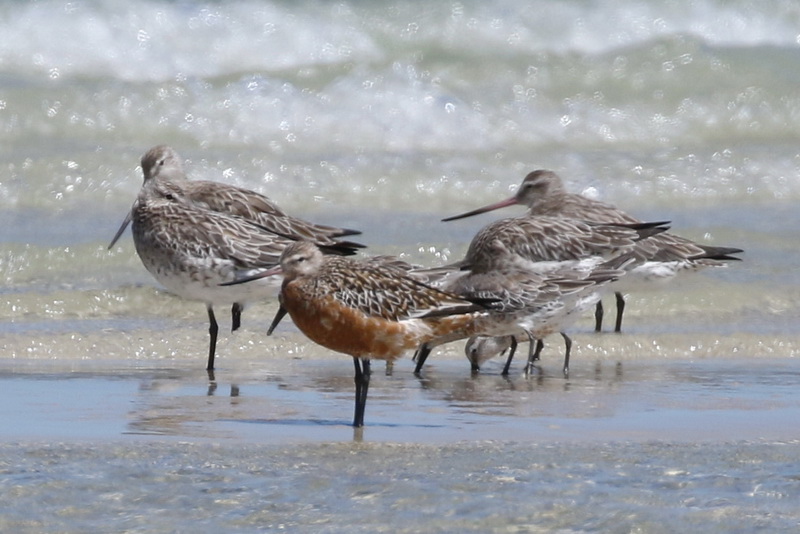
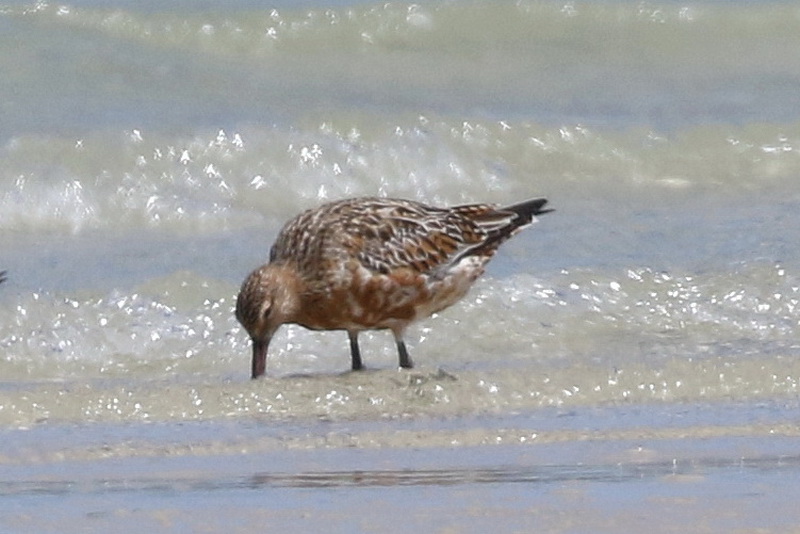
What a special place it turned out to be apart from the very long walk down to it. There were 4 huge groups of different birds – small waders in particular Little Stints all lined up in neat rows; A variety of Terns –Sandwich, Swift, Common and Little; large groupings of Greater and Lesser Flamingos and last but by no means least Bar-tailed Godwits (there must have been well over a hundred together).
Little Tern
Bar-tailed Godwit in partial breeding plumage
Bar-tailed Godwit in partial breeding plumage and showing underwing
Bar-tailed Godwit in partial breeding plumage
Bar-tailed Godwit in partial breeding plumage
Grey Plover
Common Ringed Plover
Occasionally each group would take off for some reason. They swarmed together like schools of fish in the sea and then settled back down again. That was quite a sight to see.
Bar-tailed GodwitsBar-tailed GodwitsA small flock returning
The Bar-tailed Godwits took turns to display themselves on the shoreline right in front of the hide. Amongst them were Little Stints, Curlew Sandpipers and other waders which we took ages to identify. You know what they say: If it is not this and not that etc then it must be a Knot – Red Knots in fact. Well done Sally in IDing them.
Red Knot and Bar-tailed Godwit
Red Knot
Red Knots
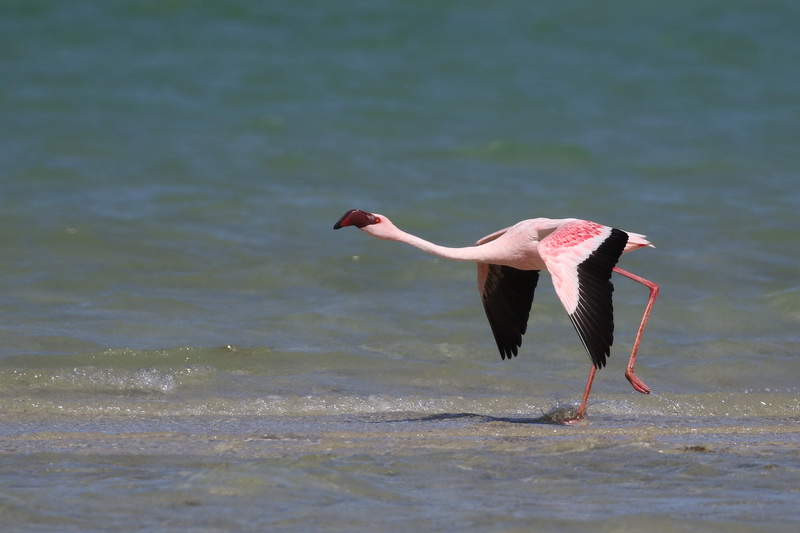
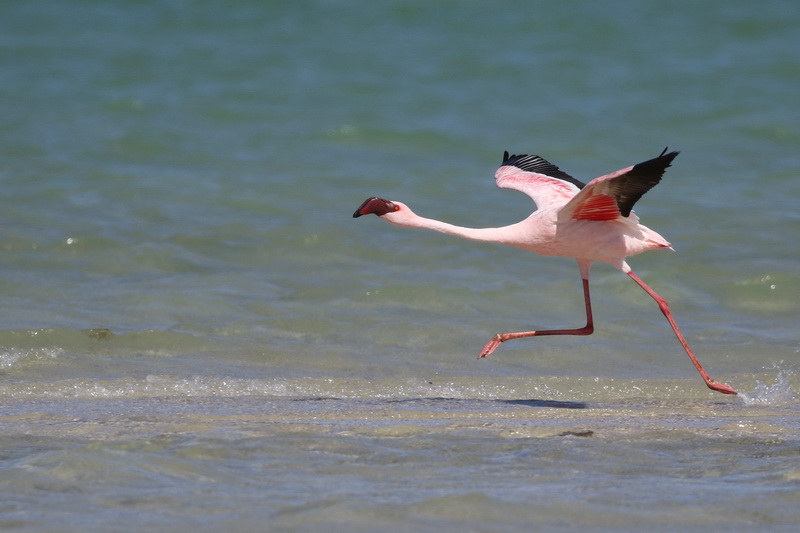
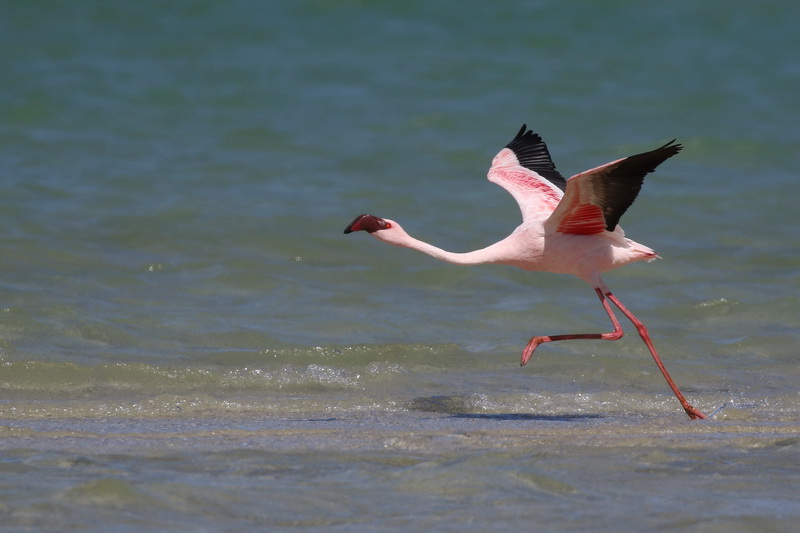
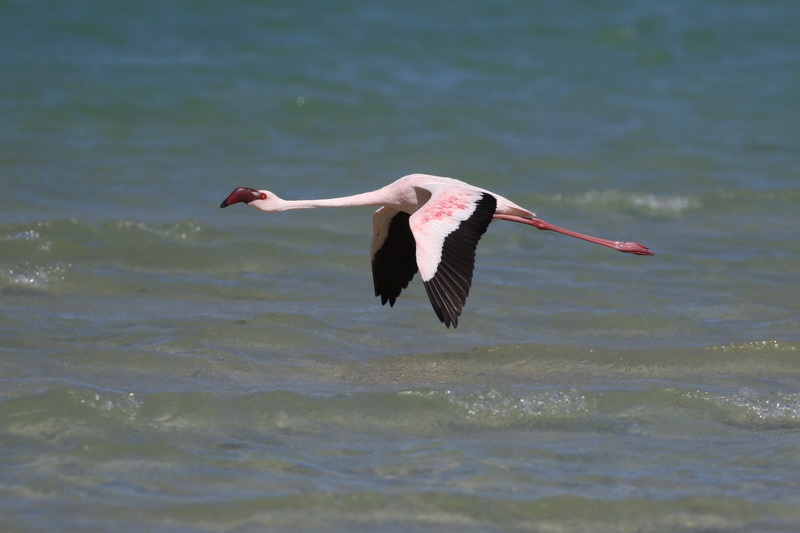
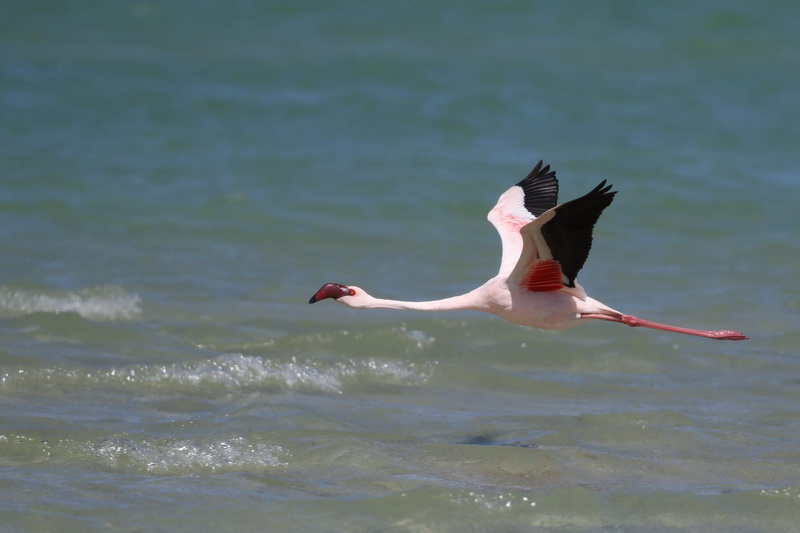
Then we had a Lesser Flamingo striding out in front of the hide trying to take off – which it eventually managed.
Lesser Flamingo getting into flight mode
Lesser Flamingo getting into flight mode – strides out
Lesser Flamingo getting into flight mode – faster still
Lesser Flamingo getting into flight mode – faster still
Lesser Flamingo getting into flight mode – yes, in the air
Lesser Flamingo getting into flight mode – away we go.
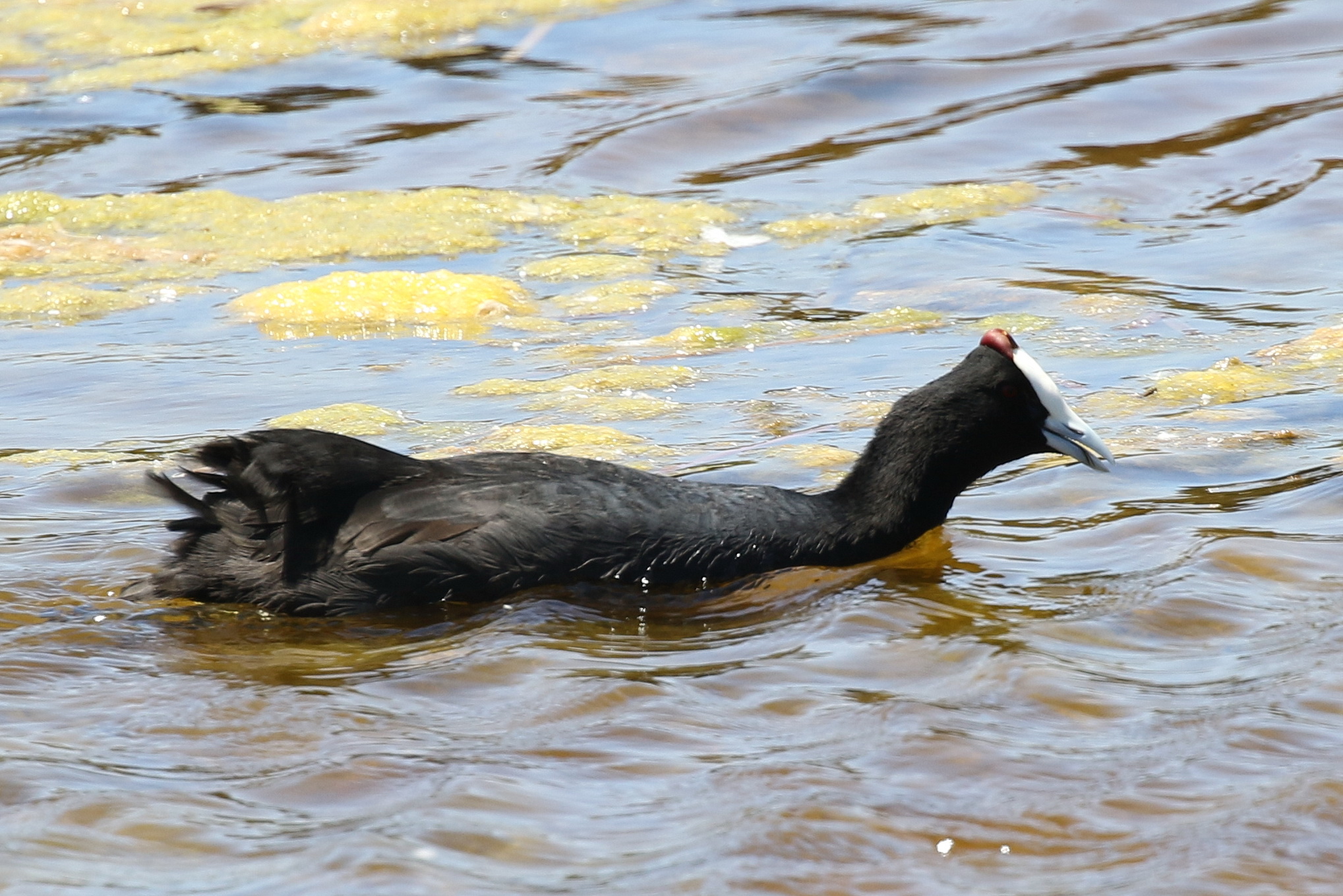
The fresh water hide – Abrahams Kraal, our next stop – was productive with sightings of some of the more common water bird species – Common Moorhen, Little Grebe, Red-knobbed Coots with chicks, Yellow Canaries and Cape Sparrow as well as a pair of Cape Shovelers.
What am I?
Cape Shoveler
Red-knobbed Coot and chicks
Red-knobbed Coot
Common Moorhen
Cape Sparrows
Then we all went to Geelbeck for a snack among the trees next to the Restaurant. The wind was pressing but the sun warmed us up. As we sat eating, Cecil’s sharp eyes noticed a Rock Kestrel sheltering itself from the wind in an alcove immediately above the entrance to the restaurant. It was not at all perturbed by guests entering only feet below.
Rock Kestrel
Another long walkway to the Geelbeck Hide proved well worth it. Sally had got the tide right – 4.5 hours after Cape Town high tide according to Birdfinder. There were little or no birds to be seen in the marshes alongside the walkway. All were to be found on the mudflats in front of the hide. What a variety of waders and other water birds even an Eurasian Curlew was spotted, again by eagle-eyed Cecil.
Eurasian Curlew
Common Whimbrel
Marsh Sandpiper
Ruddy Turnstone
Ruddy Turnstone
Sanderling
Ruff
Fortunately one side of the hide was protected from the wind and that also proved the more interesting side to see the birds.
Our campsite in Dwarskersbos was a birders delight. During the day we were serenaded by a variety of small birds all day long (at night the tree above our campsite was the local dove roost who left their calling cards all over our caravan and car).
Lesser Double-collared Sunbird
Malachite Sunbird
Cape White-eye
Cape White-eye
Karoo Scrub-Robin
Fiscal Flycatcher
White-throated Canary_
Yellow Canary
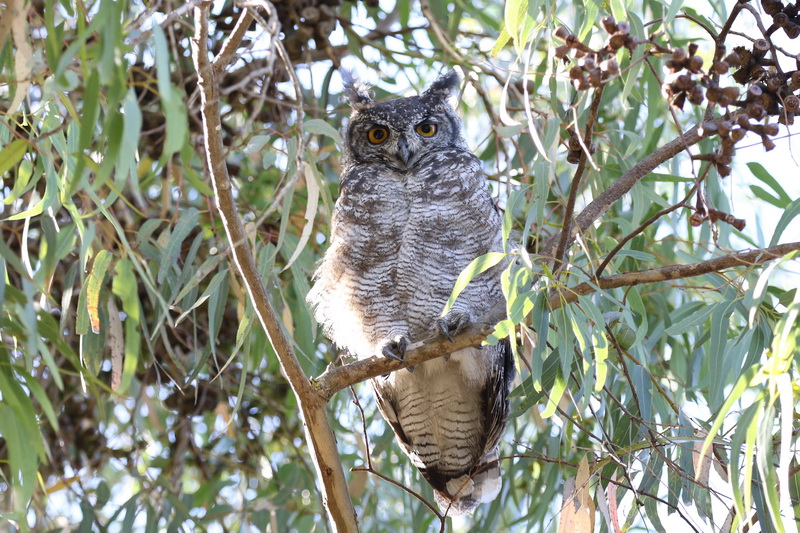
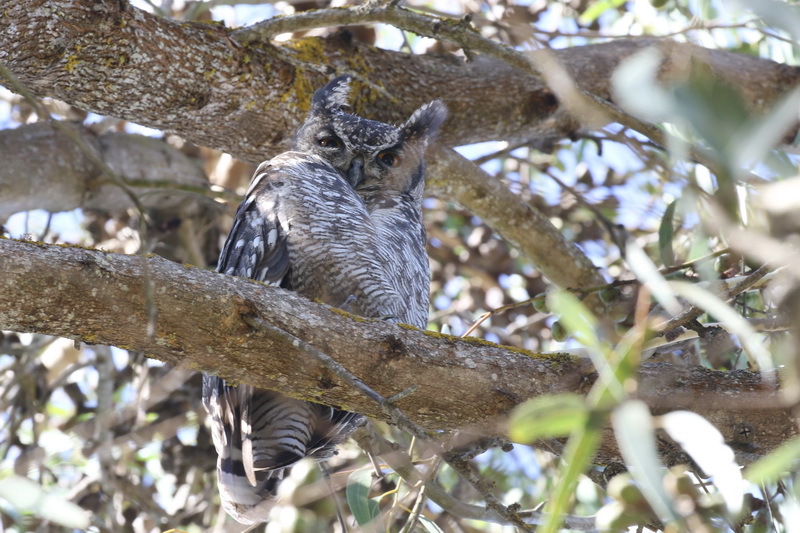
During the night we had a pair of Spotted Eagle-Owls calling above us – Woo; WoWoo. During the day we noticed that there was one roosting above us and another in a nearby tree.
Our birding trip to the Western Cape was unexpected and unplanned. It happened like this.
So, while in Australia we had booked on a trip with Desert Magic to drive through the Skeleton Coast to the mouth of the Kunene River – hopeful of seeing the Royal Tern, Baird’s Sandpiper and Angolan Swallow amongst other specials.
We got back from Australia on January 12th and started preparing for the trip mid February. There was much to organise preparing the car for the trip – getting suitable roof rack and jerry can holders; extending the fuel tank, purchase of rugged tent etc etc – R30000 expected expenditure. We had made our decisions on what to purchase got home to get an email to say the trip was off as all permits to agents had been cancelled for travelling through the Skeleton Coast.
Disappointment. But we rallied, determined to go camping.
Five days later we were off to the Cape. We could not believe that all the specials at Strandfontein, Cape Town were still being seen. They all appeared at the beginning of December and we never expected that they would hang around till we got back. Then there was the Red-necked Buzzard in Stilbaai to see and as we set off another rarity – White-rumped Sandpiper at Coega in PE.
From Howick we headed north around Lesotho and on to PE. We had travelled over 200 kms before I realised we had forgotten our power lead – not only had we left it behind, we had left it behind attached to the trailer as we left! Thankfully we had left the house keys behind with friends and they were able to disconnect the lead from the garage plug and store it inside. Good start!
Thirteen hours later we pulled into Pearsons Caravan Park close to the PE White-rumped Sandpiper sighting. The campsite was well treed with lots of shade, close to the river and highway. The ablutions were passable. Cost R234 for the site, a 20% out of season discount for pensioners – a bit steep for what it offered.
The next morning we got out early and attempted to find our way to the sighting. However, although we had the GPS co-ordinates we had to do a lot of driving up and down the N2 to figure a way to get there. Fortunately we could see where we wanted to be as it was visible as we crossed a bridge on the N2.
Once there, we had a long wait.
Greater Flamingo
Greater Flamingo
Greater Flamingo
Most of the people like us were uncertain of what to look for. Then it made an appearance close by and we could clearly identify it from its ID features in the new Roberts (Sasol sketches were way off the mark).
White-rumped Sandpiper
White-rumped Sandpiper
White-rumped Sandpiper
White-rumped Sandpiper
Back to the campsite, pack up and off to Stilbaai to try and find the Red-necked Buzzard. The drive into Still Bay was quite picturesque.
Entry to Stilbaai
Stilbaai
Estuary at Stilbaai
Stilbaai architecture
We stayed at the municipal campsite (R130 a night for the site) which although rather open was very pleasant. We found a sheltered spot away from the wind, thankfully.
Stilbaai – our campsite
Stilbaai – our campsite
Stilbaai – our campsite
That afternoon we took a ride to Melkhoutfontein on the off chance we could find the bird. It was late and very windy and our trip turned out to be a scouting trip for the morrow. And the sky was looking ominous.
Night Sky
Night Sky
The next day we were up early and headed for Melkhoutfontein, however after scouring the areas where we had heard it had been seen, we could not find it. The wind was howling and the rain threatening so we headed back to the campsite, packed up and left just as the rain started. Heading for Cape Town and Chapman’s Peak Campsite.
What a horrendous drive in thrashing rain which caused us to stop several times to let the torrential rain settle. Windscreen wipers full blast and still unable to see clearly. The heavy rain lasted more than an hour while driving. What a relief when we eventually drove out of it.
As we approached Cape Town so we noticed that our Garmin GPS was not a reliable source of the speed limits. It often showed higher speed limits to those actually shown on the road. We learnt to watch out closely for the traffic speed signs. Unfortunately when we got home we found out that it had cost us R900.
Our GPS got us to Chapman’s Peak Campsite in Noordhoek without too much hassle. A smallish campsite in a rustic environment (R180 per site per night) with all sorts of creatures in and about – Peacocks, Chickens, Helmeted Guineafowl, numerous different Geese, Goats etc. – like a small farm holding.
The sites were shady but the ablutions had a strange quirk. Loads of hot water but little cold – made for interesting and hurried showers and occasional unflushed loos. We had chosen Chapman’s Peak as other possible campsites were either in undesirable areas or too far from Strandfontein Sewerage works – our goal. Despite that it was a 40 minute drive to Strandfontein Sewerage works.
The next morning we were off bright and early – probably one of the first to get to the Temminck’s Stint site on Pan 1. We hung around looking for over two hours. People came and went – virtually all saying they had seen it before and that it was always seen from one side or the other – no consensus.
Other birds and creatures came and went – African Snipe and Water Mongoose.
Water Mongoose
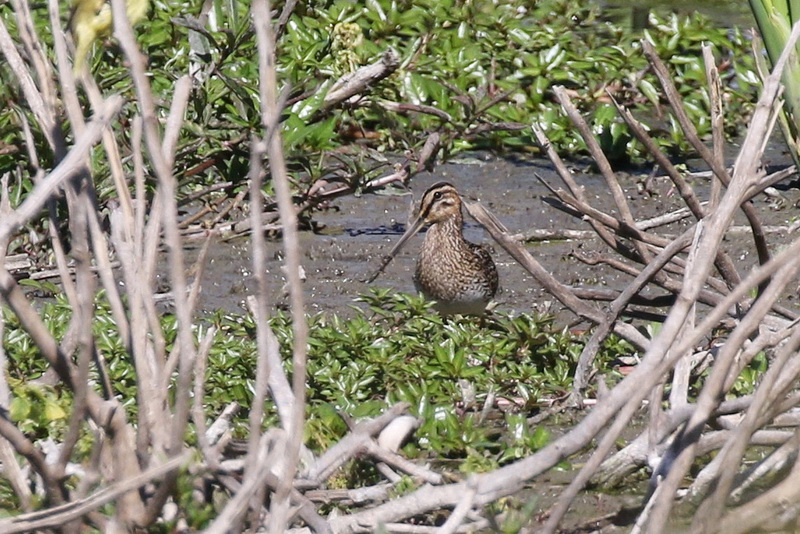
African Snipe
Levaillant’s Cisticola
That kept us on our toes and spread out. Eventually we gave up too and went off to find the Red-necked Phalarope. No sooner had we thought we found it, we got a call to say the Temminck’s had shown up.
Back we went and we too eventually had a sighting of the bird. But it was always on the move and too far away to get a decent shot.
Temminck’s Stint
We hung around for a while enjoying the snippets of a view of the bird. Apparently Baillon’s and Spotted Crakes as well as Pectoral Sandpiper had also been seen in the same spot during December. When we were there the reeds had grown substantially since December making viewing difficult and the Temminck’s had moved further away.
Next we headed for Pan 4 and the birding stand. Greater and Lesser Flamingos everywhere to be seen. Magnificent sight of numbers and colour. While on the stand we notice three Bar-tailed Godwits among the Flamingos.
Flamingos – Greater and Lesser
Bar-tailed Godwits among the Flamingos
A congestion of Flamingos – Greater and Lesser
The rest of the day was spent searching for the other specials we had missed, without success.
The next day we were back there again – first stop Temminck’s Stint. One thing we immediately noticed was that there were a lot of Little Stints present – none the day before. This as you would expect was bound to make it more difficult. However when Mr Temminck’s appeared the difference was obvious.
Then it was back to Pan 4 lookout stand. A bit of breakfast and the scope doing its business scouring the waders. What looks to be a Grey Plover was close by. However it appeared quite lean and then it unexpectedly flies and I see no black armpits. Rats I wish I had time to take a photo! Will we see it again?
Back to look for the Phalarope on Pan 2. We search high and low as Trevor Hardaker had told us he had seen it there. Scope out and we search the waders looking for something different.
Only problem was that we were looking for a bigger bird than the usual waders – Curlew Sandpipers and the like. Sally consults the new Roberts and as soon as she does she realises the mistake we were making and what to look for.
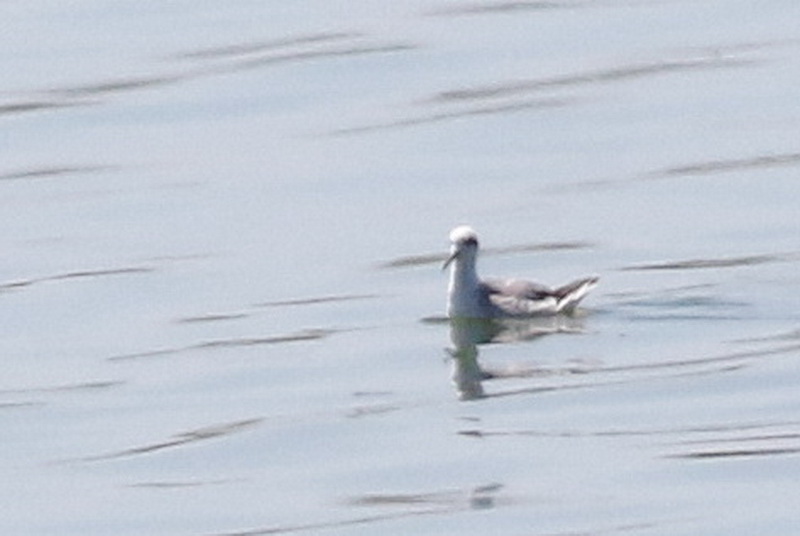
Once we learnt what to look for, the bird was very obvious among the other waders through the scope. Also the Phalarope was the only ‘wader’ swimming, all others standing or wading. Unfortunately too far away to get any reasonable photos. Great to see again. And a lesson learned – be prepared and read your field guide before setting out.
Red-necked Phalarope
Red-necked Phalarope
Then we headed back to Pan 4 lookout point. While waiting a bigger bird than the usual waders appears – a Plover. Immediately our hopes rise. Photos are taken. It is lean unlike the Grey Plover and its colouring quite pale with no black armpits – the American Golden Plover.
American Golden Plover
Back to the Temminck’s site for a final goodbye. Stay for a while but see no Temminck’s. However out of the woodwork appears the Pectoral Sandpiper! Not a lifer for either of us but also great to see again.
Pectoral Sandpiper
Here are some of the other birds photographed at the Sewerage Works:
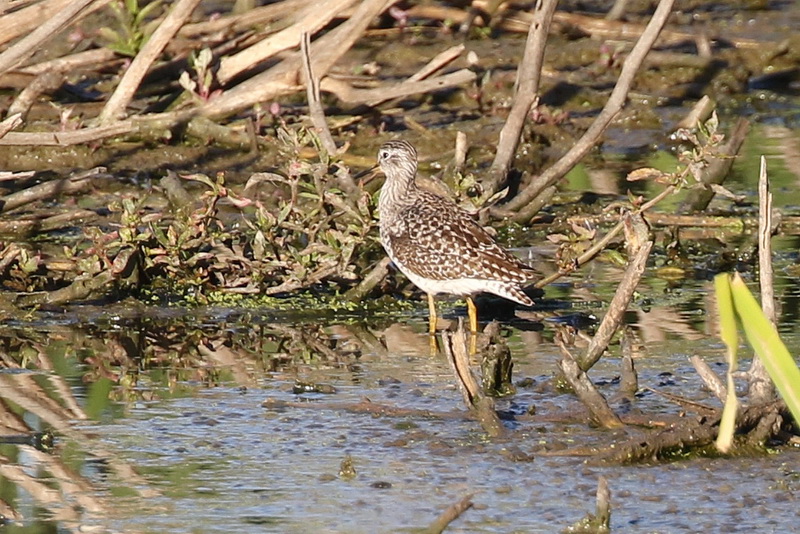
Wood Sandpiper
African Black Oystercatcher
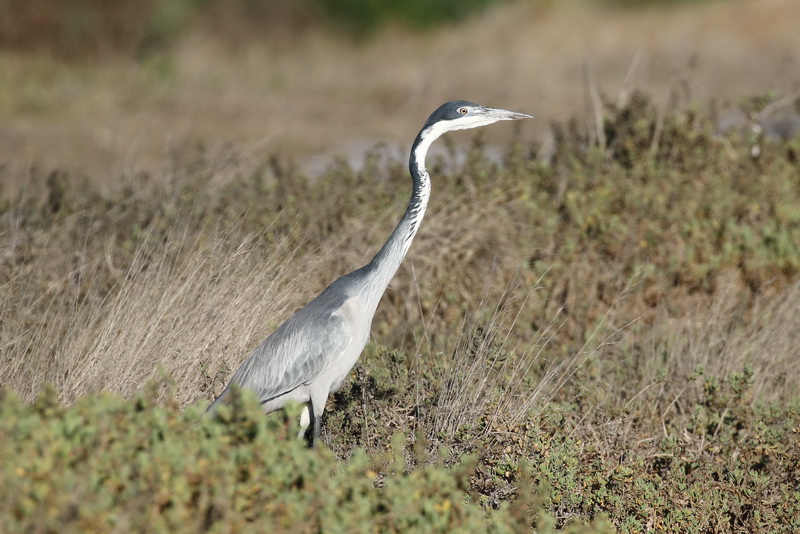
Black-headed Heron
Cape Teals and Cape Shoveler
Common Waxbill
Great White Pelicans
Karoo Prinia
Little Stint
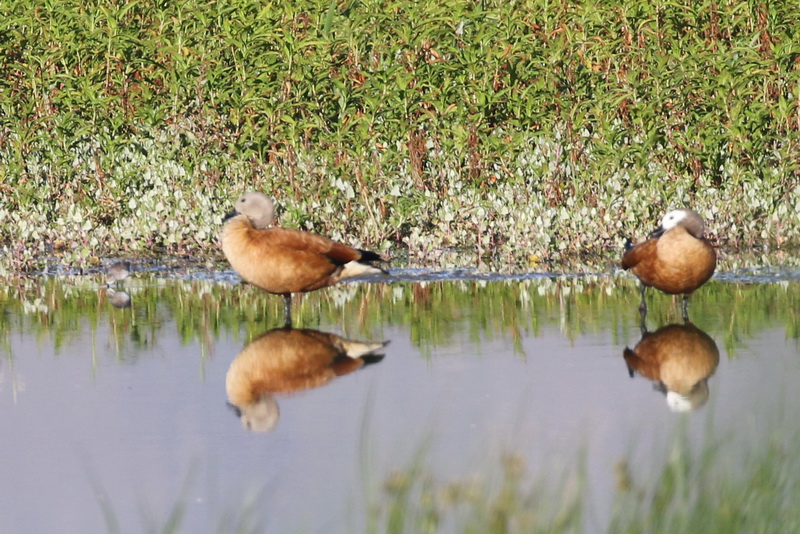
Male and female South African Shelducks
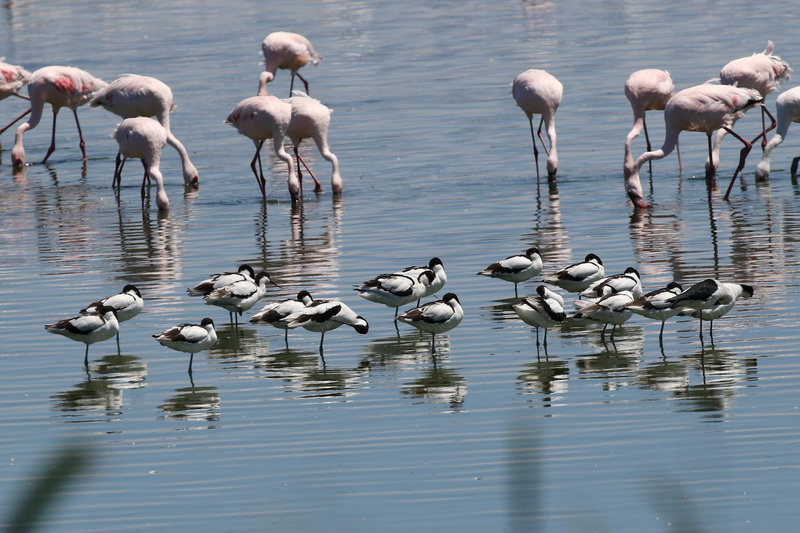
Pied Avocets among Greater Flamingos
Speckled Pigeon
Red-breasted Barn Swallow
The next day was spent in Table Mountain NR and then Kirstenbosch Botanical Gardens.
Fortunately we arrived early at Table Mountain NR. No Wild Card then R130 per person entry.
We entered and took the first road right, down to the sea.
Along the way we saw Rock Kestrel and groups of Cape Siskin as well as Lesser Double-collared Sunbirds and Bokmakierie. At the beach head we found Karoo Prinia, Familiar Chat, Cape and African Pied Wagtails, Yellow Bishop, White-fronted Plovers, Egyptian Geese, African Black Oystercatcher, Swift, Sandwich and Common Terns.
Rock Kestrel
Cape Siskin
Bokmakierie
Bokmakierie
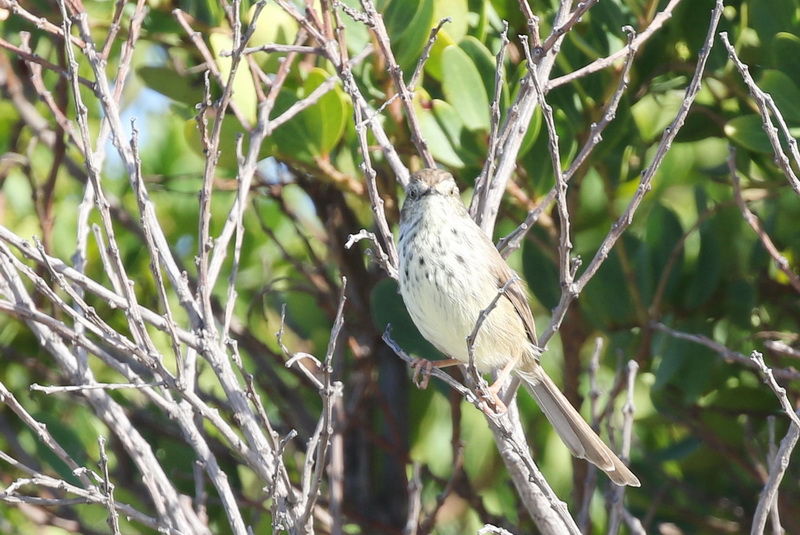
Sombre Greenbul
Cape Spurfowl
Common Buzzard
African Black Oystercatcher
Familiar Chat
Cape Canary – female or juvenile
Karoo Prinia
Otherwise the Park was quiet bird-wise and then became extremely busy with bus tours so we left for Kirstenbosch.
Always a lovely spot to spend some time walking about – even if most of it seems to be uphill! We were treated to several sightings of Orange-breasted Sunbirds and Swee Waxbills. The Spotted Eagle-Owl was seen and we learned that it had three offspring nearby – which we failed to find.
Sally and I are based in Bendigo with family. We decided to have a day away and go birding in the surrounding area.
Tim Dolby’s book “Where to see birds in Victoria” suggested we take a look at the Kerang Lakes – just over an hour’s drive north of Bendigo.
Kerang Lakes in relation to Bendigo and Melbourne
The Kerang Lakes are in a flood prone region where many rivers and creeks converge to fill wetland areas. The drive was through farm lands – very flat and not exactly attractive countryside (in our opinion).
Flat Countryside
Farming
The odd copse of trees
After an hour and a half we arrived in Kerang close to our first attempt at birding – almost 07h00.
Kerang Lakes
Based on the information in Tim Dolby’s book and the time we had available we decided to visit:
Fosters Swamp
Middle Lake
Lake Tutchewop
Round Lake and
Lake Boga.
All shown on the map above.
Fosters Swamp – a saline wetland with salt marshes round the edges was unfortunately dry. So no sightings of any waders. Needless to say we quickly left and headed for Middle Lake.
Middle Lake was a surprise. There were many birds – Ibises, numerous Ibises – Straw-necked, Australian White and Glossy – we were not surprised by the sign we saw at the entrance.
Ibis Rookery
This was definitely the highlight of our day. The facilities were good – pathways and an unusually designed bird hide overlooking the rookery. The rookery included the full extent of Middle Lake and Ibises were everywhere. It was difficult to identify other species among them. But we did see a Little Pied Cormorant sitting on a dead branch. Even a Yellow-throated Miner was seen.
Sally in front of the double storey bird hide
Bird Hide
Scenery at Middle Lake
Scenery at Middle Lake
Paul taking a stroll along one of the pathways
Unfortunately the day was very windy with the odd shower and birds were scarce. Despite that some birds were still long enough for a photo.
Blue-faced Honeyeater
Grey Teal
Red-rumped Parrot
Royal Spoonbill
Welcome Swallows
White-plumed Honeyeater
Overhead the air was constantly occupied with mainly Ibises as well as some Black Kites and Royal Spoonbills.
Black Kite
Black Kite
Black Kite
Royal Spoonbill
Glossy Ibis
Glossy Ibis
Moving on, we headed for Lake Tutchewop. Another very open lake with sparse vegetation around it. We were able to drive reasonably close passing a pair of Nankeen Kestrels flying beside us. Near the water we saw a number of water birds on the water’s edge some distance away. These included many Silver Gulls, Caspian Terns, some Whiskered Terns, a group of Red-necked Avocets as wells as many Red-capped Plovers.
Red-capped Plover
Red-capped Plover -juvenile
Red-capped Plover
Red-capped Plover
An overhead White-faced Heron caught our attention.
White-faced Heron
Driving alongside the lake heading north on a dirt track we encountered Australian Pipits every hundred metres – not necessarily in ones or twos but at times up to six together foraging on the road ahead of us.
Our next stop was Lake Round to the west of the town called Lake Boga. The Lake was full and there were some ducks on the opposite side but in all not much of interest.
And lastly to the lake with the same name as the town – Lake Boga. Again disappointing as it was very difficult to get close to the lake’s edge and there was not much to see on the expanse of water.
And then it was back to Bendigo via a different route. Passing one pond by the road there was a family of Grey Teal, a pair of Masked Lapwings, a Australian Swamphen and this Black-winged Stilt. A Black-shouldered Kite flew overhead.
Black-winged Stilt
Back home in Bendigo we were entertained by this Blue-tongued Lizard trying to get indoors.
Blue-tongued Lizard – you can see it’s blue tongue
In all we recorded seeing 38 different bird species. See our list by clicking here.
Sally’s son David and his fiancee Katrina went to Cairns for the weekend on business while we were visiting in Melbourne. Their car was at our disposal.
We took the opportunity to visit Phillip Island – about a two hour drive east of the entrance to the harbour.
Our goal was to see the Little Penguins coming in to roost at sunset. As we were there for only one night it was impossible to be at Cape Woolamai at the same time to see the millions of Short-tailed Shearwaters flying in to roost. There was also the opportunity to see Koalas. The brochures also indicated that we should find thousands of waders in the Rhyll estuary, mangroves and mudflats and that Swan lake was worth a visit for birding.
This was our first chance to go birding since we arrived. We wanted to refresh our memory of Australian birds and Phillip Island enabled us to reacquaint ourselves.
Leaving Melbourne at 05h00, we arrived just after seven and went straight to Cape Woolamai on the off chance of seeing late departures of the Short-tailed Shearwaters.
The weather was cold, overcast and very blustery. Unfortunately we were not lucky enough to see any but we did see this Swamp Harrier.
Swamp Harrier
Then we headed to Rhyll and walked to the estuary.
View of mangroves leading to the mudflats in the Rhyll estuary
Rhyll mangroces
Thousands of waders there might have been but nowhere in the area we hoped to find them. A few different species of water birds were seen in the distance including Silver Gulls, Australian (Sacred) Ibis, Pacific Black Ducks. Some photos taken in the area:
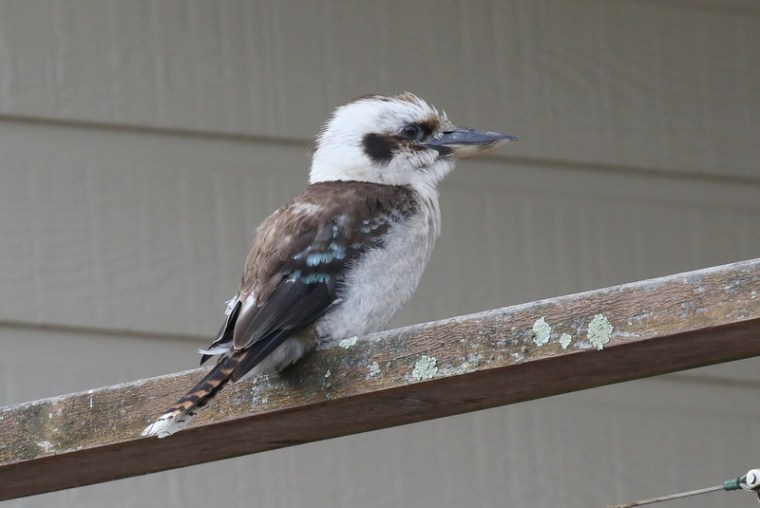
Laughing Kookaburra
Laughing Kookaburra
Silver Gull
Silver Gull
White-eared Honeyeater
Grey Fantail
Grey Fantail
Laughing Kookaburra
Laughing Kookaburra
Australian Magpie
Our next destination was the Penguin Parade to purchase a seat for the evening event. For a little extra we also were able to visit the Koala Reserve. We took a walk down to the beach where the Little Penguins would emerge at sunset to explore the area. On the way down we saw a Swamp Wallaby close-by.
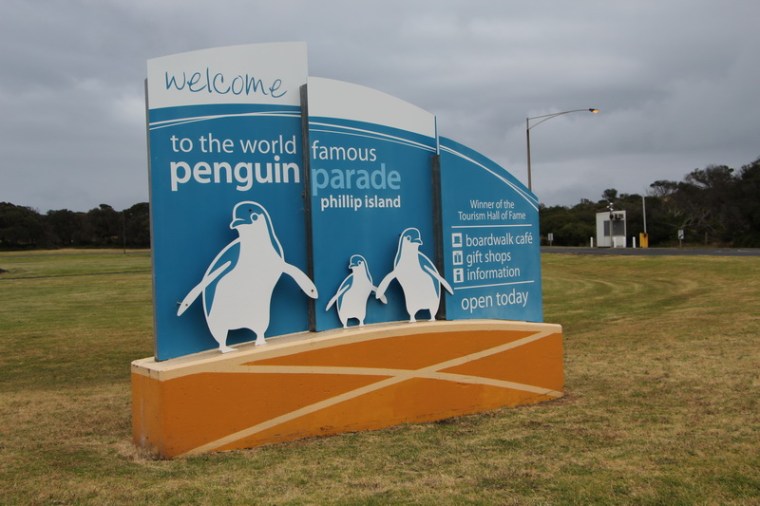
Welcome to Penguin Parade
Entrance to access the Little Penguins beach
Bench on way to beach
Grand Stands – holds 4000 people
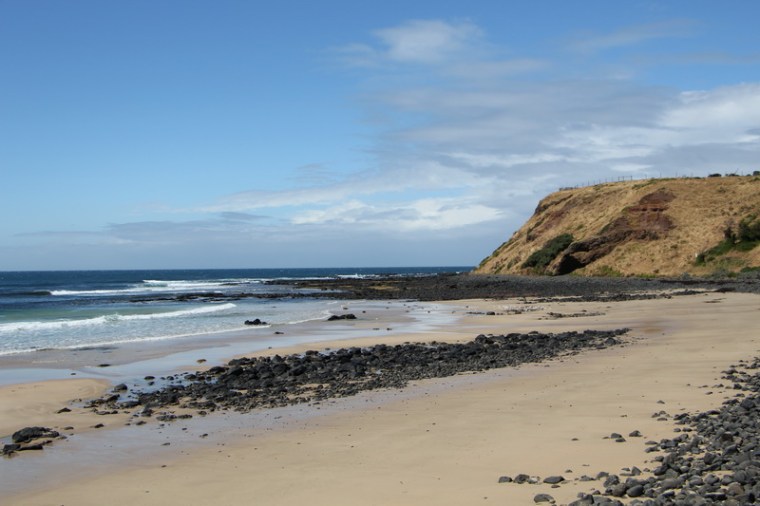
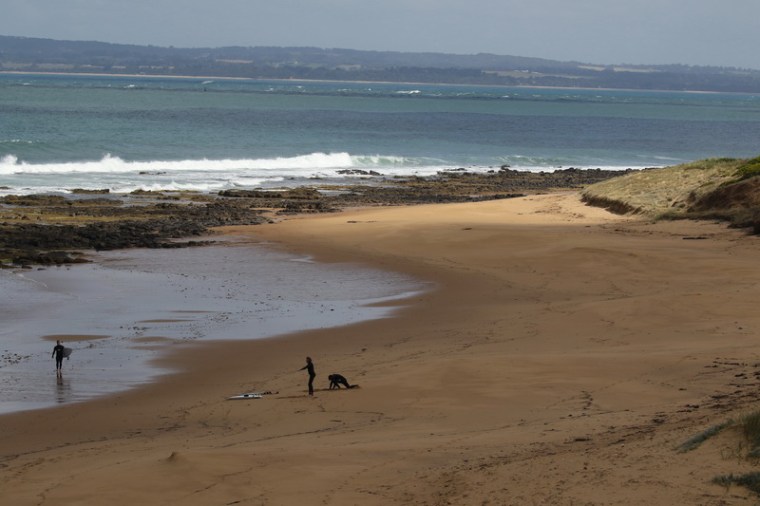
Main part of the beach where the Little Penguins exit the sea
View the other way
View to the Needles
Rough sea
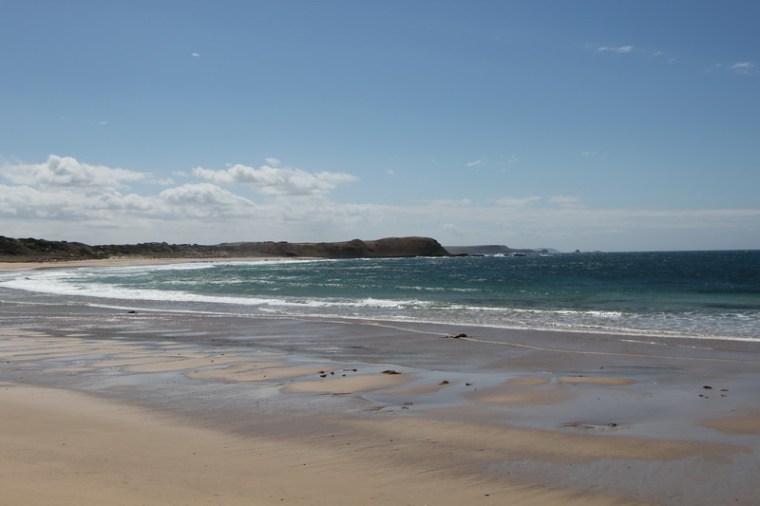
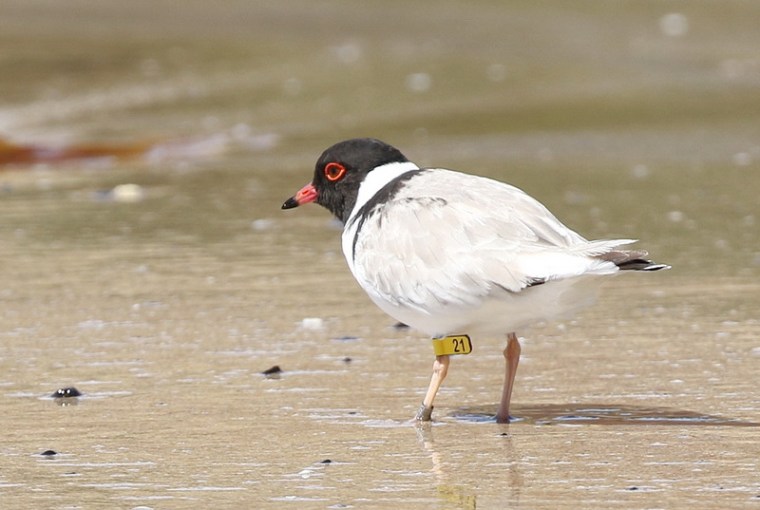
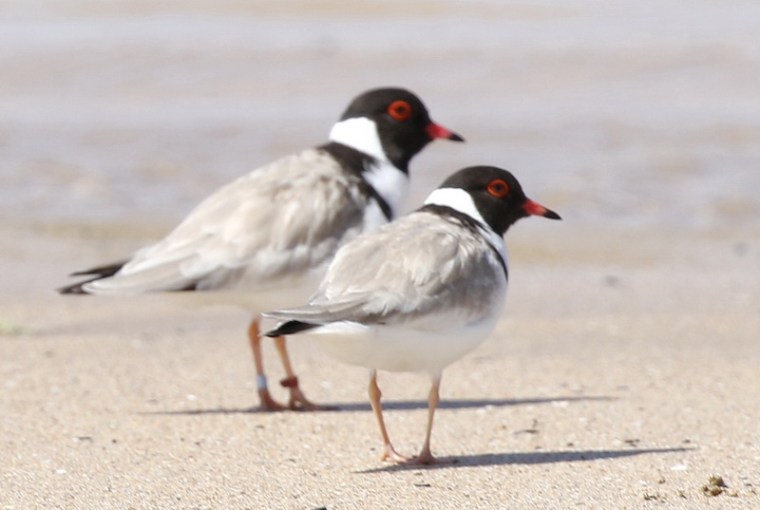
Then at the beach we found three Hooded Plovers – two with rings. We understand that this is a threatened species.
Hooded Plover
Hooded Plover
Hooded Plover
Hooded Plover
We were hoping to find the odd L Penguin in the daylight so that we could take a photo or two. Photography at night during the parade is forbidden. Again we were not fortunate. However we did find an interesting bird party at the entrance to the car park.
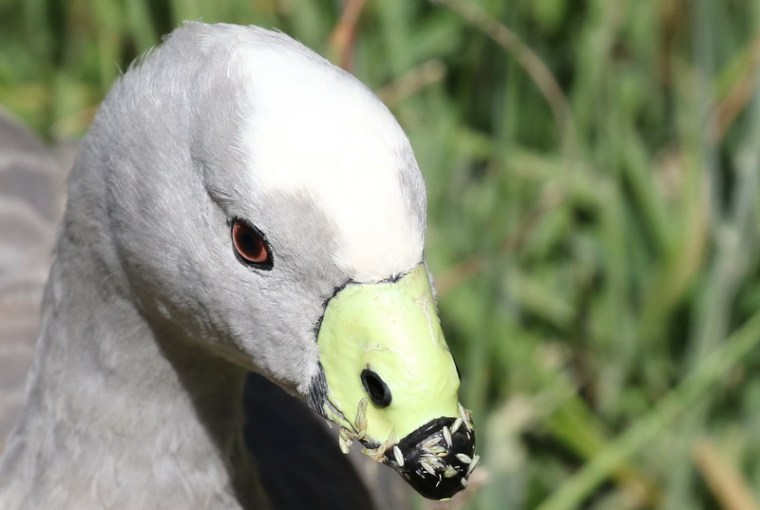
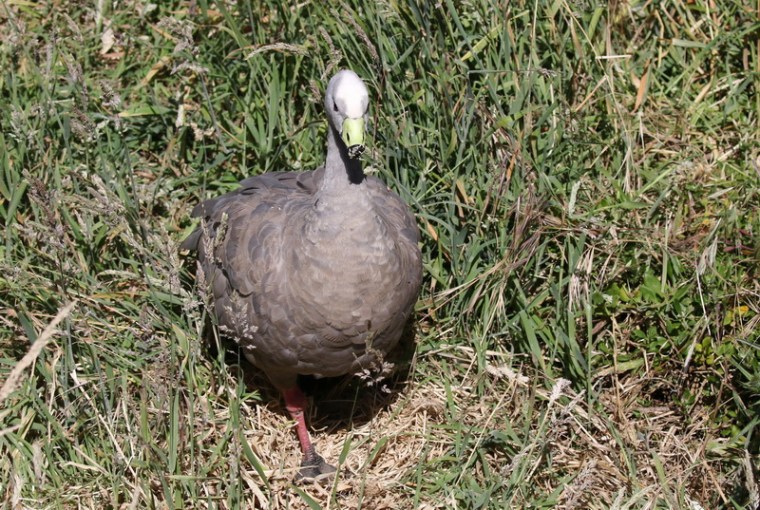
Cape Barren Goose
Cape Barren Goose
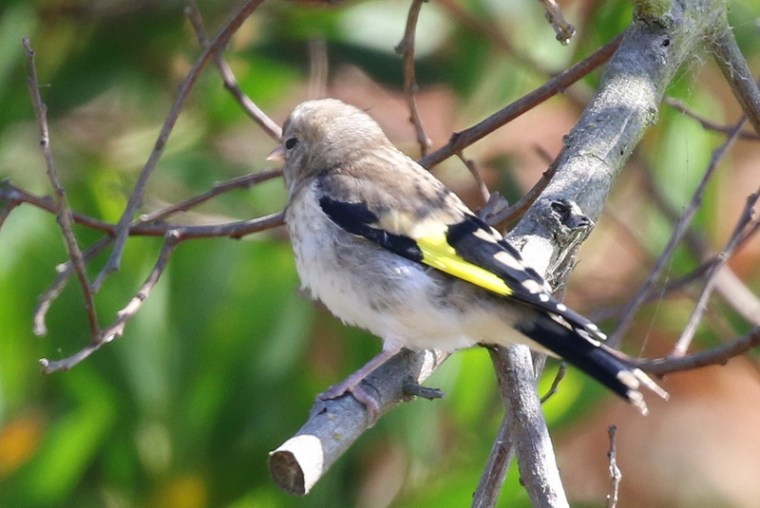
European Goldfinch – juvenile
European Goldfinch – juvenile
European Goldfinch – juvenile
European Goldfinch – juvenile
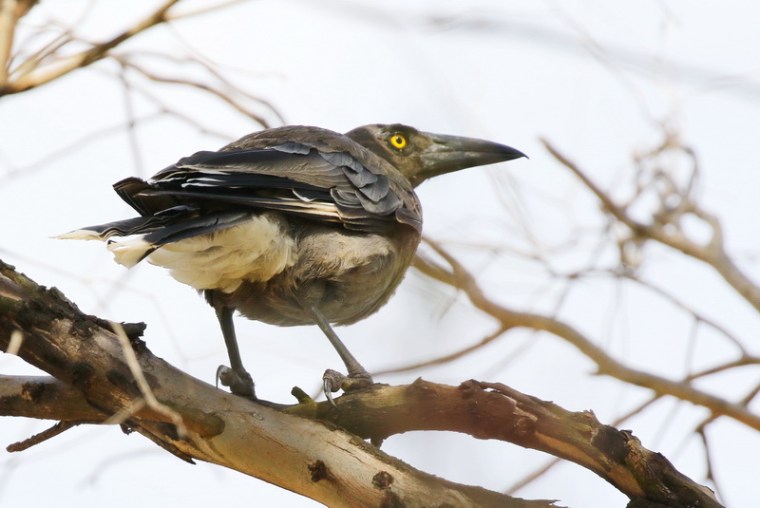
Grey Currawong
House Sparrow
House Sparrow – male
Silvereye
Silvereye
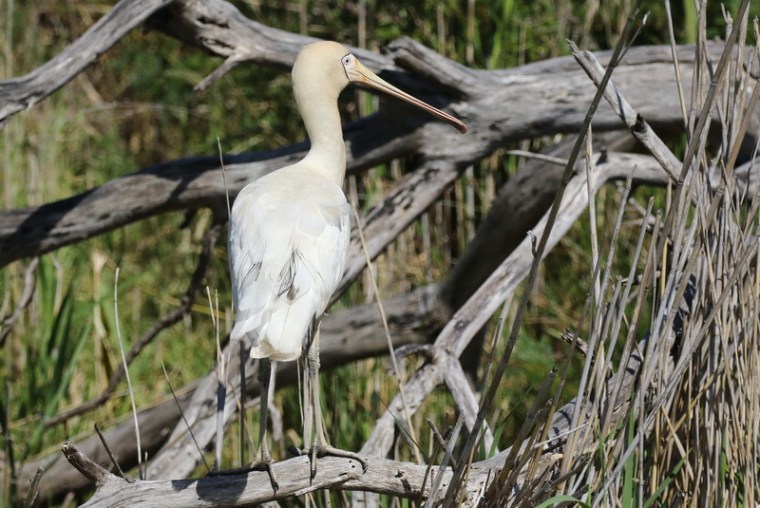
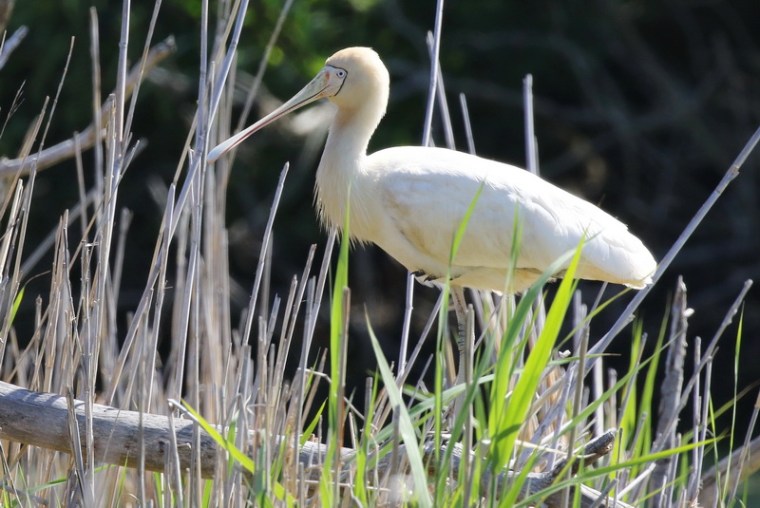
Yellow-billed Spoonbill
Yellow-billed Spoonbill
Yellow-billed Spoonbill
Cape Barren Goose
We took a drive round the headland – Nobbies – to get a high point view of coast line.
Nobbies coast line
Nobbies coast line
Nobbies coast line
Nobbies coast line
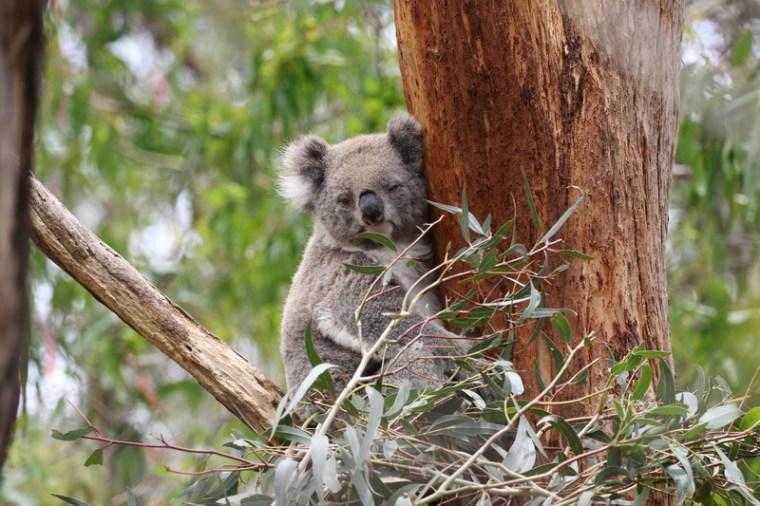
Leaving Nobbies we headed back to the Koala Reserve. There were two main fenced in boardwalks enclosing Eucalyptus trees in which several Koalas inhabited.
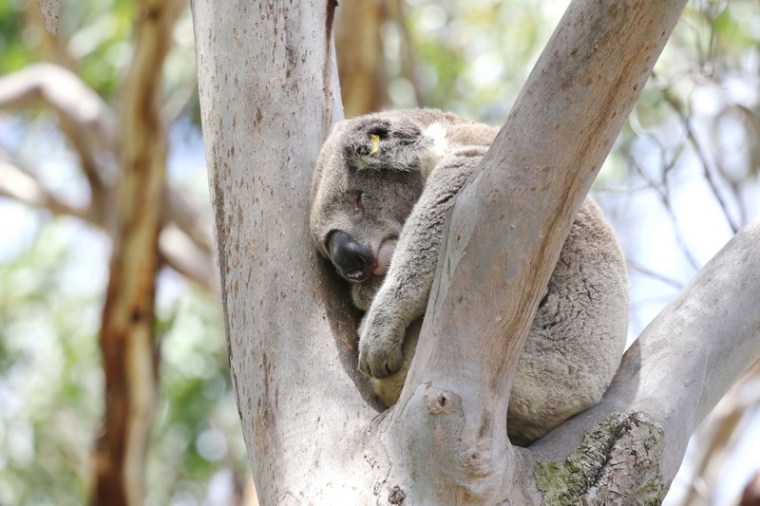
We saw three Koalas in each enclosure – doing what they do best – curled up sleeping.
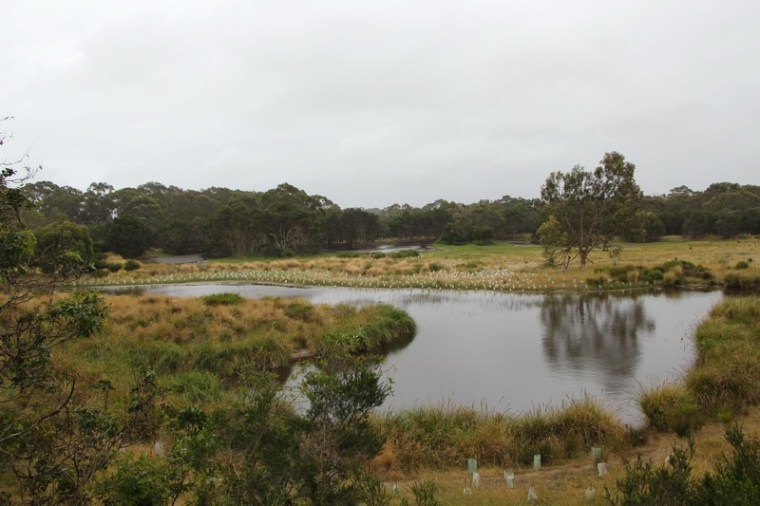
Koala wetland area from the boardwalk
Koala Boardwalk
Koala curled up
Koala having a peek
Koala clutching on
Koala wondering what’s the attraction
Koala actually caught moving.
Walking round the enclosures we saw quite a few different species of birds especially overlooking the wetlands on one of the boardwalks. Even a Swamp Wallaby made an appearance.
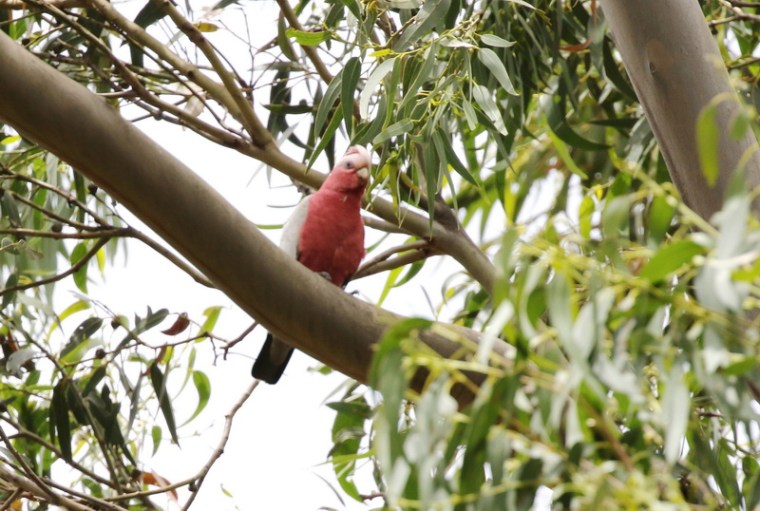
Galah
Grey Currawong
Superb Fairywren
Swamp Wallaby
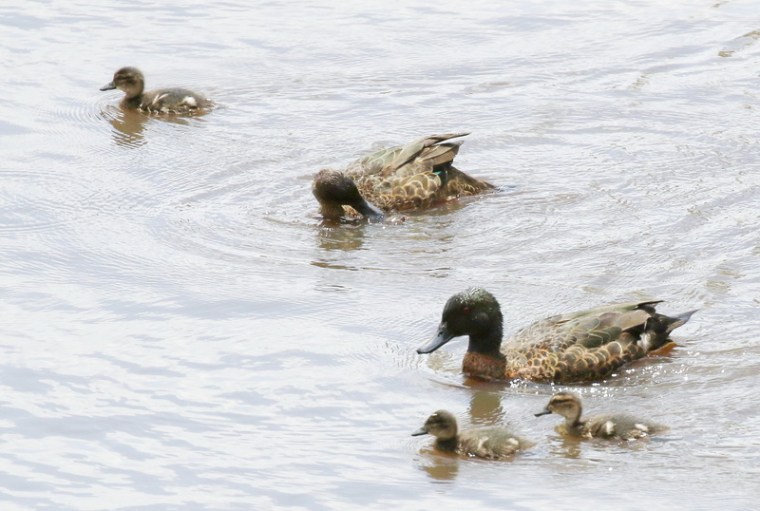
Chestnut Teal family
Chestnut Teal family
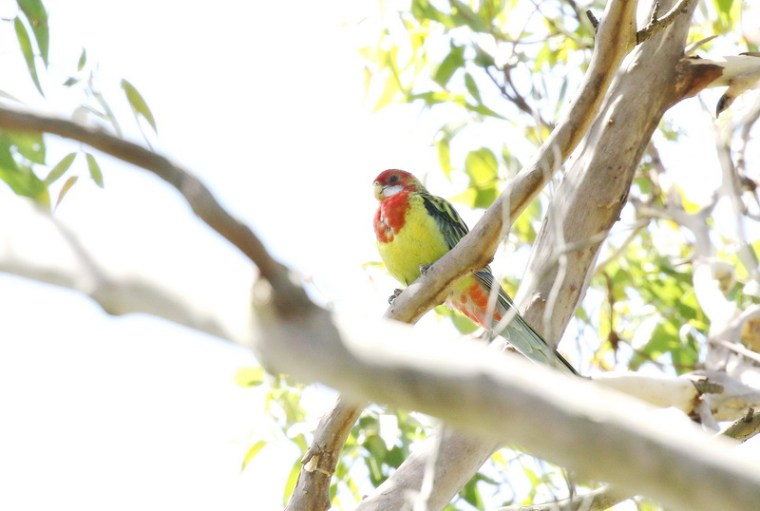
Eastern Rosella
Swamp Wallaby
Black-faced Cuckooshrike
Crested Pigeon
Noisy Miner
Sulphur-crested Cockatoo
While walking between the two enclosures a Forest kingfisher made an appearance.
Forest kingfisher
Forest kingfisher
Forest kingfisher
Forest kingfisher
After dinner we headed for the Penguin Parade – arriving an hour and a half early to get a good seat – sheltered from the wind which made the cool evening a lot colder.
Seats filling up.
As people arrived so the stands filled and even a cordoned off sand area in front of both stands filled. We waited for sundown and the first penguins were expected at 21h00. Sally and I had our binoculars with us so we were able to scout the sea for sightings of flocks of penguins gathering in groups before they made their dash up the beach.
Then the moment arrived and the first group made a dash. Up they came then one got nervous and started back – the whole lot followed.Up and down they wavered, groups and groups making their charge up the beach. Sometimes the groups were as much as a hundred strong. In total they expected almost a thousand Little Penguins to come ashore.
Several parties came up the beach between the two main grand stands so we were able to get a very close-up view. The temptation was there to take photos but most people resisted.
Then the rain came and there was a mad congested dash for shelter. Fortunately it was not a downpour. Walking back up to the car park you could hear all the youngsters calling for their parents and you could see them standing outside their burrows. The adults were walking up the roads so close you could almost touch them. It was quite an experience and all over by 22h00.
The next day we headed for Churchill Island. The first bird we encountered was a Pied Oystercatcher.
The variety of birds was limited but a few species were in abundance.
Masked Lapwing
Masked lapwing
Yellow-rumped Thornbill
Yellow-rumped Thornbill
Australian Pelican
Australian Pelicans and Black Swan
Chestnut Teal
Common Blackbird
White-fronted Chat
White-fronted Chat
White-fronted Chat
White-fronted Chat
Then we headed for Swan Lake near Nobbies. Along the path down to the hides, a bird flew in front of us – calling. At first we thought it was a pigeon but it turned out to be a cuckoo – a Pallid Cuckoo.
Pallid Cuckoo
Pallid Cuckoo
Pallid Cuckoo
Pallid Cuckoo
Pallid Cuckoo
Pallid Cuckoo
There were two hides with shallow wetlands in front of each.
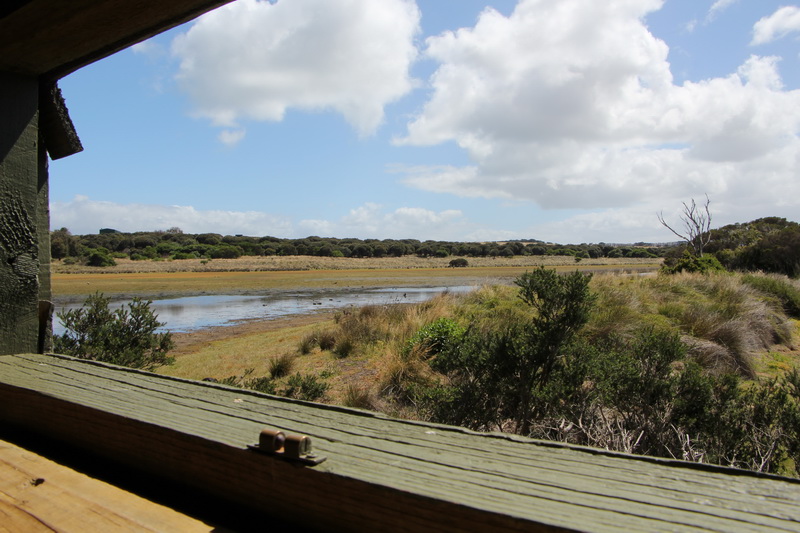
Swan Lake hide view
Swan Lake hide view
Some of the other birds photographed at Swan Lake:
Black Swan – akimbo
Black Swan
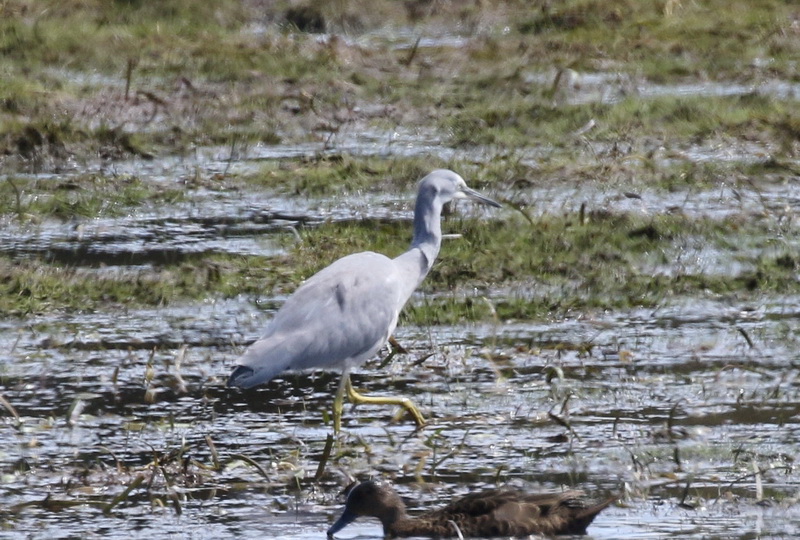
White-faced Heron
White-faced Heron
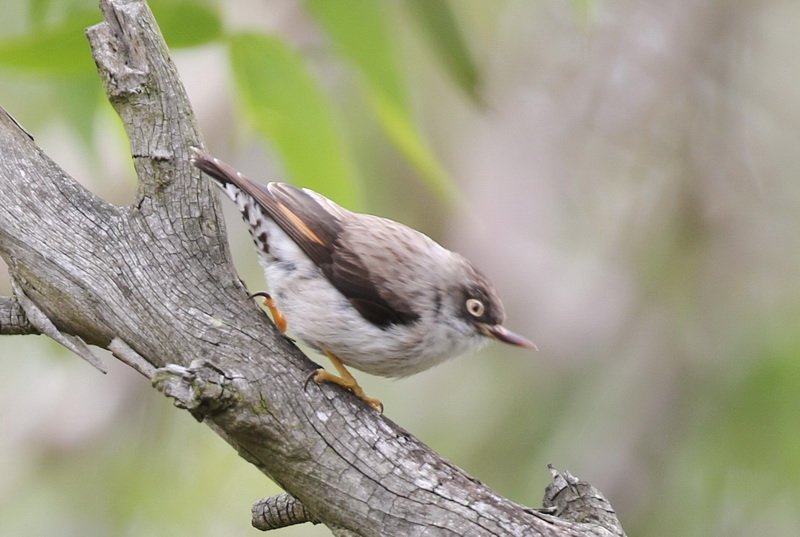
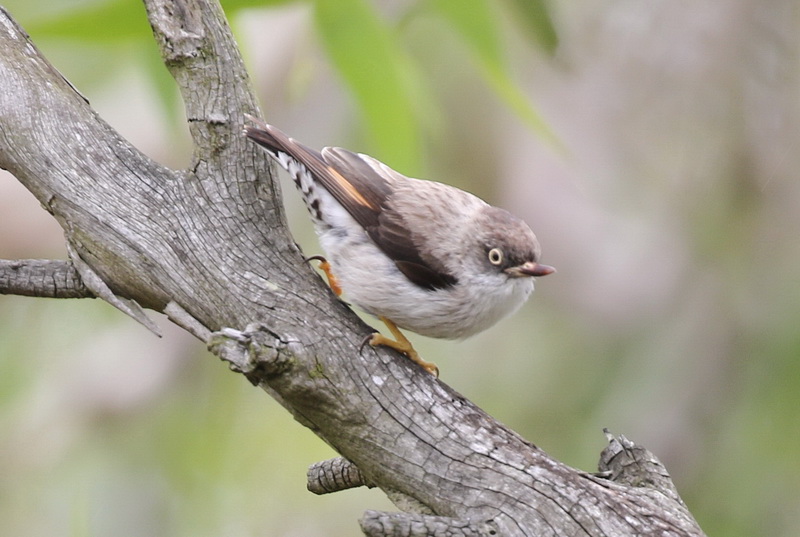
Varied Sitella
Varied Sitella
Varied Sitella
Varied Sitella
White-browed Scrubwren
White-browed Scrubwren
Straw-necked Ibis
Straw-necked Ibis
Australian Shelduck
Altogether we recorded seeing 56 species. Click here to see our bird list.
This was a very pleasant venue for us despite the weather.
Below are a few species photoed at Ben Vie on Sunday 16 October 2016. This was on an outing organised by the BirdLife KZN Midlands Bird Club led by Ian Gordon.
Note the Common Buzzard was seen near Karkloof Conservancy and not at Ben Vie.
The campsite.. Numerous flat grassy stands with water and power. Ablutions – clean with hot water.
This was both a Week-end and Sunday outing.
It was attended by ten members for the weekend and a further eleven for the Sunday outing. And as usual it was a resounding success surpassing everyone’s expectations. Not only was the birding excellent but the venue and hospitality of Richard Alcock were equally so.
As noted on both previous visits this year (and reported on the website) this can be considered the “Okavango” of South Africa.
Peter and Frankie arrived Thursday afternoon as did Sally and I. It was a drizzly cold afternoon. Despite this we took a drive round the estate heading for the hide.
Bird Hide. The path to the hide extends behind the hide to the start of the forest.
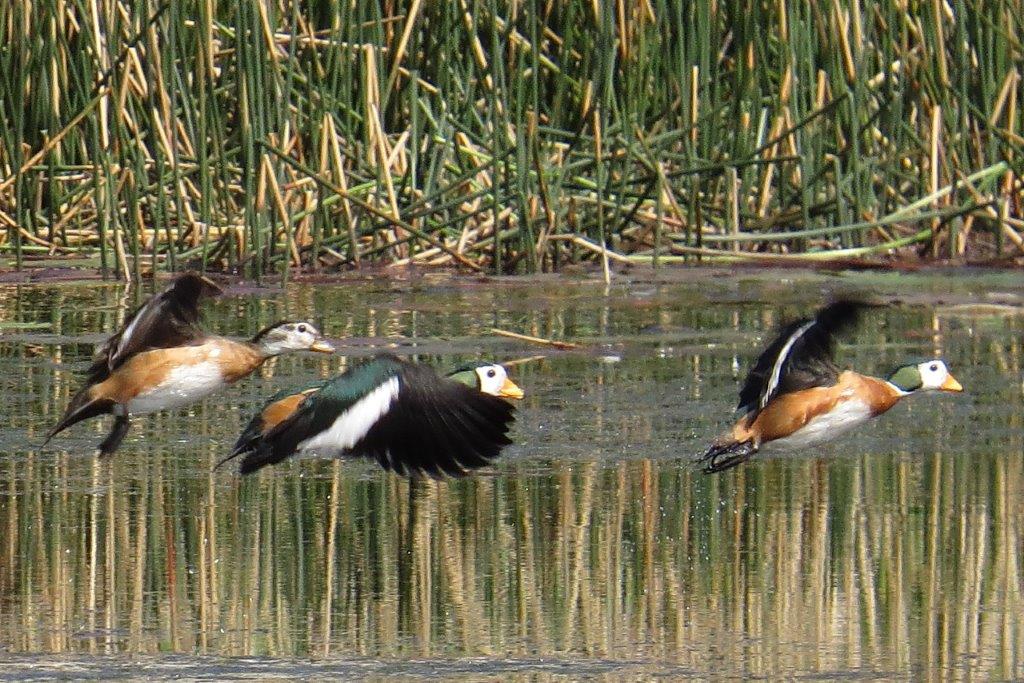
On the way just before entering the forest over 30 White-backed Ducks took off from the water’s edge showing us why they got their name. A magnificent sight. It was so unusual to see so many together.
A few of the White-backed Ducks
White-backed Ducks in flight showing their finery.
Then we drove through the woods to the 200 metre narrow grassy path through the marsh to the hide. Our mistake was not wearing our wellies as the path was through tall wet grasses.
View from the Bird Hide
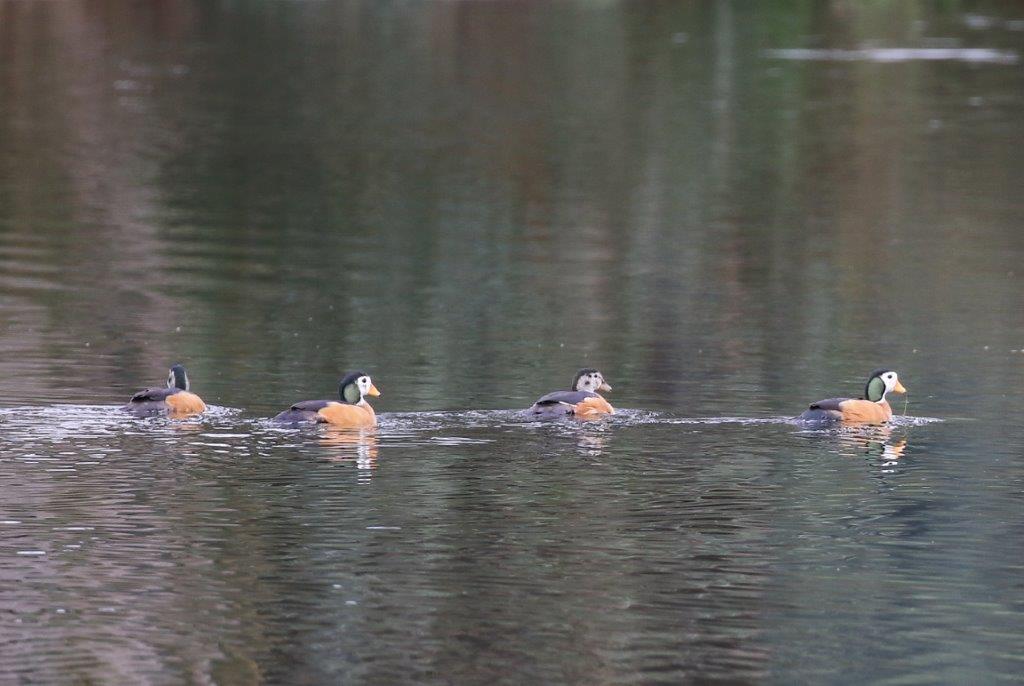
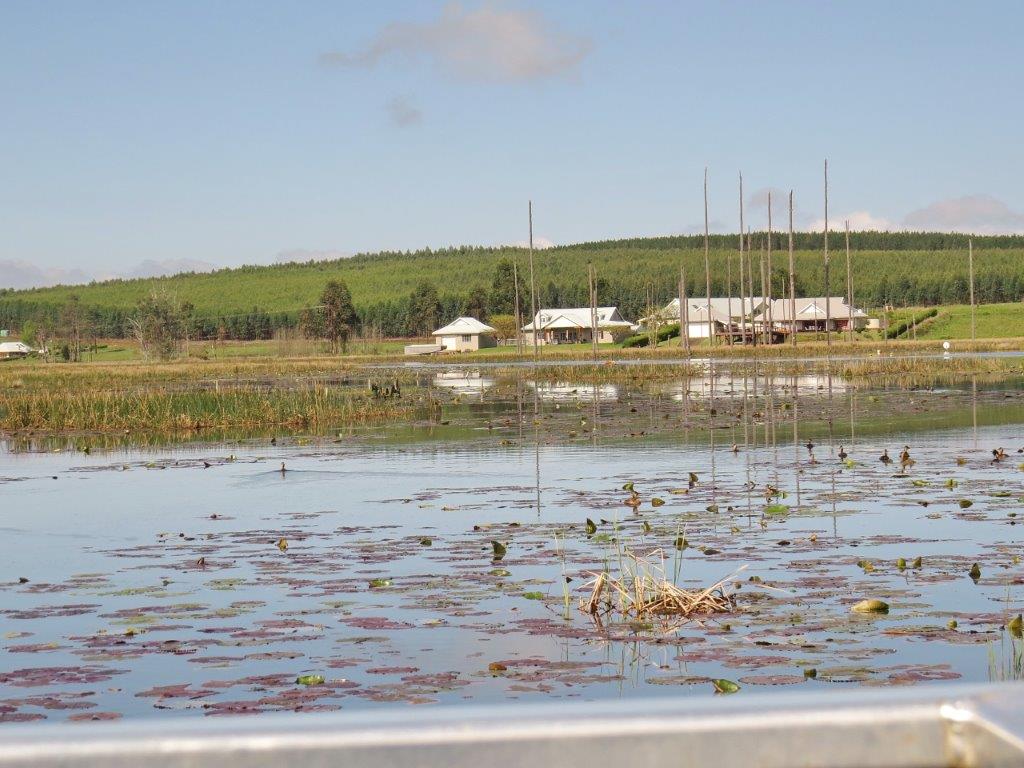
The hide is located at the start of the 7 kms channel into the wetland. As expected we saw many waterbirds including African Pygmy-Geese and White-backed Ducks. Two Grey-crowned Cranes did a fly pass and a pair of Wattled Cranes were observed some distance away close to the forest.
Red-knobbed Coot
Common Moorhen
Pied kingfisher
African Purple Swamphen
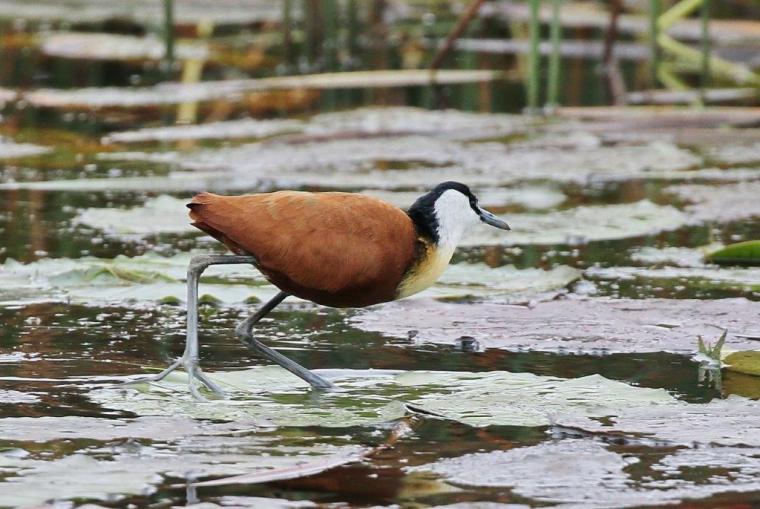
African Jacana
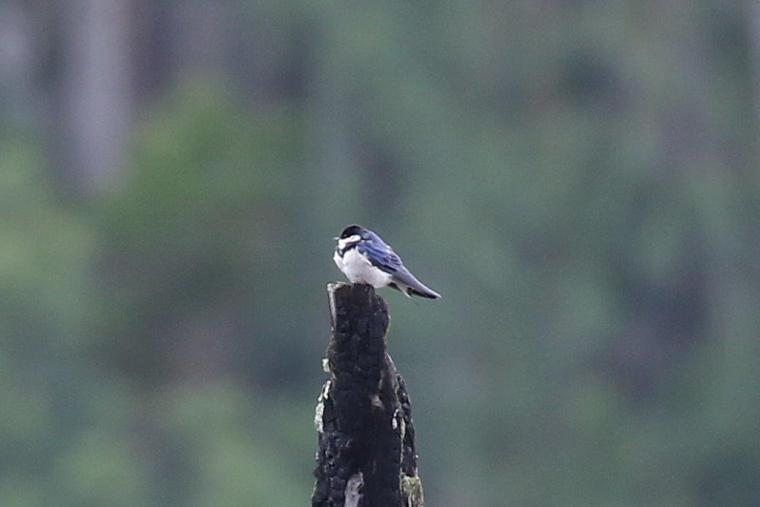
White-throated Swallow
Yellow-throated Longclaw
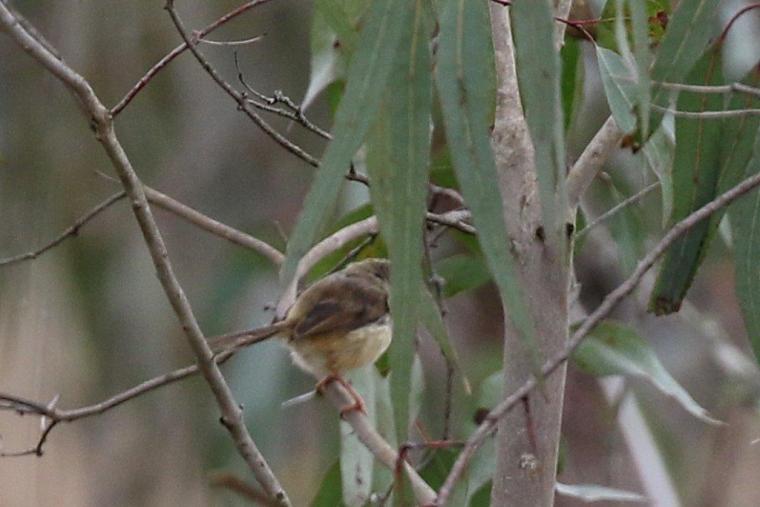
Tawny-flanked Prinia
Wattled Cranes in the distance
The next morning we returned to the hide – this time suitably attired in Wellies and warm weather-proof clothing. Again we saw most of the birds we saw the evening before including the African Pygmy-Geese, White-backed Ducks and Wattled Cranes.
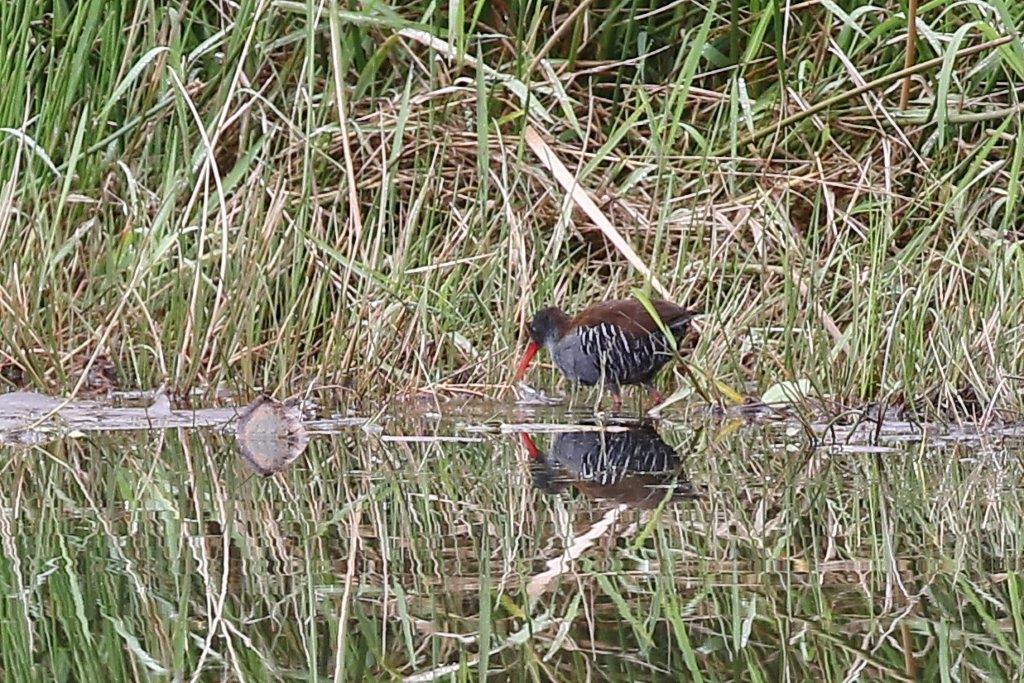
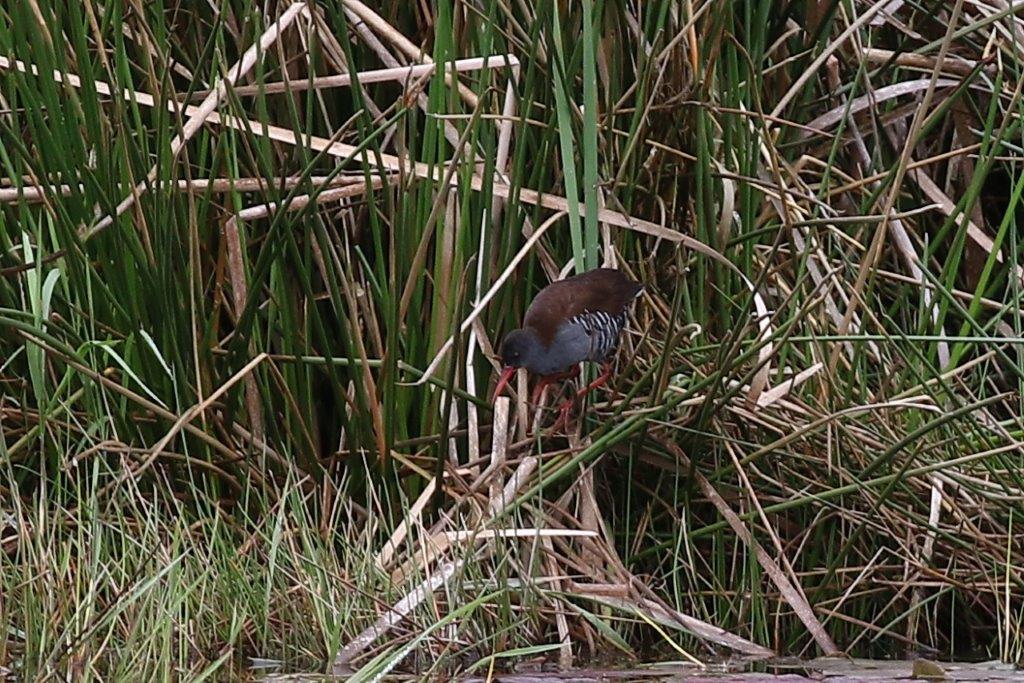
The excitement was observing an African Rail walking along the water’s edge on the far bank.
African Rail
African Rail
African Rail
African Rail
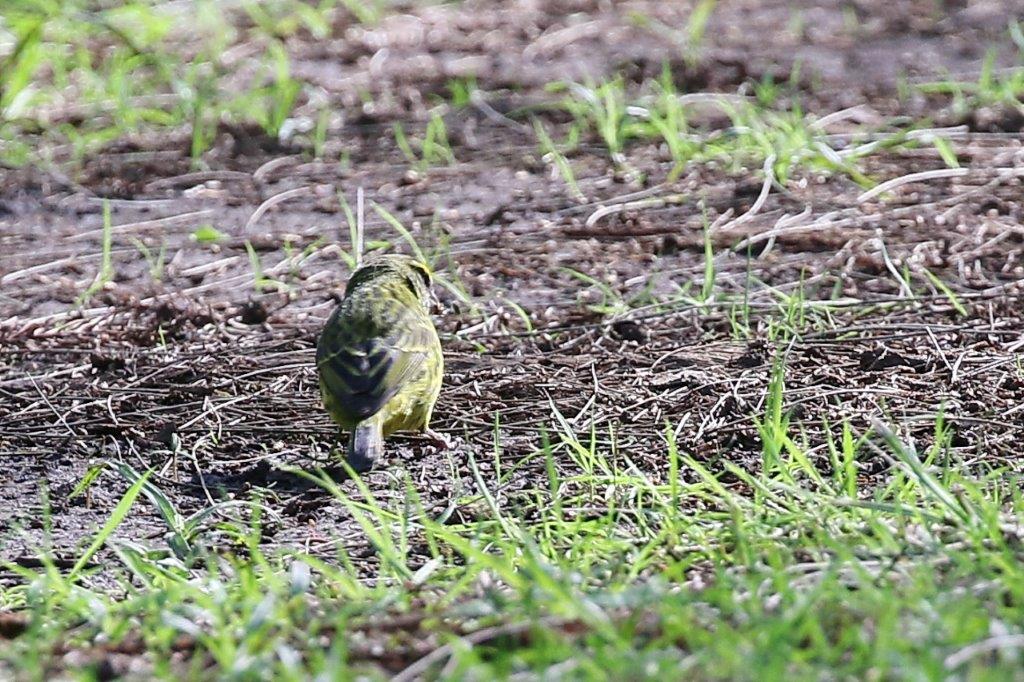
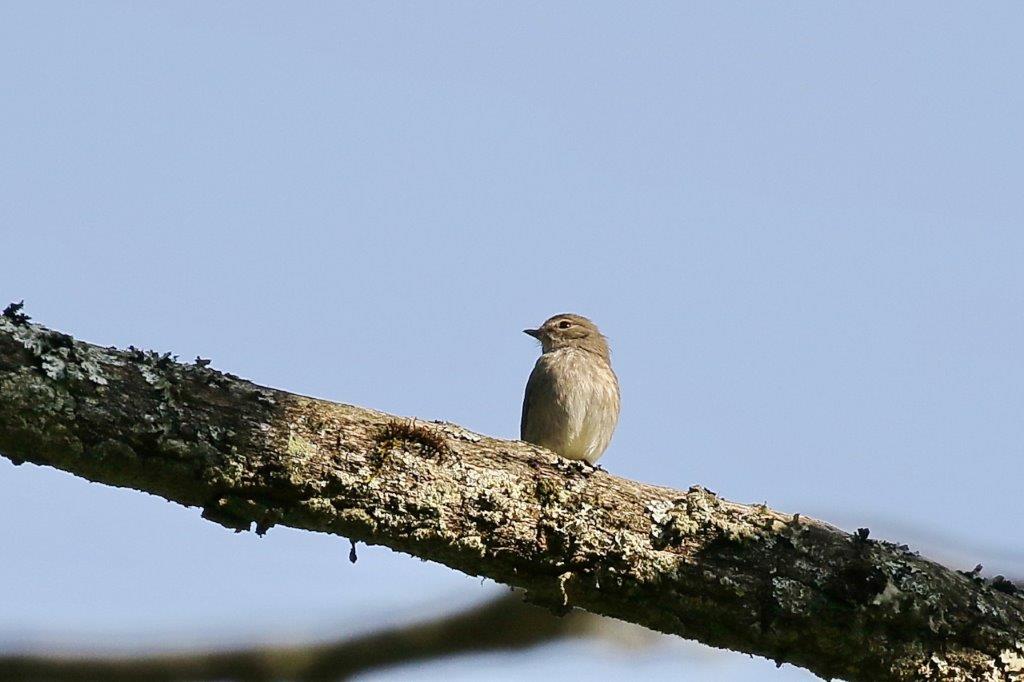
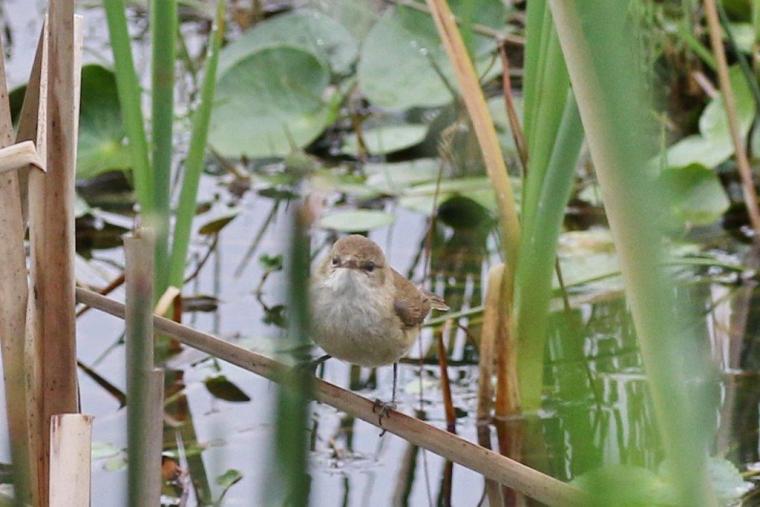
There was one little bird right next to us which we failed to ID – have a go.
Unidentified
Unidentified
Unidentified
That afternoon Cecil and Jenny arrived followed by Cheryl and John. Everyone lent a hand to set up their campsites.
Peter and Frankie getting practice for their trip to Chobe in December.
John and Cheryl’s site
Paul and Sally’s setup
Cecil and Jenny’s Afrispoor
Mark and Cecily’s site (they arrived on Saturday)
While setting up we had a juvenile Black-headed Oriole serenading us from the trees above as a Village Weaver tried to distract us.
Black-headed Oriole – juvenile
Black-headed Oriole – juvenile
Village Weaver
After setting up, we all left Cecil and Jenny to enjoy their consumptions as we headed for the lower side of the dam wall.
View from the Dam wall looking up towards the wetland area- extending to the base of the hills in the distance.
Richard has cut paths through the bush below the dam with several bridges crossing the fast flowing water from the dam. Totally different habitat and birds to be seen. Here are some of the birds we managed to photograph on that afternoon and on Sunday morning (while the Sunday outing members went on the boat trip).
Cape White-eye
Cape White-eye
Golden Weaver
Southern Grey-headed Sparrow
Spectacled Weaver
Thick-billed Weaver
Brown-throated Martin
Burchell’s Coucal
Common House-Martin
Common House-Martins
Dark-capped Yellow warbler
Golden Weaver
Bronze Mannikins in their nest
Greater Striped Swallow
Unidentified – Neddicky
Yellow-billed Kite
African Fish-Eagle
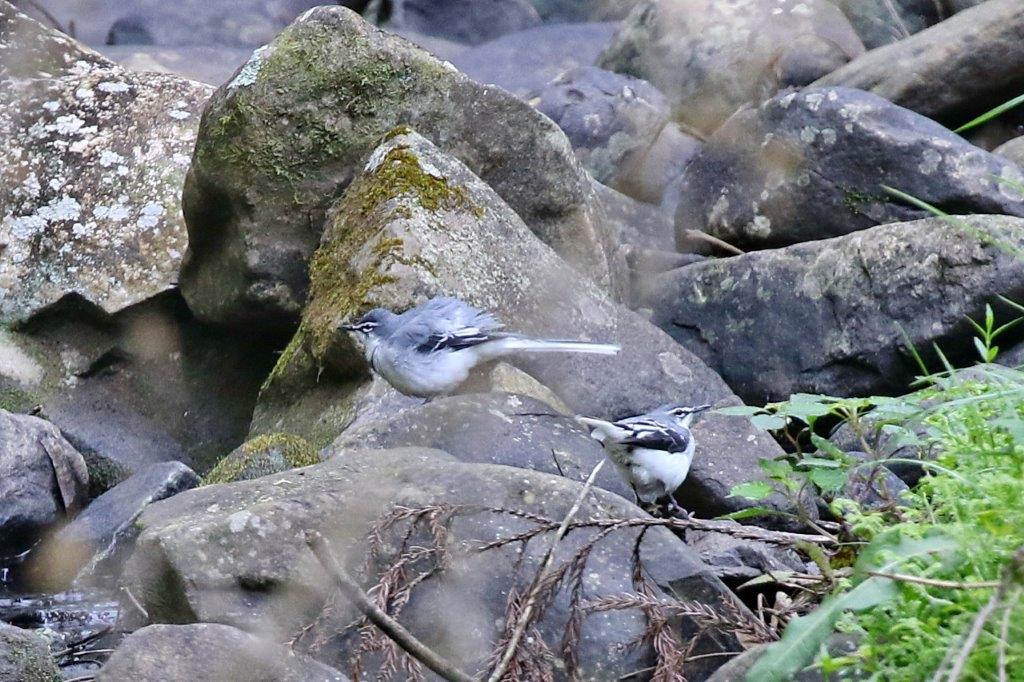
African Pied Wagtail
Window Acrea
Yellows
Vlei Rat
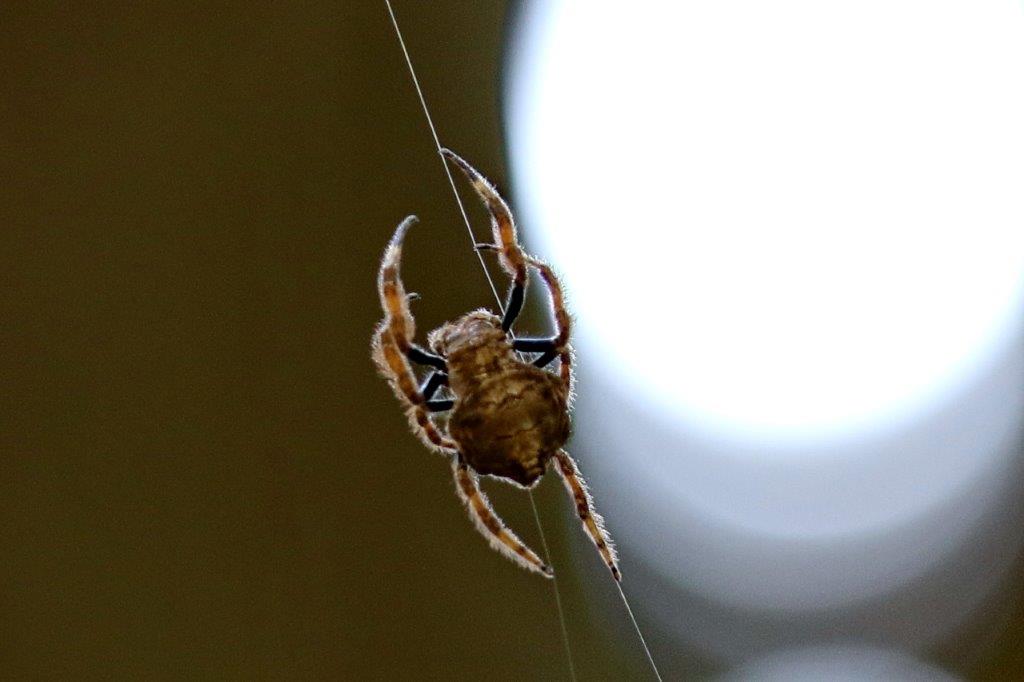
It was fascinating to see how all the spider’s webs had collected dewdrops.
Friday night proved too cold and windy for a braai so we all ended up chin-wagging till late around Cecil and Jenny’s open tent area! However we did manage an early night as it was up early to depart on the Pontoon with Richard at 06h30! the next day.
If you desire to visit this wetland paradise then you need to contact Richard Alcock – see their website for details: http://www.birdvalleyestate.co.za. You will need to come as a large group if you want to visit and be able to go up into the wetland area by boat.
Saturday morning we were all ready on time. The water was flat and we watched the fish jumping for the flies and the otters chasing behind. This was a treat we experienced each morning.
We also had two members from the Midlands Bird Club (Ian Gordon and Barry Taylor) join us. They had been on a similar outing with their members the week before and got a glimpse of what they thought might be a Striped Crake – the underside of the tail looked rufous.
Our hopes were high but expectations muted. The day still and sunny.
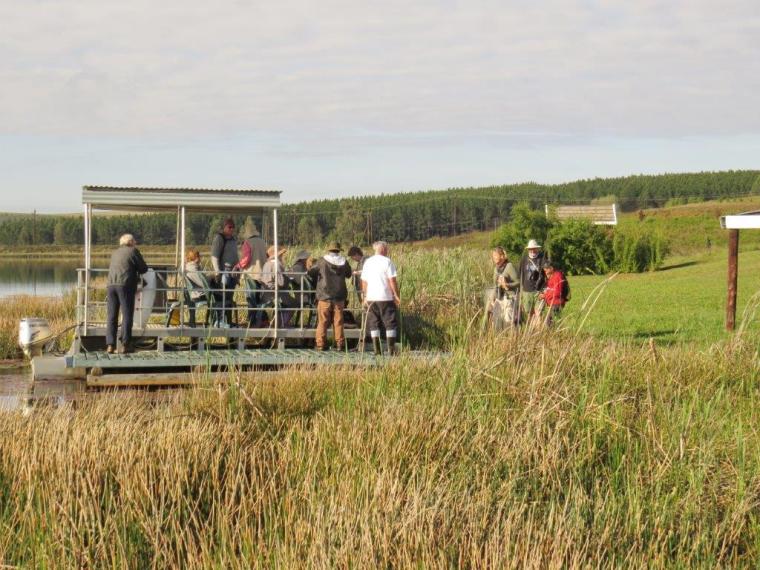
There were 10 of us and Richard as captain. Off we set towards the dam wall for a quick look round before heading up into the wetland area.
Our first surprise were a pair of African Black Ducks at the overflow of the dam.
African Black Ducks
African Black Duck
As we headed north towards the wetland area there were large groups of African Pygmy-Geese and White-backed Ducks.
African Pygmy-Geese – male and female
African Pygmy-Geese
African Pygmy-Geese
African Pygmy-Geese
White-backed Ducks
White-backed Ducks in flight
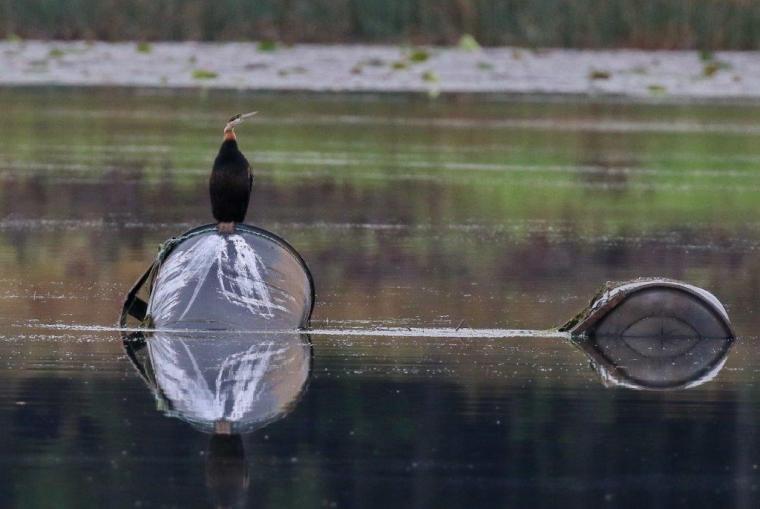
Just before we entered the channels there was this sighting of an African Darter which had us confused as to on what it was perched.
African Darter
African Darter
And then as we passed the Bird Hide we headed into the narrow channels going upstream towards the distant hills.
Looking back downstream
Habitat entering the start of the channels
In the channels looking back at the Bird Hide
Wetlands
Wetlands
Onward we travelled with Richard imparting interesting information about the area and the formation of the channels. We eventually reached the area where the possible Striped Crake may have been. Barry disembarked and flushed the likely spots but unfortunately to no avail. Then we headed back.
Relaxed bird watching
Hottentot Teal
Squacco Heron
Cape Grassbird
African Harrier-Hawk – youngster crying for food.
African Harrier-Hawk – youngster crying for food.
African Marsh-Harrier
Marsh flowers
White-faced Ducks in Richards docking area near the campsite
On return Cecily and Mark arrived and setup their roof-top tent. Mark then proceeded to get out his fishing rod and headed to where the pontoon was tied up. Out he cast -no luck; try again – out he cast and lo and behold he brings in a huge bass which when weighed was recognised as the largest caught in the dam at a whopping 3.8 kgs. and which he generously donated to local staff.
Mark and his record breaking Bass
Saturday evening was braai night. And then another gathering for more tales of past adventures which got more exaggerated as the evening wore on and the imbibing increased.
Sunday arrives – another glorious day – the water still and the otters playing. The Sunday outing members started arriving at 06h30 for the 07h30 start. Hennie and Decklan the first to arrive and then a little later Ann and Andy, followed by Dave and Penny then Sandi, Elena and Prem and finally Penny and Cheryl.
Decklan was quick to spot Mark fishing and joined him catching a fish in no time.
Then it was time for the Sunday outing members to depart. Richard the captain of course.
Boarding
Full pontoon
And then they were off
Everyone returned astonished at how good an experience they had had with Richard. Everyone wants to return and make this a regular outing. They had seen Black-backed Jackal, Reed Buck and 6 Otters – both on land and in the water – apart from the abundance of White-backed Ducks and African Pygmy-Geese. Apart from these, their sightings of the day included an African Snipe circling overhead and a pair of African Fish-Eagles trying to disperse their young.
On return everyone gathered to take in their experience and to invest in something to eat and drink before taking a walk below the dam wall, meanwhile those of us who came to make a weekend of it stayed behind to de-camp.
Some of the birds seen on their walk include:
And finally we got together to tally the birds identified for the weekend. In total there were 104 different species – click here to see the list. And we had added another 17 to the total list for Bird Valley Estate. Click here to see the Bird Valley list.
This is a very special place and a birding experience not to be missed. Get a group together, contact Richard ( see details earlier) and plan a visit.
Paul and Sally Bartho
Photos by Paul or Sally Bartho unless otherwise stated in the captions.


































































































































































































































































































 Birds are our Story